
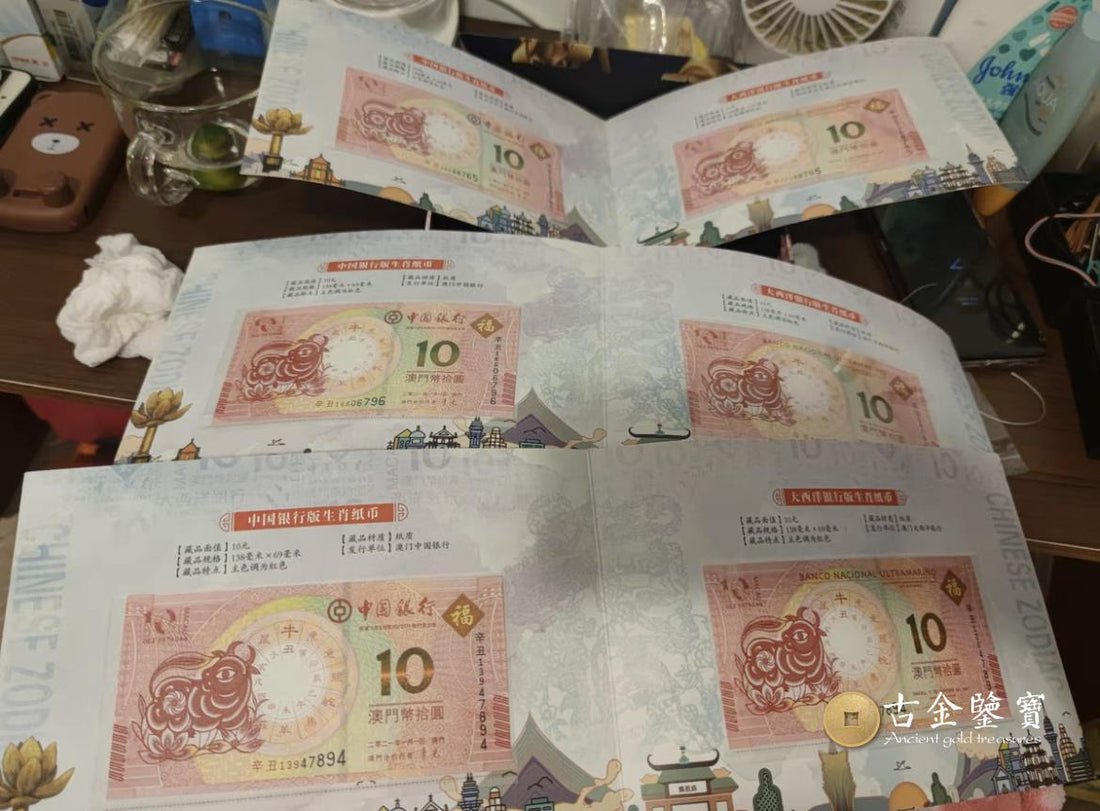
Zodiac banknotesare collected not only in Macau – over the past 20 years, many countries and regions including mainland China, Hong Kong, Fiji, and Mongolia have issued zodiac-themed commemorative banknotes. However, there are significant differences in design styles, issuance quantities, denominations, and collection values across different regions. Below is a country-by-country breakdown.
I. Origin of Zodiac Banknotes
The concept of zodiac banknotes originates from the"twelve earthly branches"system of traditional Chinese culture. However, as a form of commemorative banknote, it has only emerged in the last 20 years:
- 1990s: Commemorative coins were already common (e.g., zodiac commemorative gold and silver coins issued by China)
- 2008: Macau issued its first official zodiac banknote (Year of the Rat)
- Post-2008: Hong Kong, Macau, mainland China, and overseas Chinese communities followed suit
- 2020s: Became a popular theme in the banknote collecting community
II. Major Issuing Countries
Country 1: Macau (Leader)
Basic Information
- First issued: January 2008 (Year of the Rat)
- Issuing banks: Bank of China Macau Branch + Banco Nacional Ultramarino (BNU) Macau
- Denomination: 10 Macanese Patacas
- The first region globally to systematically issue zodiac banknotes
Characteristics
- Issued annually before the Lunar New Year
- Features a"pair"design – one from Bank of China Macau Branch and one from BNU Macau
- Annual issuance quantity is approximately 15 million notes (7-8 million from each bank)
- Issued every year since 2008, totaling 18 years by 2026
2026 Collection Market
| Year | Zodiac | Single UNC HKD Price | Pair UNC HKD Price |
|---|---|---|---|
| 2008 | Rat | $280-380 | $680-950 |
| 2012 | Dragon | $650-950 | $1,500-2,200 |
| 2016 | Monkey | $120-180 | $280-420 |
| 2020 | Rat | $80-120 | $180-280 |
| 2024 | Dragon | $180-280 | $420-680 |
| 2026 | Horse | $50-90 | $120-220 |
Value Trends
- Year of the Dragon is most valuable (special Chinese preference for dragons)
- First year (2008) has a"pioneering"premium
- Recently issued notes have lower value (high market circulation)
Country 2: Mainland China
Basic Information
- First issued: December 22, 2015 (Year of the Monkey New Year Banknote)
- Issuing bank: People's Bank of China
- Denomination: 100 Renminbi
- Nature: Legal tender (circulatable) + commemorative
Characteristics
- Issued annually before the Lunar New Year
- Issuance quantity approximately 500 million notes (far exceeding Macau)
- Features fluorescent anti-counterfeiting + three-dimensional zodiac patterns
- The first set of commemorative Renminbi in mainland China
2026 Collection Market
| Year | Zodiac | Single UNC HKD Price |
|---|---|---|
| 2015 | Monkey (First Issue) | $220-380 |
| 2016 | Rooster | $180-280 |
| 2017 | Dog | $160-240 |
| 2018 | Pig | $140-220 |
| 2019 | Rat | $130-200 |
| 2020 | Ox | $130-200 |
| 2021 | Tiger | $130-200 |
| 2022 | Rabbit | $130-200 |
| 2023 | Dragon | $180-280 |
| 2024 | Snake | $130-200 |
Country 3: Hong Kong
Basic Information
- First issued: 2012 (Year of the Dragon)
- Issuing banks: HSBC, Standard Chartered Bank, Bank of China (Hong Kong) – three banks
- Denomination: 20 HKD (some are 100 HKD)
- Nature: Commemorative banknote
Characteristics
- Issued irregularly (not annually)
- Most issues are"three-bank pairs"
- First issued in 2012 (Year of the Dragon), then 2015 (Year of the Goat), 2018 (Year of the Dog), 2024 (Year of the Dragon, for the 30th anniversary of return)
2026 Collection Market
| Year | Zodiac | Single UNC HKD Price | Three-bank Pair UNC HKD Price |
|---|---|---|---|
| 2012 | Dragon | $280-480 | $1,200-2,200 |
| 2015 | Goat | $180-280 | $650-980 |
| 2018 | Dog | $120-180 | $420-680 |
| 2024 | Dragon | $220-380 | $880-1,400 |
Country 4: Singapore
Basic Information
- First issued: 2014 (Year of the Horse)
- Issuing bank: Monetary Authority of Singapore
- Denomination: 6 Singapore Dollars (commemorative)
Characteristics
- Issued annually
- Features a hexagonal design (unique shape)
- Issuance quantity approximately 1 million notes (relatively small)
2026 Collection Market
- 2014 Year of the Horse: HK$280-450
- 2020 Year of the Rat: HK$150-240
- 2024 Year of the Dragon: HK$220-380
Country 5: Canada
Basic Information
- First issued: 2018 (Year of the Dog)
- Issuing bank: Royal Canadian Mint + banks
- Denomination: 25 Canadian Dollars (commemorative)
Characteristics
- Issued annually, but limited circulation
- Mainly commemorative collectibles for the Canadian Chinese community
- Made with silver-polymer composite material
Country 6: Other Countries
Other countries that have issued zodiac banknotes include:
- Malaysia (since 2015)
- Philippines (since 2016)
- Kazakhstan (since 2019)
- Uzbekistan (since 2020)
Zodiac banknotes from these countries have smaller issuance quantities, with overseas Chinese as the primary buyers. Market circulation is limited, but they hold unique collection value.
III. Which Country's Zodiac Banknotes Are Most Worth Collecting?
First Choice: Macau Paired Banknotes (Best Value for Money)
Reasons:
- Longest history (18 consecutive years since 2008)
- Paired banknote design (two bank versions) is a unique selling point
- Reasonable price range (HK$50-2,200, suitable for different budgets)
- Active market circulation, easy to liquidate
Second Choice: Hong Kong Dragon Banknotes (Limited Scarcity)
Reasons:
- Not issued annually; issuance years have commemorative value
- 2012 Year of the Dragon (first issue) + 2024 Year of the Dragon (30th anniversary of return) both have special historical significance
- Three-bank paired set is scarce
Third Choice: Mainland China Complete Set
Reasons:
- 10+ consecutive years since 2015, a complete set offers a sense of completeness
- Large denomination (100 Renminbi), holds legal value
- If issuance stops in the future, the existing quantity will be stable
IV. Collection Strategy Recommendations
Strategy 1: Prioritize Year of the Dragon
Zodiac banknotes for the Year of the Dragon from all countries are significantly more expensive than other years. Reason: the special Chinese cultural preference for dragons, and the largest base of market demand. If the budget is limited, collect all Year of the Dragon banknotes from issuing countries first.
Strategy 2: Paired Sets
Combined collectibles such as Macau's"Bank of China + BNU paired banknotes"and Hong Kong's"three-bank paired banknotes"are 30-50% more valuable than single notes. Prioritize collecting paired sets.
Strategy 3: UNC Grade
All zodiac banknotes should be in UNC (Uncirculated) condition; do not collect notes with circulation wear. It is recommended to purchase directly from the issuing banks (on the day of issuance) or have them graded by PMG.
Strategy 4: Retain Original Packaging
Most zodiac banknotes come with original plastic seals + commemorative folders. Complete original packaging can increase the market price by 20-30%. Do not open them for viewing.
V. What to Do If You Have Zodiac Banknotes at Home?
- Organize your existing collection (by country, by year)
- Confirm condition (is it UNC? Is the original packaging complete?)
- Estimate preliminary value against the market table in this article
- WhatsApp 98342057 to schedule a free appraisal with GuJin JianBao
- For top-tier rare editions (e.g., 2008 Macau first issue, 2012 Hong Kong Year of the Dragon), consider sending them for PMG grading
Conclusion
The global issuance of zodiac banknotes not only reflects the diversification of banknote collecting but also the influence of Chinese culture internationally. From Macau's first issue in 2008 to today, with over 6 countries having issued them, this trend is expected to continue expanding. For collectors, now is an ideal time to build a complete zodiac banknote collection – the 18-year Macau series, the 10-year mainland China series, and the four Hong Kong Dragon banknotes are all stable assets for the future.
GuJin JianBao - Professional Zodiac Banknote Buyback
Free appraisal ‧ Transparent pricing ‧ Instant cash payment ‧ On-site collection in Hong Kong, Kowloon, and New Territories. If you have similar old items, don't rush to sell them cheaply. You can WhatsApp us for an estimate first to understand the true market value.
