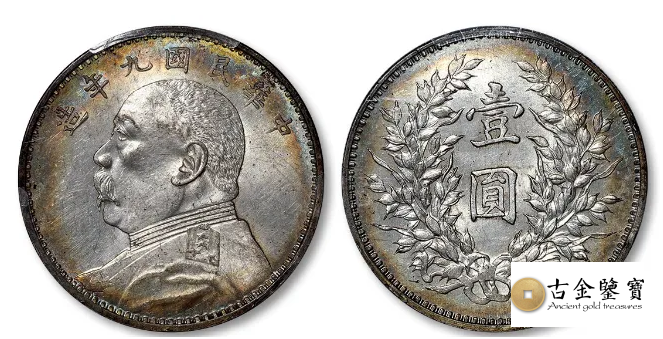
The 9th Year Yuan Datou is the year with the most variants among the four years – including the Fine Hair (Jing Fa) version, Coarse Hair (Cu Fa) version, Hainan version, Medium Hair (Zhong Fa) version, and so on. Among these, the Fine Hair version is highly sought after due to its exquisite minting and scarcity. However, the key to identifying the Fine Hair version is not the thickness of the hair, but several hidden marks:"Y-dot flower,""7-dot year,"etc. These will be explained one by one below.
I. What is the"Fine Hair Version"?
"Fine Hair"is an abbreviation for"exquisite hair strands,"referring to a variant where Yuan Shikai's portrait features particularly finely engraved hair. The core characteristics for distinguishing between the Fine Hair version and the Coarse Hair version are:
Fine Hair Version Characteristics
- Hair layers are clearly discernible, with 4 layers (topmost, second, third, bottommost)
- Each strand of hair has individual shading and luster
- The overall thickness of the hair is even, with natural gradual transitions at the edges
- Hair details around the ears are clear
- Hair in the back of the head also maintains exquisite engraving
Coarse Hair Version Characteristics
- Only 2 layers of hair are discernible
- Hair strands are rougher and lack layering
- The hair has an overall"blocky"appearance
- Hair around the ears is blurry
- Hair in the back of the head is mostly simplified
Practical judgment: Use a 10x magnifying glass to examine the hair at the very top of Yuan Shikai's head. If you can clearly count 4 layers of hair strands, it is the Fine Hair version; if you only see blurry 2 layers or fewer, it is the Coarse Hair version.
II. 3 Hidden Marks of the 9th Year Fine Hair Version
Mark 1: Y-dot Flower
Location: At the center of a certain flower at the top of the auspicious grain (Jia He) pattern on the reverse side, there is an extremely tiny Y-shaped pistil (not a standard circular flower center).
- This is an internal mark for a certain batch from the Tianjin Mint
- Requires a 30x magnifying glass to see
- Market price is 30-50% higher than ordinary Fine Hair versions (i.e., HK$25,000-65,000)
Mark 2: 7-dot Year
Location: The character"Year"(nian, year) in"Zhong Hua Republic of China Jiu Year Zao"(Republic of China Ninth Year Minted) on the obverse."7-dot year"refers to a tiny dot at the starting point of the second horizontal stroke of the"Year"character, extending from the 7 o'clock direction.
- When it appears with the Fine Hair version, the market price can reach HK$35,000-80,000
- Requires comparison with images of known genuine items, difficult for beginners to identify
- Difficult to counterfeit, reliable evidence of a genuine 9th Year Fine Hair version
Mark 3: Lower Niu Kou Zao
Location: The character"Zao"(zao, minted) in"Zhong Hua Republic of China Jiu Year Zao.""Lower Niu Kou Zao"refers to the bottom part of the"Kou"(kou, mouth) radical in"Zao"appearing in the shape of an ox's mouth (a horizontal stroke narrows and curves upwards).
- Combined with the Fine Hair version, the market price is approximately HK$20,000-50,000
- A characteristic of a certain batch from the Shenyang Mint
- Relatively easy to identify, can be used as an auxiliary authentication (appraisal) for the Fine Hair version
III. 9th Year Complete Variant Matrix
| Variant Combination | Rarity | Buyback Price Range (HKD) |
|---|---|---|
| Ordinary Coarse Hair Version | Common | $3,500 - 5,500 |
| Ordinary Fine Hair Version (no marks) | Scarce | $15,000 - 28,000 |
| Fine Hair Version + Lower Niu Kou Zao | Rare | $20,000 - 50,000 |
| Fine Hair Version + Y-dot Flower | Rare | $25,000 - 65,000 |
| Fine Hair Version + 7-dot Year | Extremely Rare | $35,000 - 80,000 |
| Fine Hair Version + Multiple Marks (2+ types) | Top Rarity | $60,000 - 150,000+ |
| Hainan Version (different auspicious grain leaves on reverse) | Rare | $20,000 - 50,000 |
IV. Appraisal Process for the 9th Year Fine Hair Version
Step 1: Confirm the Year
The characters"Zhong Hua Republic of China Jiu Year Zao"on the obverse should be clear, and the calligraphy of"Year"should be relatively bold. If it is another year, this process is not applicable.
Step 2: Determine Fine Hair vs. Coarse Hair
Use a 10x magnifying glass to examine the hair layers on the top of the head. 4 discernible layers = Fine Hair version; 2 layers or fewer = Coarse Hair version.
Step 3: Search for Marks
After confirming it is the Fine Hair version, check sequentially:
- Flower center at the top of the auspicious grain on the reverse → Y-dot flower
- Starting point of the second horizontal stroke of"Year"on the obverse → 7-dot year
- Bottom of"Zao"on the obverse → Lower Niu Kou Zao
Step 4: Comprehensive Condition Assessment
After confirming the marks, assess the overall condition (patina, reeding, sharpness of characters). It is recommended to send it for grading to PCGS / NGC. The price difference between uncertified high-grade items and graded coins can be as much as 50%.
V. Why are there so many variants of the 9th Year version?
The rich variety of the 9th Year version has 4 historical reasons:
- Multiple Mints– In 1920, 5 mints (Tianjin, Nanjing, Wuchang, Guangzhou, Shenyang) were coining simultaneously, and each mint had slightly different dies.
- Die Wear– The mintage was large that year, requiring die changes midway, and new and old dies left different characteristics.
- Internal Marks– Each mint added subtle marks to the dies to track production batches.
- Varying Craftsmanship– The Tianjin Mint's technology was the most refined (main source of Fine Hair versions), while other branch mints had coarser craftsmanship (Coarse Hair versions).
VI. Recommendations for Purchasing the 9th Year Fine Hair Version
Recommendation 1: Look for PCGS / NGC Graded Holders
The market price of the 9th Year Fine Hair version has reached a medium level, and there are targeted high-quality counterfeits in the market. Even if an ungraded Fine Hair version is genuine, it is difficult to sell at a high-price. If buying for investment, look for PCGS MS62 or higher graded coins.
Recommendation 2: Prioritize Marked Versions
Given the same budget, it is advisable to prioritize Fine Hair versions with marks (Y-dot flower, 7-dot year, Lower Niu Kou Zao), as they have better long-term appreciation potential than ordinary Fine Hair versions.
Recommendation 3: Traceable Origin
Whenever possible, choose Fine Hair versions with traceable provenance (former collectors, auction records) to avoid buying recently manufactured machine-made counterfeits.
VII. What to Do If You Suspect You Have a 9th Year Fine Hair Version at Home?
- Confirm the year"Zhong Hua Republic of China Jiu Year Zao."
- Use a 10x magnifying glass to examine the hair layers (if 4 layers are discernible, it is a Fine Hair version).
- Check for marks (Y-dot flower, 7-dot year, Lower Niu Kou Zao).
- WhatsApp 98342057 with clear close-up photos of the obverse + reverse + reeding. Gukim offers free appraisal for Fine Hair versions.
- If genuine, assistance will be provided for PCGS / NGC grading + market value estimation.
Conclusion
The 9th Year Fine Hair version is a typical"medium threshold, high return"variant in the collection ofRepublic of China silver coins. Investing within the HK$15,000-50,000 range allows you to own a high-quality collectible with a clear rarity premium and future appreciation potential. Mastering the appraisal of the Fine Hair version + identifying hidden marks is a crucial step in advancedsilver dollarcollecting.
Found a Yuan Datou while tidying up? Want to know its value?
No complicated process required. WhatsApp a clear photo to Gukim for a personal appraisal by our experienced experts. The entire process is transparent, with free appraisal and immediate cash payment. We have been operating with integrity for many years, with over 60% of our business coming from repeat customers.


