How many types of Daqing Silver Coins are there? A breakdown of Guangxu Yuanbao, Xuantong Yuanbao, | Gu Jin Jian Bao
Many people think that "Daqing Silver Coin" refers to a specific type of silver coin, but in reality, this term is a broad category – encompassing all machine-struck silver dollars minted during the 22 years of the Qing Dynasty (1889-1911). Guangxu Yuanbao, Xuantong Yuanbao, Beiyang-minted, Hubu-minted, various provincial issues… adding up to at least a dozen categories. Only by understanding the relationships between these categories can you accurately determine the identity and value of the coin in your hand.
Classification Framework: Two Main Axes
The classification of Qing Dynasty silver dollars fundamentally follows two axes:
First Axis: Reign Title – Those minted during the Guangxu reign (1889-1908) are called Guangxu Yuanbao; those minted during the Xuantong reign (1909-1911) are called Xuantong Yuanbao or Daqing Silver Coin (narrow sense).
Second Axis: Minting Authority – Those minted by provincial mints are categorized as "Provincial Minted"; those uniformly minted by the central Board of Revenue (Hubu) are categorized as "Hubu Minted"; those minted by the Tianjin Mint are "Daqing Silver Coin" (Xuantong 3rd Year).
The intersection of these two axes forms a complete classification map.
Category 1: Provincial Guangxu Yuanbao (1889-1908)
The origin of Qing Dynasty silver dollars. In 1889, Zhang Zhidong established a silver dollar mint in Guangdong, which first minted Guangxu Yuanbao. Subsequently, various provinces successively opened mints: Hubei, Jiangnan, Beiyang, Anhui, Sichuan, Yunnan, Fengtian, Jilin… over a dozen provinces minted Guangxu Yuanbao.
Each province's Guangxu Yuanbao has its own unique dragon design, minting craftsmanship, and mintage, so their market prices vary greatly:
| Province | Minting Period | Characteristics | Common VF Reference |
|---|---|---|---|
| Guangdong | 1889-1908 | China's first machine-struck dragon dollar | HK$2,000-5,000 |
| Hubei | 1893-1908 | Rare "Bensheng" (local) variety exists | HK$1,500-80,000 |
| Jiangnan | 1898-1905 | Dated by reign year, numerous varieties | HK$2,500-15,000 |
| Beiyang | 1896-1908 | Year 34 dragon dollar is most sought after | HK$3,000-25,000 |
| Sichuan | 1898-1908 | Narrow-faced dragon design, unique style | HK$2,000-8,000 |
| Fengtian | 1897-1907 | Some years are extremely rare | HK$3,000-50,000+ |
Category 2: Hubu Guangxu Yuanbao (1902-1908)
The first step in the Qing government's attempt to unify currency. In 1902, the Board of Revenue (Hubu) established a silver dollar mint, minting Guangxu Yuanbao of unified specifications. The biggest difference from provincial issues: "Hubu" is engraved on the obverse instead of the provincial name, representing direct central issuance.
Hubu issues are relatively rare because their circulation period was short and met strong resistance from the provinces. Common VF pieces are approximately HK$3,000-8,000, while high-grade pieces can reach over HK$30,000.
Category 3: Provincial Xuantong Yuanbao (1909-1911)
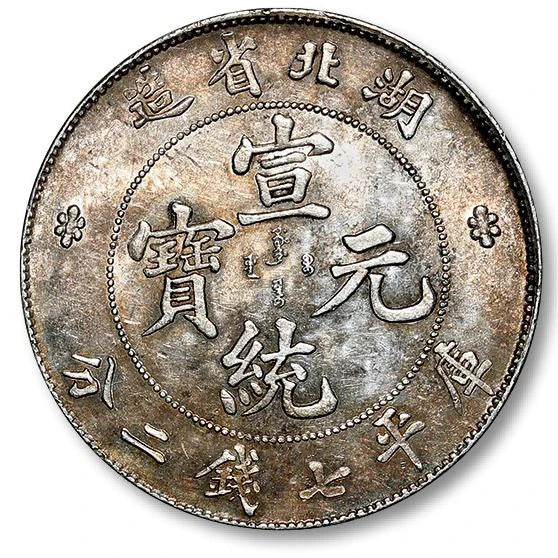
During the Xuantong reign, provinces continued to mint their own silver dollars, adopting the "Xuantong Yuanbao" reign title. Major provinces included Hubei, Guangdong, Yunnan, and the Three Eastern Provinces. The mintage of silver coins during this period was generally smaller (due to the end of the dynasty and political instability), so many provincial Xuantong Yuanbao issues are rare, and their market prices are higher:
| Province | Characteristics | Common VF Reference |
|---|---|---|
| Hubei | Most common Xuantong Yuanbao | HK$2,000-6,000 |
| Guangdong | Intricate dragon design | HK$3,000-10,000 |
| Yunnan | Strong local style | HK$5,000-20,000 |
| Three Eastern Provinces | Low mintage | HK$8,000-30,000 |
Category 4: Daqing Silver Coin – Xuantong 3rd Year (1911)
The "final masterpiece" of Qing Dynasty silver dollars. In 1911, the Ministry of Finance (Duzhibu) of the Qing government promulgated the "Currency Regulations," and the Tianjin Mint uniformly minted Daqing Silver Coins. This is what we commonly refer to as the "Xuantong 3rd Year Daqing Silver Coin" – strictly speaking, only this type is called "Daqing Silver Coin" (narrow sense).
During the trial minting phase, five dragon designs were created (Curved Whisker Dragon, Long Whisker Dragon, Short Whisker Dragon, Inverted Dragon, Large Tail Dragon), with the Curved Whisker Dragon finally selected as the official circulating version. The market prices of the five dragon designs vary greatly:
| Variety | Nature | Mintage | 2026 Reference Price |
|---|---|---|---|
| Curved Whisker Dragon | Officially Issued | Approx. 15 million pieces | HK$3,500-30,000 |
| Long Whisker Dragon | Trial Sample Coin | Extremely rare | HK$200,000+ |
| Short Whisker Dragon | Trial Sample Coin | Extremely rare | HK$150,000+ |
| Inverted Dragon | Trial Sample Coin | Extremely rare | HK$300,000+ |
| Large Tail Dragon | Trial Sample Coin | Extremely rare | HK$500,000+ |
Category 5: Beiyang-minted Guangxu Yuanbao
Strictly speaking, "Beiyang-minted" is a type of provincial Guangxu Yuanbao, but due to its special status, it is usually classified separately. Beiyang silver dollars were minted by the Tianjin Beiyang Machinery Bureau, with "Beiyang Zao" (Minted by Beiyang) engraved on the obverse. Among them, the Guangxu 34th year (1908) issue is the most sought after in the market because it was the last batch of Beiyang-minted coins, with a relatively controllable mintage and a mature dragon design.
A common VF Beiyang 34th year coin is approximately HK$5,000-10,000, while PCGS MS62 or higher grades can reach HK$30,000-80,000.
How to quickly identify which category your silver coin belongs to?
Pick up the silver coin and look at the text in the center of the obverse:
If it says "XX Province Minted Guangxu Yuanbao" → Category 1 (Provincial Guangxu)
If it says "Hubu Guangxu Yuanbao" → Category 2 (Hubu Minted)
If it says "XX Province Minted Xuantong Yuanbao" → Category 3 (Provincial Xuantong)
If it says "Daqing Silver Coin" → Category 4 (Xuantong 3rd Year)
If it says "Beiyang Minted Guangxu Yuanbao" → Category 5 (Beiyang Minted)
After confirming the category, you can then compare it with the tables above to identify the variety and market price range, which should give you a preliminary assessment of the coin in your hand.
Unsure which type your silver coin is?
WhatsApp us a photo of both sides, and we'll immediately help you identify its type and estimate its value. Free appraisal, doorstep collection available in Hong Kong, Kowloon, and New Territories.