[Ancient Gold Appraisal and Treasure Hunting · Recycling Case Study] An Unexpected Surprise in an Old Cookie Tin: The Journey of a "Meiji 21" Dragon Dollar from Discovery to Realization
In the appraisal room of "Gu Jin Jian Bao," different old items intertwine with various stories every day. Some are memories passed down through generations, while others are unexpected discoveries. Today, I want to share a recycling story about a "Dai Nippon Meiji 21-nen Ichien Ginhyo" (commonly known as a Japanese Dragon Dollar).
Origin: The Secret in the Tin Box
Last Wednesday afternoon, Hong Kong had just experienced a shower, and the air was still a bit cool. Mr. Chan (pseudonym) walked into our shop with an old paper bag. Mr. Chan, a middle school teacher nearing fifty, was refined and scholarly. He told me that while tidying up his grandfather's belongings in his old home in Sham Shui Po, he found several coins at the bottom of a rusty old biscuit tin box, one of which felt particularly substantial.
"This was left by my grandfather. I know nothing about antique coins, and leaving it at home just means it will gather dust. I searched online for legitimate silver coin recycling in Hong Kong and saw that 'Gu Jin Jian Bao' has a very professional reputation, so I wanted to bring it for you to take a look," Mr. Chan said, carefully handing me the silver coin.
Appraisal: Value Analysis from a Professional Perspective
I put on gloves and took the silver coin. Its substantial weight was characteristic of a full-weight silver coin.
【Product Information Evaluation】
-
Obverse Features: Inside the beaded rim are the characters "一圓" (Ichien), above which is the sixteen-petaled double chrysanthemum crest representing the Japanese imperial family, surrounded by cherry blossom branches and knots. The design is clear and three-dimensional.

-
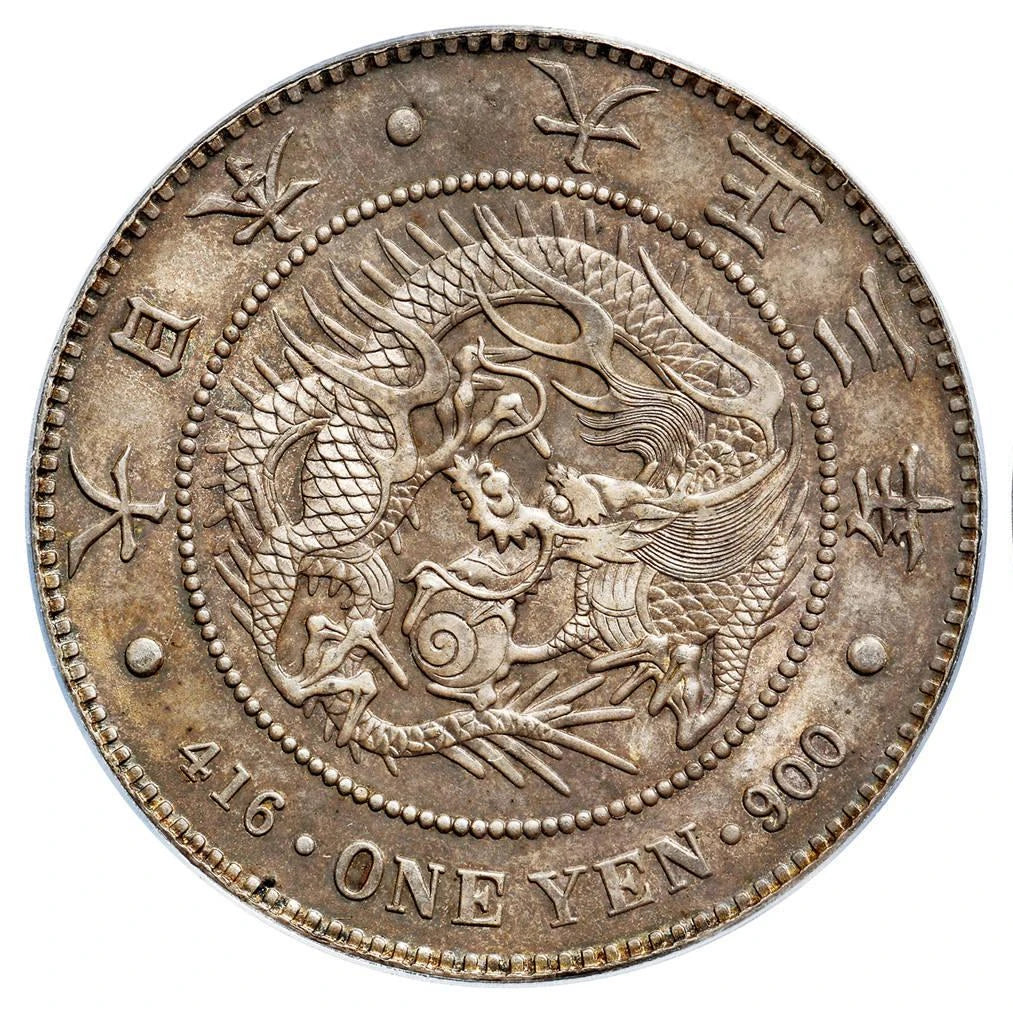
Reverse Features: A lifelike flying dragon coils in the center, with clearly defined scales, showcasing extremely high minting craftsmanship. The outer ring is inscribed with "大日本 · 明治二十一年 · 416 · ONE YEN · 900".

- Physical Data: Diameter approximately 38.1mm, weight approximately 26.96 grams (corresponding to 416 grains on the coin face), 90% silver content (900).
- Condition Review: The coin's patina (surface oxidation) is very natural, exhibiting a faint dark gray color, without any destructive artificial cleaning. Although there are extremely slight traces of circulation wear on the edges, the overall dragon scales and chrysanthemum patterns remain sharp, classifying it as a highly sought-after "fine condition" in the market.
I thoroughly explained the background of this silver coin to Mr. Chan: the Japanese Dragon Dollar from Meiji 21 (1888) circulated widely as a trade silver coin in Japan and surrounding Asian regions at the time. While not as rare as those from Meiji 8, its preservation in such a natural, uncleaned condition still gives it considerable collection and recycling value.
Relief: Finding a New Home for Old Items
After hearing my assessment, Mr. Chan nodded. He confessed, "Actually, I considered keeping it myself, but I don't know how to care for it. Hong Kong's climate is humid, and if it oxidizes and blackens, it would be a shame. Moreover, my home is currently undergoing renovation, so instead of letting it slumber in a drawer, it's better to entrust it to professionals like you, so someone who truly appreciates it can enjoy it. With the cash, I plan to take my family out for a nice meal this weekend; it's also a gift from my grandfather."
Based on the international silver price of the day and the coin's condition and year premium, we offered Mr. Chan a highly competitive recycling price. Mr. Chan was very satisfied with the price and happily completed the transaction on the spot.
Before leaving, he smiled and said, "Your appraisal process is very transparent. You not only let me know its value but also taught me a lot. This trip was well worth it."
Professional Comparison: Why Do Silver Coins Vary So Much in Price?
Many customers wonder why silver coins, despite being similar, have such varying prices. To provide a clearer understanding, we have created a comparison table of common trade silver coins:
| Coin Name | Example Year | Silver Content | Characteristics | Market Rarity & Value Assessment |
| Japanese Ichien (Dragon Dollar) | Meiji 21 (Case in this article) | 90% | Trade silver coin minted after the Meiji Restoration in Japan, exquisitely struck with a majestic dragon design. | ★★☆☆☆ (Relatively large circulation, price mainly depends on condition and specific rare years) |
| Yuan Datou (Republic of China) | Year 3 of the Republic (1914) | 89% | The most widely issued and circulated silver dollar in modern Chinese history. | ★☆☆☆☆ (Entry-level collectible, easily liquidated, special varieties such as the "signed version" are extremely valuable) |
| Guangxu Yuanbao (Dragon Dollar) | Guangdong Province Mint | 90% | Representative of machine-struck silver coins from the Qing Dynasty in China. | ★★★☆☆ (Highly favored by Chinese collectors, well-preserved old patinated dragon dollars command a significant premium) |
| British Trade Dollar | 1908 | 90% | Minted by Britain in India, primarily for Far Eastern trade, featuring Britannia on the coin face. | ★★☆☆☆ (Stable market demand) |