
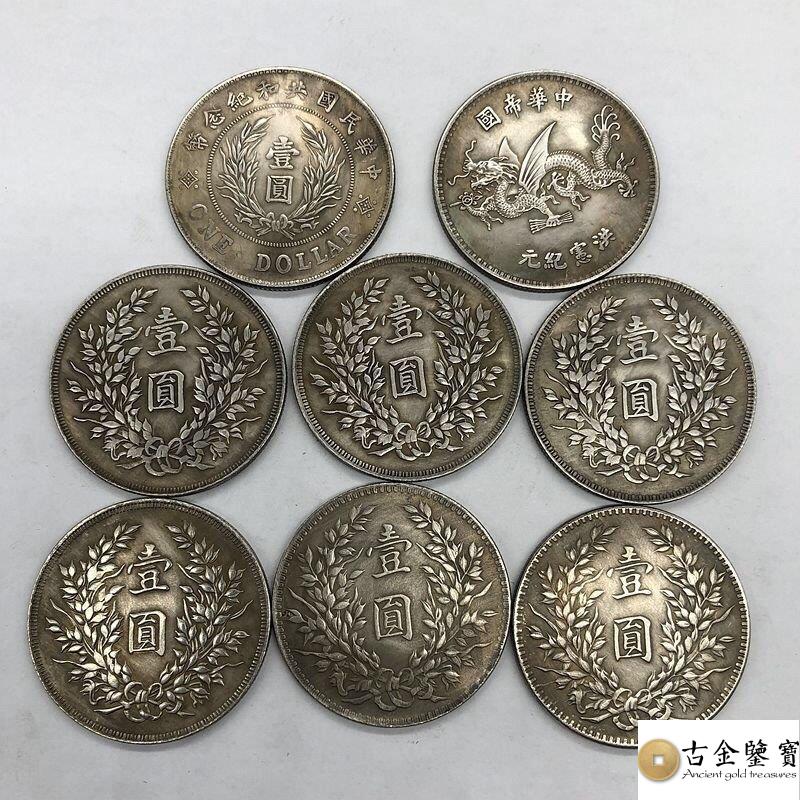
"I want to collectYuan Datou, but I don't know where to start."– We hear this almost every week. Yuan Datou is the most widely circulated, most recognized, and lowest-entry-barrier variety among Chinese silver dollars. You can get your first one for HK$3,000-5,000. However,"low barrier"doesn't mean"no pitfalls."The following 5 concepts and 3 tips to avoid traps are the fundamentals that beginners need to understand first.
Part One: 5 Essential Concepts
Concept 1: Year System
There are 4 years for Yuan Datou:
- Year Three of the Republic of China (1914)– First issue year, largest mintage (approx. 150 million pieces). Common pieces HK$2,500-4,500, a top choice for beginners.
- Year Eight of the Republic of China (1919)– Smallest mintage (due to civil war), common pieces are more expensive HK$8,000-18,000.
- Year Nine of the Republic of China (1920)– The year with the most varieties (Fine Hair, Coarse Hair, Hainan varieties, etc.).
- Year Ten of the Republic of China (1921)– Stable minting craftsmanship, with special varieties like T-dot year and notched character'Zao'.
Beginner's tip: Start with the common variety of Year Three of the Republic of China. A budget of HK$3,000-5,000 can get you a good condition specimen.
Concept 2: Variety Differences
Each year also has multiple varieties:
- Common variety: Standard design, most affordable market price.
- Secret mark variety: Has specific secret marks (e.g., O-variety, Triangle-yuan, T-dot year), premium of 5-30 times.
- Pattern coin grade: Trial strike pattern coins (e.g., L. Giorgi signed variety), premium of 200-1000 times.
Beginner's tip: In the initial stage, there's no need to pursue secret mark or pattern coin grades. First master the basics of authenticating common varieties.
Concept 3: Condition Grading
Yuan Datou's condition is graded according to the international Sheldon Scale (1-70 points):
- VF (20-35 points): Obvious circulation wear, but details are still clear.
- XF (40-45 points): Light circulation wear, most details are clear.
- AU (50-58 points): Nearly uncirculated, 70%+ original luster retained.
- MS (60-70 points): Uncirculated condition, strictly graded based on flaws.
For the same variety, an AU grade is 2-3 times more expensive than a VF grade, and an MS grade is 3-10 times more expensive than an AU grade.
Concept 4: PCGS / NGC Grading
PCGS and NGC are two internationally recognized coin grading companies:
- Provide authenticity authentication + condition grading.
- Silver coins are encapsulated in transparent plastic holders (slabs).
- Grading scores come with a certification number.
- Market liquidity is significantly increased.
Beginner's tip: It is recommended to submit coins graded MS62 or higher for professional grading. The grading fee is HK$300-500 per coin, and the value appreciation can reach 30-100%.
Concept 5: Rarity Judgment
Rarity is determined by the following factors:
- Year (Year Eight is the rarest).
- Variety (secret mark variety vs. common variety).
- Condition (MS65+ is extremely rare).
- Historical records (traceable through auction houses).
Beginner's identification: High rarity = low mintage + low surviving population + high collection demand. The combination of these three creates a market premium.
Part Two: 3 Pitfalls to Avoid
Pitfall 1: Counterfeit Traps
There are 5 common types of counterfeit Yuan Datou in the market:
Type A: Sand-cast later issues
Cast from molds made from genuine coins. Identification:
- Fuzzy lettering, lack of sharpness.
- Lighter weight (genuine coins 26.6-26.8g, sand-cast mostly 25.5-26.2g).
- Rough reeding, with signs of metal flow.
Type B: Machine-made high counterfeits
Minted with minting machines and alloys from the same era. Identification:
- Patina is chemically aged, unnatural.
- Lacks the natural wear and tear of a century of use.
- Can be discolored by wiping with a cotton swab dipped in distilled water.
Type C: Altered common varieties
Genuine coins altered into rare varieties (e.g., a common Year Three altered to an O-variety). Identification:
- Tool marks around the altered edge.
- Patina is damaged at the altered location.
- Details and depth inconsistent with other areas.
How to Avoid Pitfalls
- Most effective method for beginners: Only buy PCGS / NGC graded slabbed coins.
- Avoid online platforms (eBay, Taobao have 60-80% counterfeit rates).
- Prioritize reputable auction houses or professional coin dealers.
Pitfall 2: Cleaning Traps
The most common mistake beginners make: cleaning a"dark"heirloomsilver dollaruntil it's"shiny white."
Consequences
- Natural patina on the surface is destroyed.
- Graded as"Details"by PCGS / NGC (cleaned coin, no numerical grade).
- Market value drops by 50-70%.
How to Avoid Pitfalls
- Absolutely do not clean– no matter what method (water, toothpaste, chemicals).
- Handle with cotton gloves or tweezers to avoid sweat stains.
- Store in acid-free coin holders.
- If there are surface stains, have them handled by a professional grading company.
Pitfall 3: Grading Traps
Trap A: Sending to the wrong agency
There are other grading agencies in the market (ANACS, ICG, HKAGS, etc.), but their market recognition is far lower than PCGS and NGC. It is recommended to only send to PCGS or NGC.
Trap B: Submitting low-value coins for grading
The ROI for submitting common Yuan Datou with a market value below HK$3,000 is lower (grading fees account for too high a proportion). Recommendations:
- Common coins below HK$3,000: No rush to submit for grading.
- Mid-range coins HK$3,000-10,000: Can consider submitting for grading.
- HK$10,000+ coins: Grading is a must.
Trap C: Believing"authentication certificates"
There are"authentication certificates"issued by non-authoritative institutions on the market (e.g., some auction houses'own certificates, private appraiser certificates). These have very low market recognition and are not a substitute for PCGS / NGC.
Beginner's Staged Budget Planning
Stage 1: Entry Level (HK$3,000-8,000)
- Purchase 1 PCGS XF45 / AU58 common variety of Year Three of the Republic of China.
- Understand the basic characteristics of Yuan Datou.
- Learn authentication methods (listening to the sound, observing the patina, feeling the reeding).
Stage 2: Upgrade (HK$8,000-25,000)
- Purchase a PCGS MS62 / MS63 common variety of Year Three of the Republic of China.
- Try other years (common varieties of Year Eight, Nine, Ten).
- Complete a"four-year set."
Stage 3: Advanced (HK$25,000-100,000)
- Purchase a PCGS MS62+ special variety (Year Nine Fine Hair, Year Ten T-dot year).
- Consider a PCGS MS64 high-grade common coin.
Stage 4: Top Tier (HK$100,000+)
- Pursue PCGS MS62+ O-variety or Triangle-yuan.
- Dream collection: L. Giorgi signed variety (HK$800,000+).
Beginner's First Year Plan
Months 1-3: Learning
- Read basic books ("Illustrated Catalogue of Chinese Silver Dollars,""Research on Yuan Datou Varieties").
- Browse the official image gallery of Yuan Datou on PCGS Coin Facts.
- Join coin collecting communities (Facebook groups, WeChat groups, forums).
Months 4-6: Practice
- Purchase the first PCGS XF45 / AU58 common variety of Year Three of the Republic of China (budget HK$5,000-8,000).
- Actually touch, observe, and understand.
- Build basic authentication skills.
Months 7-12: Expansion
- Purchase an upgraded PCGS MS62 variety.
- Try other years.
- Establish the first small collection (4-5 coins).
Already Have Yuan Datou at Home? How to Start?
- Organize existing Yuan Datou (year, condition, variety).
- WhatsApp 98342057 to book a free appraisal with Gujin Jianbao.
- Confirm authenticity + estimate market value.
- For mid-range items (HK$5,000+), professional grading by PCGS is recommended.
- Gradually add new collectibles to build a complete collection.
Conclusion
Collecting Yuan Datou is not an easy field for laypeople to enter. However, by mastering the above 5 essential concepts + 3 pitfalls to avoid, beginners can build a solid foundation. The most important principles: stick to PCGS / NGC graded slabs, absolutely do not clean, and start with common varieties to gain experience. WhatsApp 98342057 to book a free beginner consultation with Gujin Jianbao.
Found Yuan Datou while tidying up? Want to know its value?
No complicated procedures required. WhatsApp a photo to Gujin Jianbao, and our experienced appraisers will personally evaluate it. The entire process is transparent, free of charge, and payment is made in cash on the spot. We have operated with integrity for many years, with over 60% of our business coming from repeat customers.
