Japanese Antique Silver Coin Collecting Craze: How much is your"Meiji Year 3"1-yen silver dragon coin | Gu Jin Jian Bao
Hello everyone, I am the owner of "Ancient Coin Appraisal". As a professional old coin and precious metal dealer with many years of experience in Hong Kong, one of the most common questions I get asked by customers during my daily appraisal and Buyback work is:"How much is this old Japanese silver coin my grandpa left me worth now?"
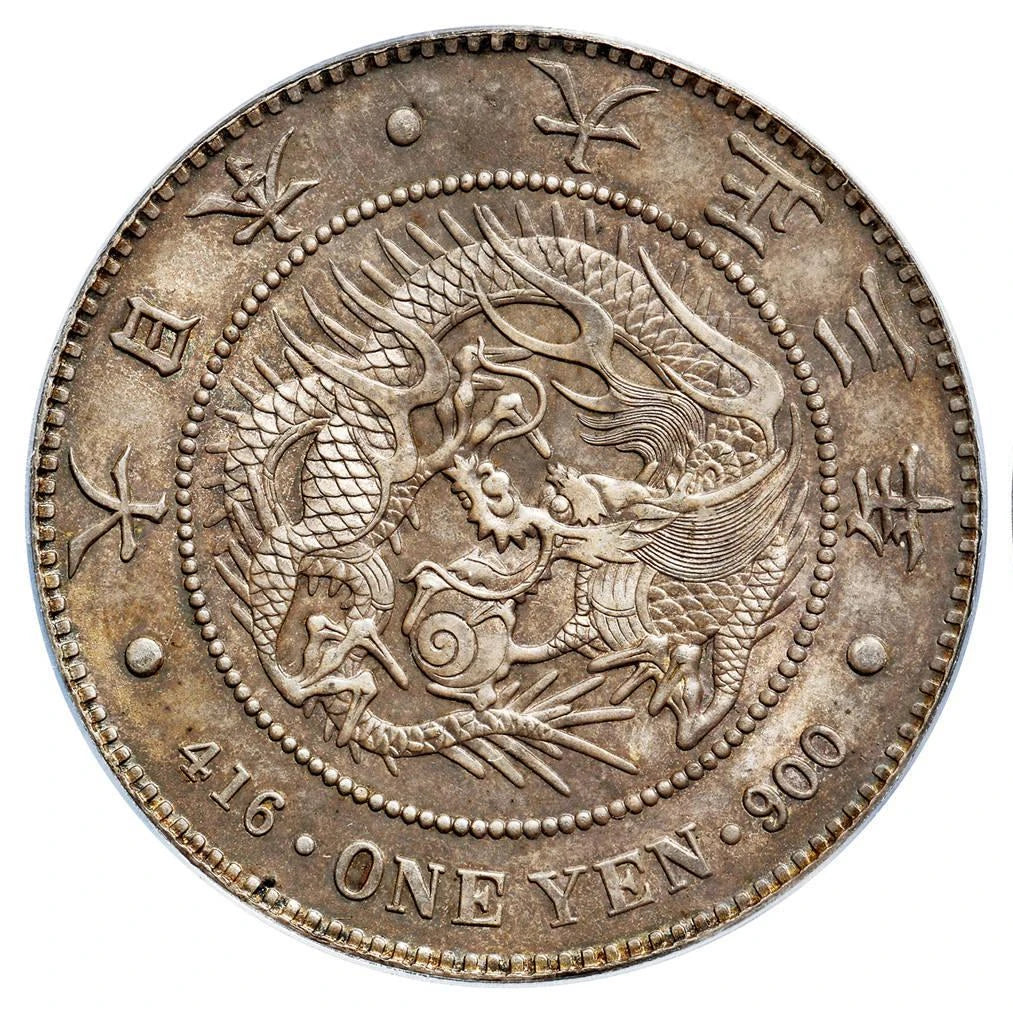
Entering 2024 to 2026, the global demand for safe-haven physical assets has surged, coupled with the rise in industrial value of silver, bringing an unprecedented boom to the Asian coin collecting community. Amidst this boom, the"Dragon Dollar"(silver dollars engraved with dragon patterns) issued in modern Japan has become the absolute focus of auctions and Buyback markets across the Strait. Among them, the"Meiji 3rd Year 1 Yen Dragon Silver"issued in 1870 is the most legendary, crowned by collectors as the"King of Modern Currency".
Today, from the perspective of a professional recycler, I will thoroughly dissect the historical background, variations, the latest market buyback prices in 2026 (converted to Hong Kong Dollars for you), and how to distinguish genuine from fake using the naked eye and experience, for this old Japanese silver coin. This is an invaluable guide. If you also have such old silver dollars at home, please read it carefully!

I. Why is the "Meiji 3rd Year 1 Yen Dragon Silver" so precious?
In the latter half of the 19th century, Japan underwent the Meiji Restoration, transitioning from a feudal shogunate system to a modernized nation. During the Edo shogunate, the currency circulated in Japan was extremely complex, including koban and ichibugin, which severely hindered international trade. To align with international standards, the Meiji government, in 1870 (Meiji 3rd Year), spent 60,000 Hong Kong Dollars to purchase a complete set of advanced minting machinery from the closed Hong Kong Mint.
These "Meiji 3rd Year 1 Yen Dragon Silver" coins, minted at the Osaka Mint using retired machinery from Hong Kong, were the first large-scale modern silver coins in Japanese history to be produced using Western machinery. The coins were technically guided by British experts and their molds were personally engraved by the renowned Japanese sculptor, Kanae Katsuya, perfectly combining the aesthetics of traditional oriental dragon patterns with Western machine minting craftsmanship.
The official mintage of this silver coin was approximately 3,685,049 pieces. Although its original intention was to serve as a currency for international trade settlement, due to the loss, damage, or melting of a large number of silver coins during circulation, coupled with a century of historical turmoil, Meiji 3rd Year Dragon Silver coins in excellent condition are extremely rare today. This "historical limitation and extremely high rate of attrition" is the core basis supporting its high collectible value today.

II. Understand the Variations at a Glance: The Secret of "Te-kawari" with Tenfold Price Differences
In professional coin appraisal, besides condition, the most important factor determining the buyback price of an old silver dollar is its"variation."During the production of the Meiji 3rd Year Dragon Silver, many subtle differences arose due to mold engraving, repair, or replacement, which are called"Te-kawari"in Japanese. Below are the core variations that determine price differences:
1. Variation in the Calligraphy of the Character"Yuan "(Yen): Normal"Yuan ","Zheng Bei Yuan "(Seikai-en) and"Qian Bei Yuan "(Kekkai-en)
The writing of the two characters"Yi Yuan "(one yen) on the obverse is the most important part for distinguishing variations, mainly observing the structure of the character"Bei"(shell) below"Yuan "(member) inside"Yuan "(yen).
- Normal"Yuan "(Hutsu-en): The most common basic variation. Characterized by a shorter diagonal stroke (11th stroke) at the bottom left of the"Bei"radical, making it appear broken.
- "Zheng Bei Yuan "(Seikai-en): The strokes are full and neat, without any defects. The diagonal stroke at the bottom left is tightly connected to the border, appearing dignified and elegant. It is rarer and typically commands a much higher market value than the normal"Yuan ".
- "Qian Bei Yuan "(Kekkai-en): This is a highly prestigious and most sought-after rare varietyamong Meiji 3rd Year Dragon Silver coins. Its prominent feature is a clear break or absence in the horizontal-vertical stroke (9th stroke) above the"Bei"character. Statistics show that"Qian Bei Yuan "accounts for only about 2% to 3% of existing Dragon Silver coins and is highly coveted at auctions.
2. Geometric Features of the Rising Sun Side: With Rim vs. Rimless
The center of the reverse side of the coin features a sun pattern (Nissho) representing Japan, surrounded by radiating rays.
- With Rim (Yu-rin): There is a thick and clear raised circular border line between the sun pattern and the radiating rays.
- Rimless (Mu-rin): There is no distinct border line around the sun, and the junction between the rays and the disc is treated more smoothly. In recent market systems, the "Rimless" version, especially in high-grade conditions, usually commands a higher premium than the "With Rim" version.
3. Marks of History: Marugin (Circled Silver)
After Japan adopted the gold standard in 1897, the 1 yen silver coin ceased circulation domestically. To enable these silver coins to continue being used as trade currency in overseas regions such as Taiwan, Korea, and mainland China, the Japanese government manually stamped a"Yin"(silver) character within a circle on the silver coins.
- Left Marugin / Right Marugin: The stamp is placed on the left side of"Yi Yuan "(one yen) on the obverse (processed by the Osaka Mint) or on the right side (processed by the Tokyo Mint). In the past, collectors considered this artificial damage, but today,"Marugin"is regarded as a valuable testament to the currency wars and trade history of East Asia. PCGS-graded coins with"Marugin"and in excellent condition now command significantly higher market premiums than ordinary raw coins.

III. 2026 Latest Meiji 3rd Year Dragon Silver buyback price List
To give everyone a more intuitive understanding, I have compiled the latest buyback price references based on real transaction data from Japanese, Hong Kong, and international auctions in the first quarter of 2026.(Note: Prices are affected by daily international silver prices and supply and demand in the collector's market. The Japanese Yen data below has been converted based on the April 2026 exchange rate, approximately 1 JPY = 0.052 HKD, for reference only. Actual buyback prices require on-site assessment of the physical coin by a professional appraiser.)
| Coin Variation and Grade | Good/Fine (VF) | Extremely Fine (XF~AU) | Uncirculated (UNC / MS63) | Top Graded Coin (MS64~MS65+) |
|---|---|---|---|---|
| Normal"Yuan "(With Rim) | Approx. HK$ 880 | Approx. HK$ 1,300 - HK$ 1,820 | Approx. HK$ 2,600 - HK$ 3,900 | From approx. HK$ 6,760 |
| Normal"Yuan "(Rimless) | Approx. HK$ 1,040+ | Approx. HK$ 2,340 - HK$ 4,420 | Approx. HK$ 5,460 | From approx. HK$ 9,620 |
| "Zheng Bei Yuan "(Seikai-en) | Approx. HK$ 1,040 | Approx. HK$ 2,080 - HK$ 7,540 | Approx. HK$ 7,800+ | From approx. HK$ 12,480 |
| "Qian Bei Yuan "(Kekkai-en) (Extremely Rare) | Approx. HK$ 2,340 | Approx. HK$ 4,420 - HK$ 6,500 | Approx. HK$ 10,660 - HK$ 15,080 | From approx. HK$ 27,040 |
| Marugin (Left/Right) | Approx. HK$ 780+ | Approx. HK$ 6,500 - HK$ 7,800 | Approx. HK$ 10,400+ | Approx. HK$ 32,760 (MS62) |
Professional Insight: From the table above, it's clear that grading score and variationare the twin determinants of price. A common worn-out raw coin might only be worth a little over a thousand Hong Kong Dollars, but if it is an uncirculated, full-luster"Qian Bei Yuan "(Kekkai-en) that has received a high MS65 grade from an international authority (such as PCGS or NGC), its value can easily exceed twenty to thirty thousand Hong Kong Dollars.

IV. Ancient Coin Appraisal Exclusive: 4 Tips to Distinguish Genuine Meiji 3rd Year Dragon Silver from Fakes
As the price of old silver coins rises, fake coins on the market have evolved from crude sand casting in the early days to today's "real silver high-fakes" and computer 3D engraving. Below are my core defense strategies for daily appraisal as a recycler:
1. Physical Measurement: Standard Weight and Dimensions are Crucial
The official standard diameter of the Meiji 3rd Year 1 Yen Dragon Silver is 38.58 mm, with a standard weight of 26.96 grams, and the material is an alloy of 90% pure silver and 10% copper.
- Genuine Coin Performance: A genuine coin, after a hundred years of circulation, should have a reasonable worn weight falling between 26.86 grams and 26.96 grams.
- Fake Coin Flaws: Common fake coins made of white copper or aluminum-zinc alloy, if the diameter is correct, often weigh only 22 to 24 grams. If the counterfeiter tries to achieve the 27-gram weight, the coin's thickness will inevitably exceed the limit of the genuine article (genuine coins are about 2.6mm thick, fakes are often over 3mm thick).
2. Microscopic Details: Look at Leaf Veins, Horse Teeth, and Dragon Scales
- Plant Leaf Veins: The chrysanthemum and paulownia leaf patterns on the reverse of genuine coins are formed by a single strike from a press with hundreds of tons of pressure. The leaf veins are as fine as hair, distinctly raised, and sharply edged. Counterfeit coins, due to low-pressure casting, often have blurred, rounded, and less three-dimensional leaf veins.
- Horse Teeth (Edge Dots): The circle of dots around the edge of the coin is called "horse teeth." Genuine coins have dots that are uniform in size, evenly spaced, and perpendicular to the coin's surface. Counterfeit coins often have dots that vary in size, appear "connected," or are irregularly arranged.
- Dragon Scales and Dragon Whiskers:The scales of a genuine dragon are distinctly layered, with a strong 3D Li Ti Gan を. Counterfeit dragon scales often appear"melted"or flattened, and under magnification, small casting bubbles or pinholes may be visible.
3. Sound Test: Silver's Sound Sings
- Sound of Genuine Silver: Gently hold the silver dollar by its center, suspending it, and tap its edge lightly with another coin. A genuine silver coin will emit a solid, prolonged, soft "om..." sound, with a lingering echo and clear metallic quality.
- Sound of Fake Coins: Lead or tin alloys will produce a very dull, heavy "thud, thud" sound with no lingering echo. If it's a steel core plated with silver, the sound will be extremely sharp and short, like a "clink, clink."
4. The Secret of Patina: What to Do if Your Family Heirloom Silver Dollar Turns Black? Never Clean It!
This point is extremely important! Many customers see that the surface of their inherited silver dollar exhibits deep brown, black, or variegated colors (this is called "patina" in numismatics), and they mistakenly believe it is dirt, so they use silver cleaner, toothpaste, or even steel wool to clean it. This is absolutely a value-destroying act! Natural patina is a protective layer (silver sulfide) formed by the slow chemical reaction of silver with trace sulfur compounds in the air over a hundred years. This layer of patina is not only a "mark of history" but also a natural barrier against counterfeiting. In high-end auction markets, silver dollars with attractive "colorful old patina" can fetch several times more than coins that have been scrubbed to a bright, shiny original color. Once a silver dollar is cleaned, its historical traces are erased, and its asset value will plummet by over 50%.

Conclusion: The Golden Opportunity to Convert History into Cash
From 1870 to 2026, the Meiji 3rd Year 1 Yen Dragon Silver has long surpassed its original function as currency, becoming a historical testament to East Asia's modernization process and a financial asset highly sought after by collectors worldwide. Today, as prices for alternative investments like Japanese whisky and Rolex watches undergo correction, old silver coins, with their rich cultural heritage and dual precious metal attributes, are demonstrating strong anti-inflation resilience.
Whether you want to understand the true value of your family heirlooms or wish to convert idle antique silver coins into substantial cash returns, finding a reputable recycler with professional spectrometer equipment and practical experience is crucial.
If you have Meiji 3rd Year Dragon Silver, Guangxu Yuanbao, Great Qing Silver Coins, Yuan Datou, or other old banknotes or stamps, please contact us now!
【Ancient Coin Appraisal】Hong Kong's Professional High-Price Buyer for Old Coins / Silver Dollars / Stamps / Rolex / Gold
✅ Professional Appraisal: Combining decades of practical experience with scientific instruments to accurately determine variations and authenticity. ✅ High-Price Buyback: Staying current with 2026 international auction trends, never suppressing prices, offering transparent quotes. ✅ Flexible Transactions: Providing free preliminary online appraisal, supporting in-store transactions or on-site cash collection service across Hong Kong, ensuring your privacy and security.
Company Name: Ancient Coin Appraisal Contact WhatsApp: (852) 98342057 👉 Click to send photos of your collection to us and get a free professional appraisal and high-price quote instantly!
(Friendly reminder: Please keep your silver dollars in their original state. Do not clean, bump, or abrade them yourself, as this may affect their precious collectible value and buyback price!)
Want to know the value of your old items?
Ancient Coin Appraisal offers free appraisals, valuation within 30 minutes, same-day doorstep purchase, and instant cash payment. WhatsApp us a photo, and we'll immediately appraise it for you, no need to visit the store in person.