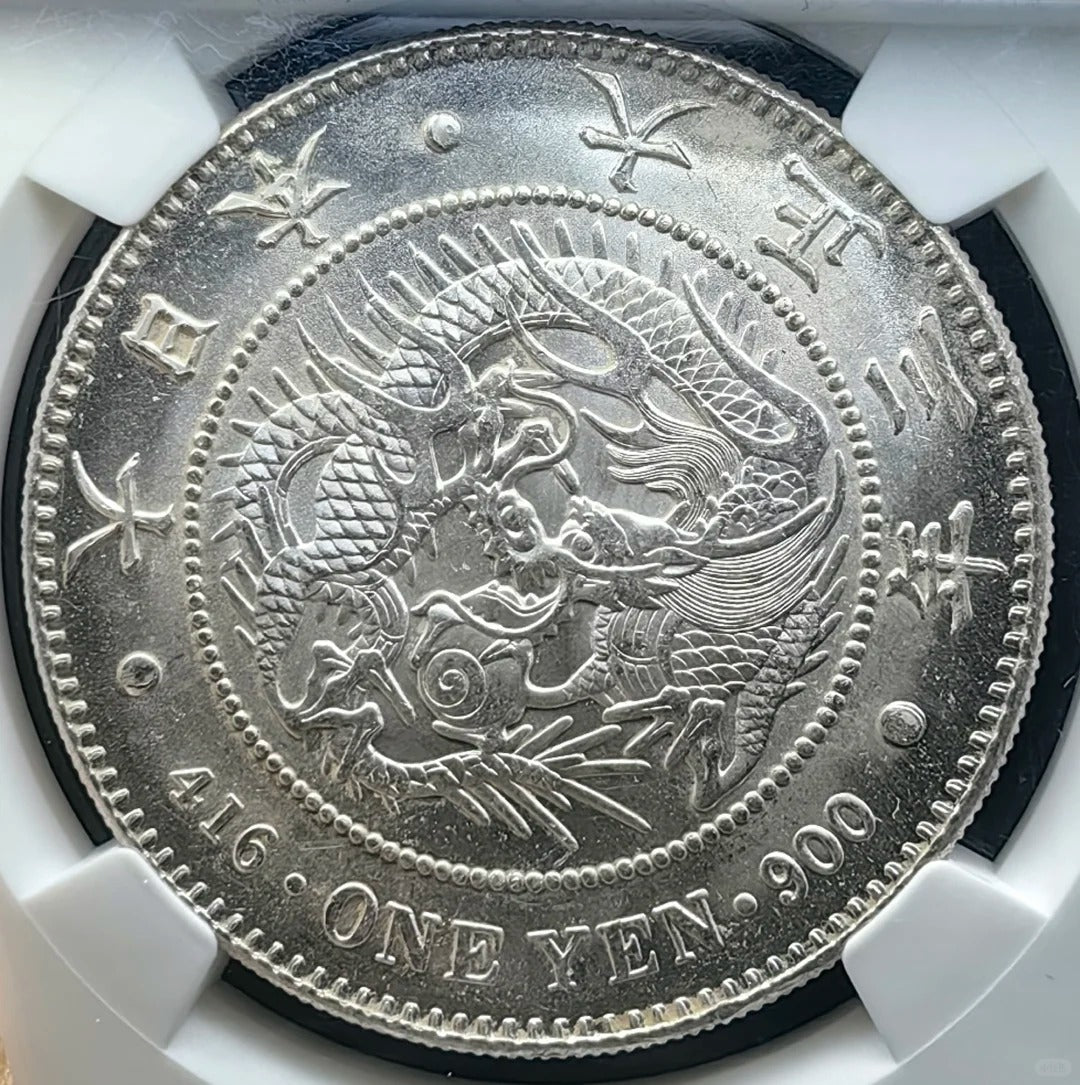
During the Meiji period, Japan minted two types of silver coins that were similar in appearance but entirely different in purpose: the Trade Dollar and the One Yen Silver Coin. Many people cannot distinguish between the two, even believing them to be the same. However, in the secondary market, their market prices can differ by several times. Understanding their minting background, design differences, and collecting status is crucial for accurate valuation.
I. Background of Japan's Currency Reform in the Meiji Period
After the Meiji Restoration in 1868, Japan faced an urgent need for currency unification. The problems at the time were:
- The diverse currencies of the Edo period (gold koban, silver ingots, copper coins) no longer met modern needs.
- Large quantities of foreign silver dollars (especiallyMexican Pesos) flowed into Japan, threatening monetary sovereignty.
- Trade with China (the Chinese market) required suitable silver coins.
In 1871 (Meiji 4th year), the Japanese government promulgated the"New Currency Act,"establishing a new silver standard system:
- The"Yen"was adopted as the monetary unit.
- 1 Yen = 26.96 grams of pure silver.
- Minting of Edo period currencies was ceased.
- Western minting technology was introduced (Osaka Mint established).
II. Trade Dollar
Issuance Background
The"Trade Dollar"was a silver coin specifically issued by Japan for trade with China between 1875 and 1877 (Meiji 8th to 10th year). The background was:
- China was Japan's largest trading partner at the time.
- Foreign silver dollars like the Mexican Peso circulated in the Chinese market.
- Japan hoped to participate in international trade with its own silver coins.
Specifications
| Item | Specification |
|---|---|
| Denomination | 1 Yen |
| Weight | 27.22 grams |
| Silver content | 90% |
| Diameter | 38.6mm |
| Thickness | 2.5mm |
| Mint | Osaka Mint |
Design
Obverse: Reverse:
- Obverse: Central dragon motif + surrounding Japanese Kanji characters ("Trade Dollar","One Yen","Meiji [Year]").
- Reverse: Large Kanji character"Yi Yuan"(One Yen) in the center + surrounding chrysanthemum motif.
Note: The dragon motif of the Trade Dollar contrasted with the eagle motif of the Mexican Peso at the time, clearly indicating an East Asian cultural identity.
Mintage and Surviving Quantity
The Trade Dollar was minted for a short period (only 3 years), with a total mintage of approximately 2.7 million pieces. However, most of these were shipped to China for trade settlement. Most surviving Trade Dollars are held by collectors in China and Taiwan.
2026 Hong Kong Buyback Price
| Condition | 2026 Buyback Price (HKD) |
|---|---|
| Circulated (VF) | $15,000-25,000 |
| Lightly Circulated (XF-AU) | $30,000-50,000 |
| Uncirculated Graded (MS62+) | $80,000-150,000 |
| Top Graded (MS65+) | $350,000+ |
III. One Yen Silver Coin
Issuance Background
The"One Yen Silver Coin"was Japan's official circulating currency from 1870 to 1914 (Meiji 3rd to Taisho 3rd year). The background was:
- The standard currency of the Meiji government (a product of the"New Currency Act").
- Primarily circulated within Japan.
- Also used for international settlements.
Specifications
| Item | Specification |
|---|---|
| Denomination | 1 Yen |
| Weight | 26.96 grams |
| Silver content | 90% |
| Diameter | 38.1mm |
| Thickness | 2.6mm |
| Mint | Osaka Mint |
Design
- Obverse: Central dragon motif + surrounding Japanese Kanji characters ("Yi Yuan","Japan","Meiji [Year]").
- Reverse: Large Kanji character"Yi Yuan"(One Yen) in the center + surrounding chrysanthemum motif (similar to the Trade Dollar but with slight differences in detail).
Main Versions (by period)
| Period | Year | Key Features |
|---|---|---|
| Early Meiji | Meiji 3-10 (1870-1877) | Trade Dollar and One Yen issued simultaneously, multiple varieties |
| Mid-Meiji | Meiji 11-30 (1878-1897) | Standard design, stable mintage |
| Late Meiji | Meiji 31-45 (1898-1912) | Later versions, more common in existence |
| Early Taisho | Taisho 1-3 (1912-1914) | Continuation of Meiji design, minting ceased in 1914 |
Rare Versions
- Meiji 3 (1870) One Yen- First year of issue, rare, HK$50,000-200,000
- Meiji 3 Lack of"Bei"in"Yuan"Version- Missing the"Bei"character within"Yuan", extremely rare, HK$120,000-300,000
- Meiji 8 (1875) Standard"Bei"in"Yuan"Version- Issued in the same year as the Trade Dollar, notably surviving
2026 Hong Kong Buyback Price (Common Version)
| Condition | 2026 Buyback Price (HKD) |
|---|---|
| Circulated (VF) | $1,500-2,500 |
| Lightly Circulated (XF-AU) | $2,500-4,500 |
| Uncirculated Graded (MS62+) | $5,500-15,000 |
| Top Graded (MS65+) | $25,000-50,000 |
IV. Trade Dollar vs. One Yen Silver Coin: 5-Dimensional Comparison
| Dimension | Trade Dollar | One Yen Silver Coin |
|---|---|---|
| Issuance Year | 1875-1877 (only 3 years) | 1870-1914 (45 years) |
| Denomination Text | "Mao Yi Yin"(Trade Dollar) | "Yi Yuan"(One Yen) |
| Primary Use | Settlement for trade with China | Domestic circulation in Japan + international |
| Weight | 27.22 grams | 26.96 grams |
| Silver Content | 90% | 90% |
| Total Mintage | Approx. 2.7 million pieces | Approx. 150 million pieces |
| Surviving Quantity | Rare | More common |
| Average VF Market Price | HK$15,000-25,000 | HK$1,500-2,500 |
| Market Circulation | Mainly Chinese and Taiwanese collectors | Global Chinese communities |
V. Why is there such a large price difference between the two?
Reason 1: Mintage Discrepancy
The total mintage of the Trade Dollar was about 2.7 million pieces, while the One Yen Silver Coin was about 150 million pieces. A 55-fold difference directly impacts the surviving quantity and rarity.
Reason 2: Short Minting Period
The Trade Dollar was only minted for 3 years (1875-1877), while the One Yen Silver Coin was minted for 45 years (1870-1914). A short minting period means fewer experimental versions and fewer surviving pieces.
Reason 3: Cultural Uniqueness
The Trade Dollar represented Japan's first systematic attempt to participate in the international silver dollar market. It holds a unique historical status as a tangible testament to Japan's currency modernization.
Reason 4: Collector Circle Positioning
The Trade Dollar is positioned as a"rare item,"primarily circulating in high-end auction houses. The One Yen Silver Coin is a"mainstream circulating item,"widely circulated among collectors of all levels.
VI. How to distinguish which type ofJapanese silver coinyou have at home?
Method 1: Check the text on the obverse
- If"Mao Yi Yin"(Trade Dollar) appears = Trade Dollar
- If"Yi Yuan"(One Yen) appears (without"Mao Yi Yin") = One Yen Silver Coin
Method 2: Check the year
- Meiji 8-10 (1875-1877) = Potentially a Trade Dollar (One Yen Silver Coins were also minted during this period)
- Meiji 3 (1870) or after Meiji 11 (1878+) = One Yen Silver Coin (Trade Dollars had ceased minting)
Method 3: Check the weight
- 27.22 grams = Trade Dollar
- 26.96 grams = One Yen Silver Coin
- The difference is 0.26 grams, requiring a precise electronic scale.
VII. Advice for purchasing Japanese silver coins
Advice 1: Look for PCGS / NGC grading
High-quality counterfeits of Japanese silver coins are common (especially for Trade Dollars and Meiji 3rd year coins). It is essential to look for international grading slabs.
Advice 2: Prioritize rare years for Trade Dollars
1875 (Meiji 8th year) was the first year of issue for Trade Dollars, and its market price is 30-50% higher than the other two years.
Advice 3: Prioritize rare versions for One Yen Silver Coins
Rare versions such as the Meiji 3rd year"Lack of'Bei'in'Yuan'"and the Meiji 3rd year"Standard'Bei'in'Yuan'"have the greatest appreciation potential.
Advice 4: Avoid cleaning
The natural patina of Japanese silver coins is crucial for preserving their value. Once cleaned, their value can drop by 50-70%.
Conclusion
The Japanese Trade Dollar and One Yen Silver Coin are two important products of Japan's currency modernization during the Meiji period. Although both are 1-yen silver standard coins, their minting background, purpose, and rarity differ greatly, resulting in an 8-15 times difference in market price. For Chinese collectors, the Trade Dollar holds unique cultural significance due to its historical background in trade with China. If you have Japanese silver coins at home, it is advisable to carefully distinguish between the Trade Dollar and the One Yen Silver Coin - they might have unexpected market value.
Gu Jin Jian Bao | Hong Kong Professional Old Coin, Commemorative Coin, Silver Dollar,Porcelain,Gold Buyback
WhatsApp / Phone:98342057| Free on-site appraisal in Hong Kong, immediate cash or Faster Payment System settlement.
Send photos of your collectibles via WhatsApp for a free preliminary valuation. Experienced appraisers personally inspect items, ensuring confidentiality, transparency, and peace of mind.
