From Trade Dollars to Round Silver Ingots: Japanese Dragon Silver's Witness to a Century of East Asian | Gu Jin Jian Bao
The Meiji Restoration and the Birth of the Dragon Silver: In Pursuit of International Trade Standards
After Emperor Meiji ascended to the throne in 1868 and initiated the Meiji Restoration, Japan actively sought modernization and eagerly wished to integrate into the international economic system. In the mid-to-late 19th century, international trade in East Asia primarily circulated foreign silver coins such as the Spanish dollar and the Mexican peso. To address this, the Japanese government decided to emulate these international standards and mint its own trade silver coins.
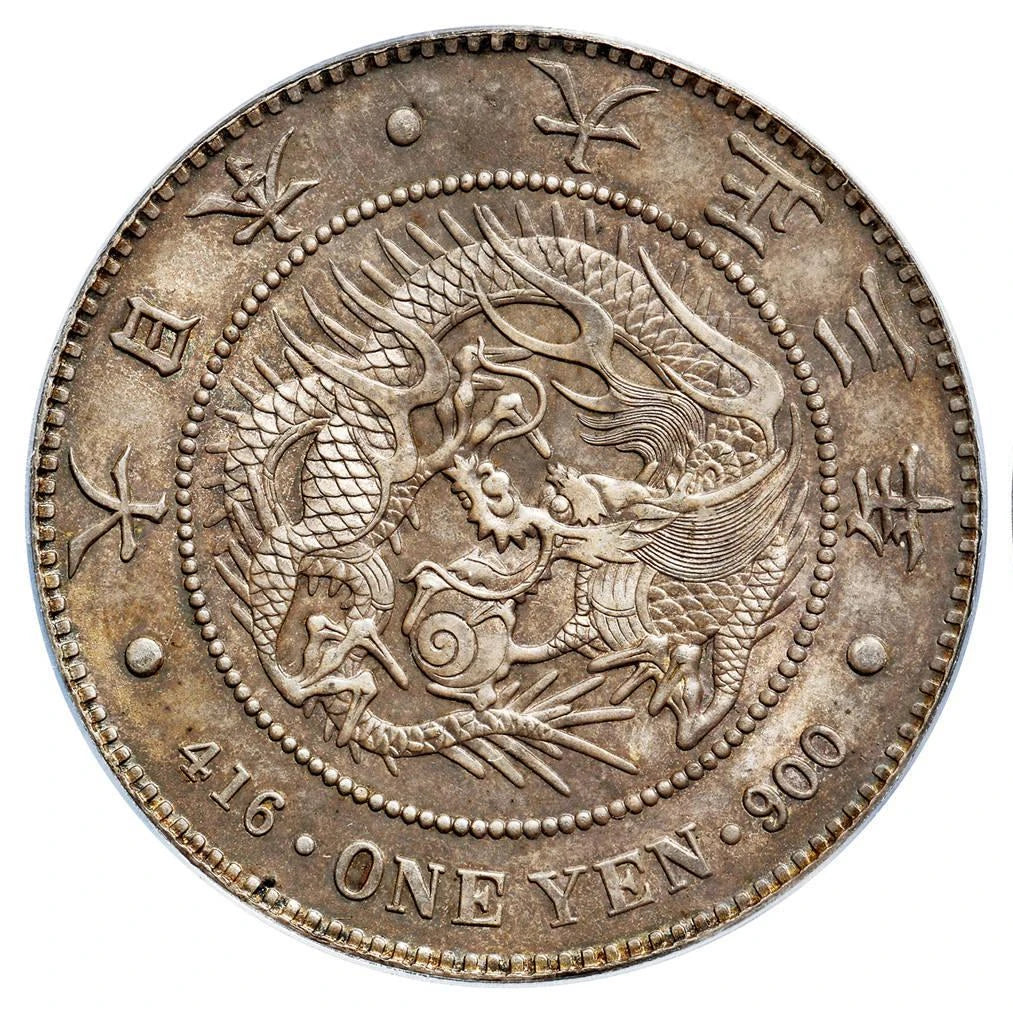
In Meiji 3 (1870), after Japan purchased minting machinery from Hong Kong (the machinery originally belonged to the Hong Kong Mint, which closed in 1868), it began minting its own silver dollars. The design of these silver dollars, particularly the flying dragon motif on the obverse, was intended to make them more readily accepted by cultures in East Asian regions such as China and Korea, as the dragon symbolized authority and power.
Early issued one-yen silver coins (such as the "Sun Dragon Silver" from Meiji 3), and subsequently the "Trade Silver"minted between Meiji 8 and 10 (1875–1877), served this purpose. The most distinctive feature of the Trade Silver series is the inscription of"Mao Yi Yin"(Trade Silver) on the reverse. The standard weight of this Trade Silver was set at 420 grains (approximately 27.22 grams), slightly heavier than the regular one-yen version (416 grains/26.96 grams). This was to precisely match the weight standard of the Mexican peso, ensuring its smooth circulation in international trade.

Impact of the Gold Standard: From Domestic Currency to the Devaluation of "Circular Silver Ingots"
The status of dragon silver as Japan's de facto standard currency was challenged shortly after the Meiji Restoration. In 1897 (Meiji 30), the Japanese government officially adopted the gold standard system through the Currency Act, aligning with global trends.
This significant reform directly altered the fate of dragon silver within Japan:
- Prohibition of Circulation: From April 1, 1898 (Meiji 31), the one-yen silver coin was prohibited from circulation and use within Japan.
- Status Demotion: As it no longer held legal tender status, the value of dragon silver plummeted within Japan. It could only be used as a carrier of the precious metal silver and was therefore disparagingly referred to by the Japanese government and the public as "circular silver ingots"(Yuan Xing Yin Kuai).
At the same time, to prevent domestic and foreign merchants from arbitraging with dragon silver (i.e., exchanging it for gold domestically), the Japanese government stamped approximately twenty million dragon silver coins, intended for export to China, Taiwan, and Korea, with the character "Yin"(silver) on the reverse. This stamp explicitly indicated that these silver coins could not be exchanged for the later gold one-yen coins.
Colonial Currency and Material Guarantee in Turbulent Times
Although dragon silver was "abandoned" in mainland Japan, it found new roles in its colonies and spheres of influence. The Japanese government continued to mint dragon silver until Taisho 3 (1914).
- Collateral in Taiwan: From the beginning of Japanese rule in Taiwan in 1895, dragon silver and subsidiary coins were the primary currencies of trade. Even after circulation ceased in mainland Japan in 1898, the Japanese government continued to mint one-yen silver coins and began exporting large quantities to Taiwan from 1901 (Meiji 34). These silver coins played an important role as collateral for the newly issued gold yen banknotes of the Bank of Taiwan.
- Foundation of Trust in Turbulent Times: The intrinsic value of dragon silver was particularly prominent during the tumultuous post-war years. For example, in Min Republic 38 (1949), after the collapse of the old Taiwan dollar due to hyperinflation, when the government issued the New Taiwan Dollar, it placed a large number of Japanese dragon silver coins at the counters of the Bank of Taiwan to restore public confidence in paper money. At that time, the government stipulated that three New Taiwan Dollars could be exchanged for one silver dollar. This demonstrates the stability of dragon silver as a physical hard currency during times of credit crisis.

Market Value and Collection Investment Considerations
Today, Japanese dragon silver has become an important historical collectible. However, due due to the enormous total issuance of regular one-yen versions, amounting to approximately two hundred million coins, there is a very large circulation in the market, resulting in generally low prices for ordinary condition dragon silver.
Key factors influencing the value of dragon silver include:
-
Rare Versions: Truly "sky-high" prices are often concentrated in special versions with extremely limited mintage, such as:
- Meiji 3 "Sun Dragon Silver": Mintage of approximately 3,685,049 coins, common condition value around HKD 4,500 (price converted to HKD at current exchange rate).
- "Trade Silver" Series: Total mintage of approximately 3 million coins, prices are higher than regular versions.
- Very Early Versions: Such as Meiji 7 (mintage of 942,006 coins) and Meiji 8 (mintage of only 139,323 coins), can fetch HKD 100,000 or more in uncirculated condition.
-
Storage Condition: Regardless of how common the version, storage condition is a key determinant of price. Only coins in excellent storage condition (MS60 and above) can achieve the high prices circulated online.
-
Authenticity Identification: Due to the brisk trading of dragon silver, the market is flooded with fakes. Fakes are often characterized by impure metal ratios (e.g., severely underweight, genuine standard is 26.96 grams with an error margin of 1-2%), or crude details in the design (e.g., blurred dragon scales, uneven reeding). We at "Ancient Coin & Precious Metal Appraisal" strongly advise collectors to be vigilant when encountering "perfect condition" items or products with excessively low prices, and to conduct initial screening using methods such as year exclusion, weight/size checks, and judging the relative positions of the obverse and reverse.
Want to know how much your silver coin is worth?
Welcome to use our precise quotation service through theJapanese Silver Coin Buyback series.
【Ancient Coin & Precious Metal Appraisal】Professional Buyback and Appraisal Services
Japanese dragon silver witnessed the monetary epic of modern East Asia, from being a "Dragon Coin" for international trade to an "ingot" discarded by its homeland. It is not only a collectible but also a microcosm of historical periods.
If you hold Japanese dragon silver or any valuable coins, whether rare versions or family heirlooms, we at "Ancient Coin & Precious Metal Appraisal" provide professional, fair, and fast appraisal and acquisition services.
Contact us now to get the value your collection deserves:
Contact method: WhatsApp: (852)98342057
Ancient Coin & Precious Metal Appraisal, making your transactions easy and trustworthy.
Ancient Coin & Precious Metal Appraisal – Professional Japanese Dragon Silver Buyback
Free appraisal ‧ Transparent quotation ‧ Instant cash ‧ On-site purchase services in Hong Kong, Kowloon, and the New Territories. If you have similar old items, don't rush to sell them cheaply. You can first WhatsApp us for an estimate to understand the real market value.