I. How It Began: “Old Scrap” in a Tin Box
Last Tuesday afternoon, Mr Chan from Sham Shui Po arrived at the Gu Jin Jian Bao appraisal room carrying a rusty old tin box. An ordinary Hong Kong office worker, he had recently been worrying about the financial proof required for his daughter’s studies in the UK next year. While sorting through his grandfather’s belongings, he happened to find the box under a bed, filled with old coins.
“I thought they were just ordinary old coins. Some had even turned black, and I nearly threw them out as scrap,” Mr Chan said with a slightly self-conscious smile. “A friend told me they might be antique silver dollars and suggested I ask a specialist buyer to take a look. That is how I found you online.”
Mr Chan’s concern is a common one. Many people know little about inherited antiques or silver coins. They worry that an unscrupulous dealer will press down the offer, but also wonder whether the pieces may in fact be worthless. I first put him at ease, then opened the history-laden tin box with him.
II. The Appraisal: Looking Past the Dust
Several of the coins caught my attention. To make sure Mr Chan understood what he had, I examined them carefully in front of him and explained each part of the assessment.
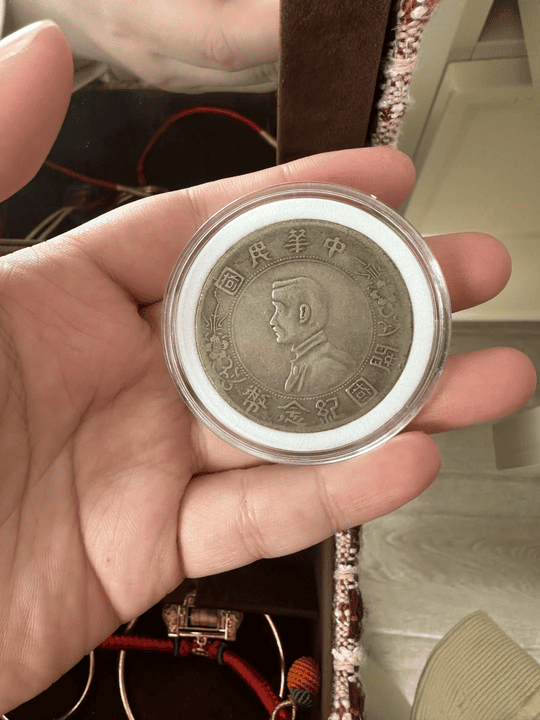
1. Founding of the Republic Commemorative Silver Dollar (the Sun Yat-sen “Little Head” Dollar)
I carefully lifted out one example and showed Mr Chan its details.
- Obverse: A profile portrait of Sun Yat-sen occupies the centre. The clerical-script Chinese legend above reads “Republic of China”, while the inscription below reads “Commemorative Coin of the Founding of the Republic”.
- Reverse: The denomination “One Yuan” appears in clerical script at the centre with a grain-ear design. Around the edge are the English legends “MEMENTO” and “BIRTH OF REPUBLIC OF CHINA”.
- Condition: The surface had naturally oxidised, leaving areas of dark patina. This was the “old patina” formed over time and, in our on-site assessment, supported the coin’s age and historical authenticity. The lettering remained clear, the edge was regular, and there were no obvious hard knocks. Overall, it was an attractive example in above-average condition.

2. British Trade Dollars (also called “Standing Britannia Dollars”)
We then turned to several silver dollars with a distinctly foreign design.
- Obverse: Britannia stands in warrior dress, holding a trident in her right hand and a shield in her left. The shield bears the Union Jack, while “ONE DOLLAR” and the year of issue appear around the figure.
- Reverse: A longevity motif occupies the centre, with the Chinese denomination “One Yuan” above and below and the same denomination in Malay script to either side.
- Condition: These British Trade Dollars were among the principal foreign currencies circulating in China during the late Qing and Republican periods. Mr Chan’s examples had sound fields and strongly struck designs. Britannia’s facial outline and the details of the shield were still clearly visible, giving the coins substantial collector and buyback appeal.


After precise weighing, a ring test and a comparison of details under magnification, I confirmed that the coins were genuine. Taking both the day’s international silver price and the collector premium for antique coins into account, I made Mr Chan a sincere buyback offer. He was visibly relieved: the unexpected proceeds exactly covered the shortfall in the funds required for his daughter’s overseas studies.
III. Comparison of Similar Silver Dollars
To give other sellers in Mr Chan’s position a clearer idea of what they may have, we have compared several silver dollars commonly encountered in the Hong Kong buyback market:
| Common name | Official name | Historical background | Market demand and buyback value | Main valuation factors |
| Sun Yat-sen “Little Head” | Founding of the Republic Commemorative Silver Dollar | Minted from 1912 to commemorate the founding of the Republic of China. | High. Widely circulated, but issued in many varieties, including the lower five-star and upper six-star types, and keenly collected. | Rarity of the variety, naturalness of the patina and wear to the portrait. |
| Yuan Shih-kai “Fat Man” Dollar | Yuan Shih-kai Portrait Silver Dollar with Grain-Ear Reverse | Minted from 1914 and used as a principal circulating coin during the Republican period. | Very high. An established and highly liquid part of the market. | Year, including the scarcer Year 8 issue; variety, such as the O-marked type; and the remaining surface lustre. |
| Standing Britannia Dollar | British Trade Dollar | Minted by Britain from 1895 for circulation mainly in the Far East. | Medium to high. Its Chinese, English and Malay inscriptions give it a distinctive historical character. | Year, privy-mark variety such as B or C, and the clarity of Britannia’s face and shield. |
| Mexican Eagle Dollar | Mexican Eagle Silver Dollar | A Mexican silver coin that entered China in the middle and later nineteenth century. | Medium. It was once the most widely circulated foreign silver dollar in China. | The condition and style of the edge, whether straight or patterned, and the completeness of the old patina. |
IV. Antique Coin and Silver-Dollar Buyback FAQ
Q1: The old silver dollars I found at home are dirty, dark and tarnished. Should I clean them before asking for a buyback assessment?
Absolutely not. The dark oxidation on a silver dollar is known as patina. It records the passage of time and is one factor used during authentication. Cleaning with chemicals or abrasion, including brushing with toothpaste, can badly damage the original surface and lustre, causing a steep loss in value. Leave the coin as it is and let a specialist assess it.
Q2: I have no purchase receipt or appraisal certificate for these silver dollars. Will you still buy them?
Yes. Antiques and old silver dollars are often passed down through generations, so having no certificate is entirely normal. Gu Jin Jian Bao’s appraisal team can examine authenticity through experience and specialist instruments; no prior certificate is required.
Q3: How is your buyback price determined?
We consider two parts. The first is the coin’s material value, including its silver weight and the international precious-metal benchmark. The second is its collector premium as an antique. That premium is assessed from the coin’s rarity, variety, condition, including wear and patina, and current market demand, producing a price that is intended to be fair and transparent.
V. Contact Gu Jin Jian Bao
Do you also have unused silver coins, antiques or gold at home? There is no need to leave them gathering dust in a corner. We offer a free, specialist and confidential preliminary online estimate, with straightforward transactions and cash settlement.
- WhatsApp: 98342057
- WeChat: john19998
- Tel: 852-98342057
Gu Jin Jian Bao helps a long-held collection realise its true value. You are welcome to contact us for an appointment.
