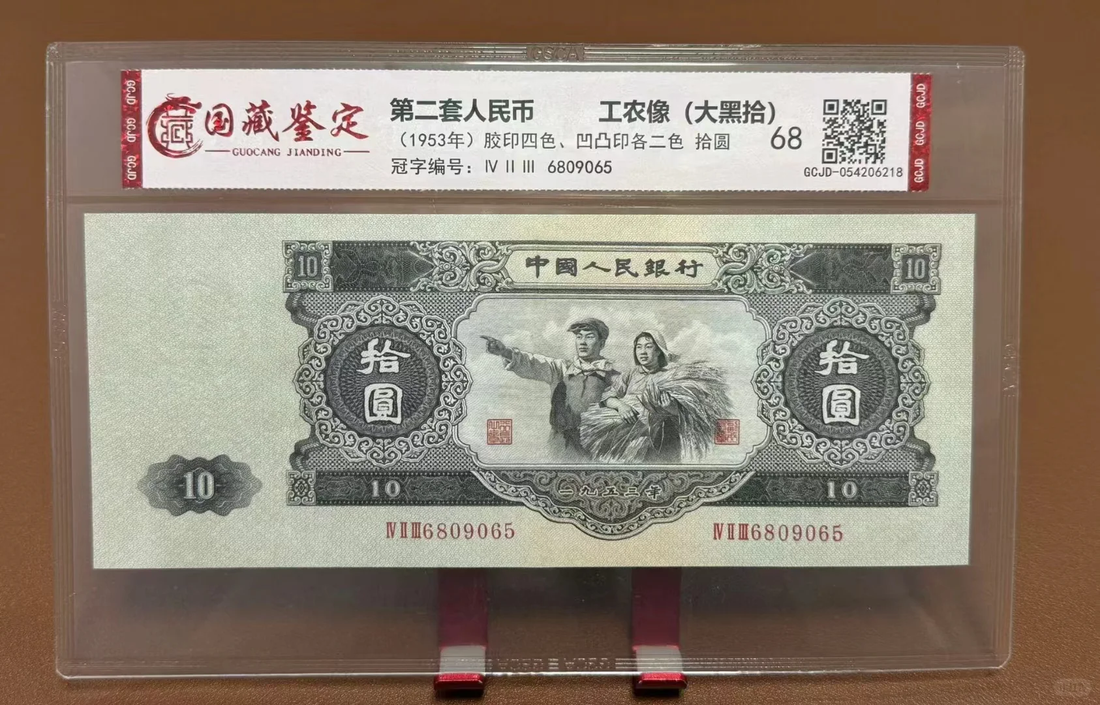
Among the second series of Renminbi,"Big Black Ten"and"Soviet Three-Yuan"are two terms often discussed in currency circles. The former is the 1953 version of the ten-yuan note, the largest banknote in the history of Renminbi; the latter is the only three-yuan denomination ever issued in China's currency history. Coupled with the one-month limited recall in 1964, these two banknotes have largely disappeared from circulation.
In recent years, while engaging inused banknote Buybackin Hong Kong, we've received an increasing number of calls like"I found a dark green three-yuan note while cleaning the house."This article will clarify a few things: the historical background of these two notes, their recent transaction ranges, key identification points to distinguish fakes, and how to handle them if you happen to possess one without making mistakes.
1. The Three Major Denominations of the 1953 Series: Why They are Called"Soviet Three-Yuan"
In the early days of the People's Republic of China, although thefirst series of Renminbiaccomplished the task of unifying currency, it suffered from complex editions (62 types in total), a maximum denomination of 50,000 yuan, and weak anti-counterfeiting features. At the time, the country's printing industry was not capable of establishing an advanced monetary system, particularly lacking high-quality watermarked paper and deep intaglio printing equipment.
Therefore, it was ultimately decided that the three large denominations of the 1953 series—three yuan, five yuan, and ten yuan—would be designed by China but printed by the Soviet Union, which would also provide the technology and paper. In numismatic circles, these three notes are collectively referred to as"Soviet Three-Yuan"(in a broad sense), while the narrow sense of"Soviet Three-Yuan"specifically refers to the unique three-yuan denomination banknote.

2."Big Black Ten": The"King of Banknotes"in Currency Circles
Among the second series of Renminbi, the 1953 ten-yuan note has long been known as the"King of Banknotes"for several reasons.
1. Large Size and Unique Design
The"Big Black Ten"has a size of210 mm × 85 mm, making it the largest banknote ever issued in the history of Renminbi. Its dominant color is black, with extremely wide white borders, earning it the nickname"Big White Border"among the public. The obverse features images of a male and female worker-peasant, reflecting the nature of the New China, founded on the alliance of workers and peasants.
2. Extremely Short Circulation Period, Very Few Remaining
The"Big Black Ten"was issued on December 1, 1957. However, in the early 1960s, Sino-Soviet relations deteriorated. To prevent the Soviet side from using the printing plates to counterfeit banknotes and disrupt financial order, the People's Bank of China issued a notice onApril 14, 1964, requiring the recall of the three large-denomination banknotes printed by the Soviet Union within one month.
The recall was very thorough at the time, with people exchanging their old notes for new ones. As a result, very few"Big Black Ten"notes remained in circulation, and even fewer have survived to this day in good condition, making them exceedingly rare.

3. 2026 Hong Kong Market Buyback Price Range
The table below is based on recent auction records and current exchange rates (approximately 1 Renminbi to 1.1 HKD). Actual transaction prices depend on condition, any repairs, and the grade assigned by international grading services.
| Condition Grade | Grading Reference (PMG) | Market Characteristics | Buyback Reference Price (HKD) |
|---|---|---|---|
| Uncirculated (UNC) | 60 points and above | Crisp paper, sharp corners, no folds | HK$440,000 – $550,000+ |
| Extremely Fine (XF-AU) | 50–58 points | Occasional slight soft fold, no obvious stains | HK$275,000 – $495,000 |
| Very Fine (VF) | 25–35 points | Several obvious folds, minor corner damage | HK$110,000 – $220,000 |
| Circulated (G-F) | 10–20 points | Soft paper, tears or stains | HK$33,000 – $88,000 |
📷 Found a Big Black Ten or Soviet Three-Yuan at home?
Don't flatten folds or use clear tape. Take clear photos of the front, back, and all four corners with your phone, then send them to us viaWhatsApp 98342057. We'll provide a reasonable estimated price range within half an hour. Appraisals are free, and there's no obligation to sell.
3."Soviet Three-Yuan": The Only Three-Yuan Denomination in China's Monetary History
The 1953 series three-yuan banknote is the only time a three-yuan denomination has been issued in China's monetary history. The setting of this denomination was clearly influenced by the Soviet ruble system of the time (1, 3, 5 denominations).
The"Soviet Three-Yuan"banknote's main color is dark green, with a front design depicting the Longyuankou Stone Bridge in Jinggangshan, a revolutionary sacred site. Like the"Big Black Ten,"the"Soviet Three-Yuan"was issued on March 1, 1955, and was also subject to a one-month limited recall in 1964. Due to the historical uniqueness of the"three yuan"denomination, the"Soviet Three-Yuan"has long transcended the realm of legal tender, becoming a tangible cultural relic for studying early financial diplomacy in the PRC.

Latest Buyback Prices for Soviet Three-Yuan (HKD Estimates)
| Condition Grade | Grading Reference (PMG) | Buyback Reference Price (HKD) | Rarity |
|---|---|---|---|
| Uncirculated (UNC) | 60 points and above | HK$55,000 – $110,000+ | Extremely rare, highly sought after by top collectors |
| Extremely Fine (XF-AU) | 50–58 points | HK$44,000 – $60,500 | Very little circulation, paper still has texture |
| Very Fine (VF) | 25–35 points | HK$22,000 – $44,000 | Shows natural signs of circulation, market staple |
4."Six-Dimensional Authentication"for Big Black Ten and Soviet Three-Yuan
After the market price of these two notes exceeded hundreds of thousands of Hong Kong dollars per piece, a large number of high-quality counterfeits naturally appeared. In practice, the following points are relatively solid criteria for judgment:
- Intaglio Printing Embossment (Core): Genuine Big Black Ten and Soviet Three-Yuan notes both utilized the advanced intaglio printing technology of the Soviet Union at the time. Touching the surface of the note, you can feel a strong tactile embossment. Pay special attention to the hair on the forehead of the peasant woman on the front of the Big Black Ten—on genuine notes, each strand of hair is clear, distinct, and three-dimensional; counterfeit notes produced by modern color printing or offset printing often show blurred hair without any detail.
- National Emblem Fixed Watermark: A fixed watermark of the national emblem is hidden in the blank area on the left side of a genuine Big Black Ten. When viewed against light, the five-star watermark appears semi-transparent, with clear layers and natural transitions. Counterfeit watermarks are often later hard-pressed or printed with semi-transparent ink, appearing dark and lacking depth when viewed against light.
- Paper and Sound: Genuine notes use high-quality cotton fiber printing paper imported from the Soviet Union. The paper is tough, and gently flicking it in your hand produces a crisp, lingering sound. Most counterfeit notes use ordinary wood pulp paper, producing a dull, muffled sound.
- Size"Shrinkage Rule": Due to the natural properties of cotton fibers, after decades, the actual size of a genuine Big Black Ten often shrinks by about 1 to 2 millimeters (i.e., 208–209mm) compared to its original standard (210mm). Be highly vigilant if you encounter a note claimed to be in uncirculated condition with a size greater than or exactly 210mm.
- Precision of Background Lines: Under a 40x magnifying glass, the background lines on genuine notes are clear and continuous; on counterfeit notes, the lines may appear scattered, intermittent, or even exhibit uneven thickness and blurry dots.
- Ink on Corners: After decades, the intaglio ink on the corners of genuine notes will show very slight, natural wear; high-quality counterfeits, in an attempt to appear new, often have overly pristine corner ink, which can give them away.
Similar authentication logic is supplemented from another perspective in theBanknote Condition and Serial Number Collection Guide; reading both will provide a more comprehensive understanding before authentication.
5. Buyback Price Ranges for Other Popular Denominations in the Second Series of Renminbi
Besides the"Big Black Ten"and"Soviet Three-Yuan,"several other notes in the second series also hold significant value:
- Red Five Yuan (1953 series, printed by the Soviet Union): HK$33,000 – $55,000 (Seagull watermark version is more valuable)
- Seagull Five Yuan (1956 series, printed domestically): HK$16,500 – $27,500
- Yellow Five Yuan (1956 series): HK$2,750 – $4,400
- Pagoda Mountain Two Yuan (1953 series): HK$4,950 – $7,700
- Red One Yuan (1953 series Tiananmen): HK$5,500 – $9,350
- Black One Yuan (1956 series): HK$3,300 – $5,500
If you have third series Renminbi (green back with watermark 1 Jiao, jujube red 1 Jiao), you can also refer to theThird Series Renminbi Collection Value GuideandThird Series Renminbi Preservation Practices. If you have fourth series Renminbi, you can refer to theFourth Series Renminbi Collection Value Guide.
6. 2026 Market Dynamics and Regulatory Boundaries
In mainland China, starting fromFebruary 1, 2026, the"Regulations on Renminbi Cash Payments and Services"jointly issued by the central bank and three other departments officially came into effect, strictly stipulating that no institution shall refuse Renminbi cash payments. This regulation re-establishes the legal status of physical cash, injecting confidence into the entire physical currency collection market.
However, for collectors, it is crucial to understand the legal boundaries:The currently circulating Fifth Series Renminbi is strictly prohibited from speculation and trading; the First, Second, Third, andFourth Seriesof old banknotes, which have ceased circulation, fall within the legitimate and compliant category of antique and art trade.As an international auction hub, Hong Kong has a strong capacity to absorb these rare and out-of-print old banknotes, making it one of the primary markets for monetization.

7."Four-Prevention"Preservation: How to Store Unsold Notes to Prevent Deterioration
Once you acquire a Big Black Ten or Soviet Three-Yuan, proper preservation directly determines its ultimate value. It is recommended to follow the"Four-Prevention"principles:
- Mold Prevention: Optimal room temperature is 18–20°C, with relative humidity between 50%–60%. In Hong Kong, where summer humidity often reaches eighty percent, banknotes should be stored in an electronic dehumidifier cabinet during humid seasons.
- Folding Prevention: Avoid repeated direct touching with hands, as sweat and oils can cause banknotes to oxidize and yellow. Use acid-free paper sleeves or hard plastic holders for protection.
- Fading Prevention: Absolutely prohibit exposure to direct sunlight or prolonged illumination by high-intensity spotlights.
- Strictly No Washing or Ironing: Never attempt to clean old banknotes with potassium permanganate or other chemical agents, nor iron out creases. Such actions directly damage the paper fibers and original ink, leading to a"Cleaned"label from PMG and a market value drop of over seventy percent.
8. Monetization Process: Take a Photo → 30-Minute Appraisal → On-Site Transaction
The search for"Big Black Ten"and"Soviet Three-Yuan"is essentially a race against time. As time passes, these old banknotes, which carry the history of the early days of the People's Republic of China, will continue to increase in cultural value and market premium.
If you discover such banknotes in a deep drawer or safe, do not dispose of them carelessly. Professional appraisal and Buyback channels are essential to realize the actual market value of these"family heirlooms."Gujin Jianbaooffers free online preliminary appraisals and high-price physical buybacks throughout Hong Kong:
- WhatsApp:98342057
- WeChat:john19998
- Phone:852-98342057
Send us a clear photo, and we'll provide an estimated price within 30 minutes.
Professional Second Series Renminbi Buyback ‧ Free Appraisal
No complicated procedures. Simply send a photo via WhatsApp, and our senior appraisers will personally evaluate it. The entire process is transparent, and payment is made in cash on the spot. We have been operating with integrity for years, with over 60% of our business coming from returning customers.
