I. The Meeting: It Began with a Yellowed Stamp Album
Last Tuesday afternoon, after a sudden shower had passed over Hong Kong, the air was a little cool. Mr Chan, a retired secondary-school teacher approaching 60, came into Gu Jin Jian Bao’s consultation room carrying a well-worn stamp album.
“My father left this to me. He was very fond of stamp collecting in the 1980s, but I know little about it. Hong Kong is so humid that I am afraid the stamps will deteriorate completely in my care. I would rather have you look at them and, if they have value, turn them into cash for my granddaughter’s education fund.” As he spoke, Mr Chan carefully removed a small red stamp in a transparent sleeve from the album.
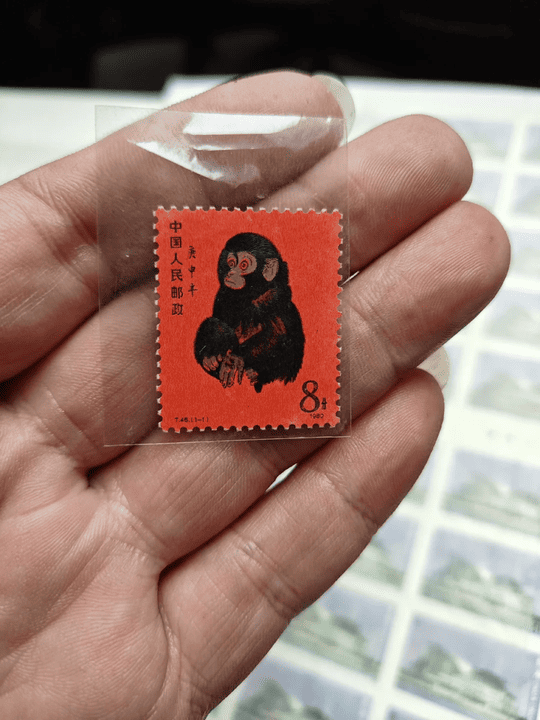
It was the famous 1980 T.46 Gengshen Year special stamp, commonly known as the “1980 Monkey stamp” or the “Golden Monkey”.


II. The Appraisal: What the Details Revealed
Our first step was a close, methodical examination. The Monkey stamp is valued not only because it was the first zodiac stamp issued by the People’s Republic of China and based on artwork by Huang Yongyu, but also because its combination of photogravure and engraving gives it distinctive visual and identification features.
1. The Front: A Vivid Classic with Its Golden Sheen Still Visible
The photographs of Mr Chan’s stamp showed a front that remained quite presentable.
- Engraved lines: The monkey’s individual hairs were clearly defined, with the strong relief associated with engraved printing.
- Colour: The red background remained rich, while a faint golden sheen was still visible on the monkey’s face and limbs, where the gold powder had not fully oxidised.
- Authenticity assessment: After considering the ink texture, screen pattern and characteristic lettering, our on-site assessment in this case was that it was a genuine Monkey stamp.
Mr Chan was visibly pleased to hear that it was genuine. I then explained the point that matters greatly in the trade in antiques and stamps: condition is everything.
2. The Back: Ageing and Damage to the Gum
Wearing gloves, I gently turned over the protective sleeve.
Unfortunately, the back was in poor condition, most likely because the stamp had not been kept in stable temperature and humidity during its earlier years:
- Heavy staining: There were obvious black ink smudges and spots on the back. These may have resulted from contact with other printed material, with damp conditions causing ink transfer or mould.
- Damaged gum: The original gum was no longer complete and had lost its original gloss and even surface.
“Mr Chan, this is indeed a genuine Monkey stamp, but the staining and gum damage on the back will reduce its market value substantially,” I explained. In philately, the price difference between a Mint Never Hinged (MNH) Monkey stamp and one with significant faults can be very large.
After reviewing the market context openly and objectively, we made Mr Chan an offer reflecting the stamp’s impaired condition. He appreciated the direct explanation and signed the buyback agreement there and then. “If I leave it in a drawer, it will only grow mouldier and may eventually be worth nothing,” he said. “It is better to let someone who understands it take care of it, and the money gives it a practical value for my family.”
III. Market Guide: How Condition Affects Comparable Monkey Stamps
The following comparison shows why condition can have such a strong effect on a buyback assessment:
| Condition grade | Front | Gum and reverse | Collector grade / buyback value |
| Top-grade mint (MNH) | Bright colour, a clear golden sheen, sharp corners and no creases | Full, fresh original gum, with no staining, fingerprints or yellowing | Very high (sought after at auction and near the top of the market) |
| Average / minor faults | Normal colour, perhaps with very slight fading or a lightly blunted corner | Hinge traces, partial staining such as that seen on Mr Chan’s stamp, or light yellowing | Medium (accessible to a wider range of collectors, but usually discounted more heavily) |
| Used | A postmark, possible wear or missing perforations | No gum, sometimes with envelope paper remaining | Lower (depends on the clarity and rarity of the postmark, with interest as postal history) |
| Repaired / poor | Severe fading, tears or added colour | Regummed, washed or affected by heavy mould | Very low (mainly of reference or study interest) |
IV. Gu Jin Jian Bao FAQ: Stamp and Antique Buyback Questions
-
Q1: My stamps or coins have developed some mould and yellowing. Should I clean them before asking for an assessment?
A: No. Chemical cleaning or physical rubbing without conservation training can easily damage a stamp’s paper fibres or a coin’s original patina, causing a sharp loss in value. Leave the item as it is and let an appraiser examine the existing condition.
-
Q2: What happens after you buy a stamp with staining on the back, like Mr Chan’s?
A: In a case such as this, the stamp is sent to a specialist conservation provider for non-destructive mould treatment and stabilisation to prevent further deterioration. Its condition is then clearly disclosed before it is offered to a collector whose priority is owning a genuine Monkey stamp rather than obtaining a faultless example.
-
Q3: What else do you buy besides stamps, and is there a charge for an assessment?
A: Gu Jin Jian Bao handles antiques, gold, silver coins and dollars, rare stamps, paintings and calligraphy in Hong Kong. The initial online assessment and in-store appraisal described here are free of charge.
V. Giving an Unused Collection a New Purpose
A stamp album inherited from an older relative or a box of old silver coins and antiques can carry memories of its time. If you have a similar collection and are unsure what to do with it, or want to understand its present market value, you are welcome to contact Gu Jin Jian Bao. Our aim is to keep the buyback process professional, transparent and considerate for every customer.
Contact us for a free assessment:
- WhatsApp: 98342057
- WeChat: john19998
- Tel: 852-98342057
Gu Jin Jian Bao — a dependable specialist for turning collections into cash.
