
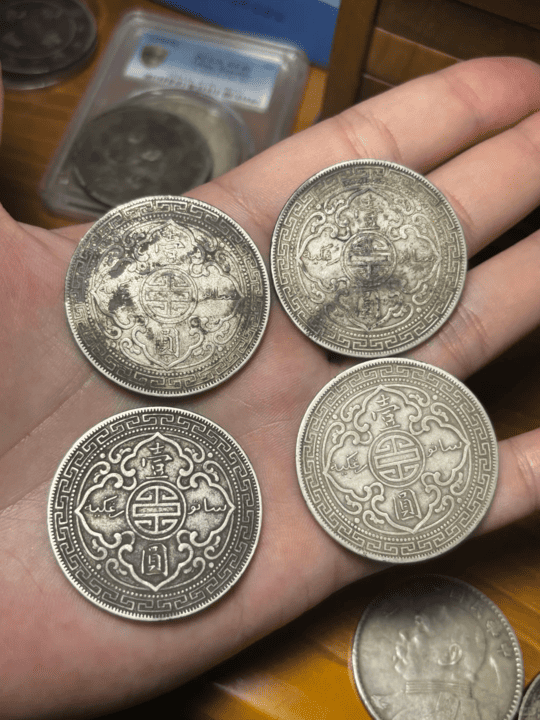
Give every British Trade Dollar one identifier
Before taking close-ups, make sure each detail can be found on a complete face. Keep overall photographs, measurements and attachments under the same number.
- Identification: visible year, denomination, principal designs and rim legends
- Measurements: original weight and diameter with tools and units
- Condition: applied marks, holes, solder or altered edge sections
Number the holder separately and transcribe its label as a lead. Do not fill a hidden field from a similar standing-figure trade coin.
The term British Trade Dollar describes the coin family; the individual date, mintmark and condition still have to be read from the piece in hand.
Photograph the circumference as an unbroken sequence
Use overlapping sections for reeding, lettering or other edge detail. Preserve joins, rim work, piercings and solder rather than cleaning or filing them for clarity.
Separate patina colour, circulation rub, weak strike, wiping lines and chemical brightness. Keep the original measurement and unit beside the surface views.
Read each face before comparing dimensions
Transcribe the year, denomination, national wording, mintmark and principal designs. Mark anything blocked by wear or plastic instead of assuming it from a catalogue entry.
Photograph both faces with the full rim, then add located details of the standing figure, reverse design, surrounding text, mintmark and edge.
Describe patina and wear without altering them
Keep British Trade Dollars separate from Junk dollars, French Indochina piastres, Morgan dollars and other foreign silver. Their weights and edge forms must not cross between records.
A grading holder provides a printed attribution and grade. Check the enclosed date, mintmark, designs and visible surface independently.
Know when the actual coin needs examination
Preserve old sleeves, applied marks and provenance statements as supporting evidence. They do not replace the coin's inscriptions, designs, surface or edge.
Use the visible year, denomination, country wording and designs as the formal basis. A Chinese market nickname remains a useful index only.
A focused British Trade Dollar review
Start with complete faces and visible legends, then add the full edge, original weight and diameter. Keep tool, unit and measuring point with every figure.
Map each chop, piercing, scratch or altered rim section on a whole view. An isolated enlargement should not dictate the condition of the entire coin.
Retain the original photographs when lighting or orientation is repeated. Later images can clarify a detail without erasing how the surface first appeared.
Do not wash, polish, scrape, acid-test or open a grading holder merely to finish the set. Identify what direct access would answer before accepting that risk.
Before consultation, confirm that coin number, photographs, date, denomination and design all agree. Keep any unresolved reading visible for the specialist.
