
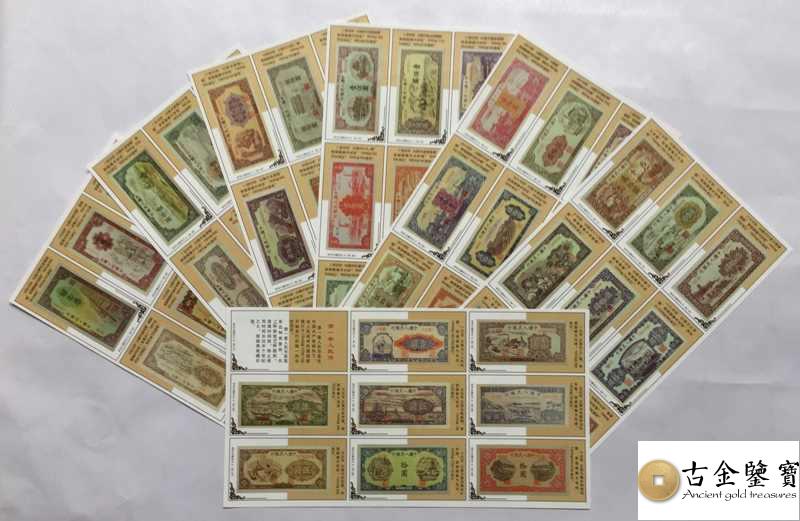
The first series of Renminbi had a short history of only 7 years—it was first issued in Shijiazhuang on December 1, 1948, and completely withdrawn from circulation on May 10, 1955. However, these 7 years precisely covered three historical stages: the end of the War of Liberation, the founding of New China, and the Buyback of the national economy. The issuance and withdrawal of each banknote were closely linked to the political and economic situation of the time. Below is a breakdown along the timeline.
I. Eve of Birth: 1947-1948
1947: Monetary Chaos with Each Liberated Area Acting Independently
During the War of Liberation, each liberated area (North China, Northeast China, East China, Central Plains, etc.) had its own currency:
- Jin-Cha-Ji Border Region notes (issued by Jin-Cha-Ji Border Region Bank)
- Beihai Bank currency (Shandong Liberated Area)
- Jinan Bank currency (North China Liberated Area)
- Zhongzhou Farmers'Bank currency (Central Plains Liberated Area)
- Northeast Bank currency (Northeast Liberated Area)
This diversified currency severely affected inter-regional commercial activities. In October 1947, the Central Committee of the Communist Party of China decided to unify the currency and prepare for the establishment of the People's Bank of China.
Early 1948: Preparing for the People's Bank of China
In April 1948, the Central Committee of the Communist Party of China held a meeting in Pingshan County, Hebei, and formally decided:
- To merge the Jin-Cha-Ji Border Region Bank, Jinan Bank, and Beihai Bank
- To establish the"People's Bank of China"
- To issue a unified currency, the"Renminbi"(Renminbi)
- Location: Shijiazhuang
July-October 1948: Banknote design, layout approval, first batch printing.
II. December 1, 1948: Historic First Issuance
On December 1, 1948, the People's Bank of China was officially established in Shijiazhuang, Hebei. On the same day, the first batch of 3 denominations of Renminbi was issued:
- 50 Yuan (Workers and Farmers)
- 20 Yuan (Train)
- 10 Yuan (Sawing Wood)
These three notes were the"founding works"of the first series of Renminbi. That day marked the beginning of modern Chinese currency.
III. 1949: Phased Expansion of Issuance
Early 1949: Final Stage of the War of Liberation
In January 1949, the People's Bank of China successively issued:
- 1 Yuan (Workers and Farmers)
- 5 Yuan (Sailboat), 5 Yuan (Shepherd)
- 10 Yuan (Workers and Farmers), 10 Yuan (Train), 10 Yuan (Irrigation)
- 20 Yuan (Coal Cart), 20 Yuan (Textile), 20 Yuan (Pumping Water), 20 Yuan (Harvest), 20 Yuan (Threshing)
- 50 Yuan (Railway), 50 Yuan (Red Factory), 50 Yuan (Blue Factory)
- 100 Yuan (Great Wall), 100 Yuan (Factory), 100 Yuan (Red Worker), 100 Yuan (Beihai Bridge), 100 Yuan (Sailboat)
October 1, 1949: Founding of the People's Republic of China
After the founding of New China, currency unification accelerated:
- Old currencies from various liberated areas were exchanged for Renminbi at a certain ratio
- The KMT government's Jinyuan Quan (gold yuan notes) and Yinyuan Quan (silver yuan notes) were completely abolished
- Foreignsilver dollars(Mexican dollars,dragon dollars, etc.) were withdrawn from circulation
This process was called"currency unification"and was the foundation of New China's economic construction.
IV. 1950-1952: Expanded Issuance and the Korean War
1950: Issuance of High Denomination Banknotes
Due to inflationary pressure, higher denominations were issued in 1950:
- 200 Yuan (Exercise, Paiyun Hall, Summer Palace, Great Wall, Steelmaking)
- 500 Yuan (Harvester, Crane, Tractor, Zhengyangmen, Farming)
- 1000 Yuan (Autumn Harvest, Two Horses Plowing, Coal Transport, Horses Drinking, Coal Cart)
1951: Borderland Themes + High Denominations
Starting from May 1951, denominations of 5000 Yuan and 10000 Yuan were issued, including the famous"Four Heavenly Kings":
- 500 Yuan Zhan De Cheng (October 1)
- 5000 Yuan Mongolian Yurt (May 17)
- 10000 Yuan Herding Horses (May 17)
- 10000 Yuan Camel Team (October 1)
These were all Xinjiang and Mongolian themes, reflecting the political narrative of New China's border unification and multi-ethnic unity.
1952: During the Korean War
The Korean War (1950-1953) put pressure on China's economy, and new denominations continued to be issued:
- 5000 Yuan (Shepherd, Weihe Bridge, Tiller, Tractor)
- 10000 Yuan (Two Horses Plowing, Warship)
V. 1953-1955: Complete System to Withdrawal
1953: Layout Refinement
The last wave of issuance for the first series of Renminbi:
- 5 Yuan (Weaving)
- 500 Yuan Zhan De Cheng (Second Batch)
- 1000 Yuan (Three Horses Plowing)
- 50000 Yuan (Harvester, Xinhua Gate)
A total of 62 denominations/designs were issued in 1953, and the first series of Renminbi system was basically completed.
February 21, 1955: Historic Withdrawal Announcement
The State Council issued the"Order on Issuing New Renminbi and Withdrawing the Current Renminbi":
- The first series of Renminbi was withdrawn from circulation at an exchange rate of 1:10,000
- Original 10,000 Yuan denomination = New Renminbi 1 Yuan
- Withdrawal deadline: May 10, 1955 (North China, East China), June 10, 1955 (other regions)
- Old currency became invalid for those who failed to exchange by the deadline
March-June 1955: Mandatory Exchange Period
This period was critical for the large-scale Buyback and destruction of the first series of Renminbi. Most of the old currency Bought back by the central bank was centrally destroyed (incinerated, pulped). A small number were preserved by historical archives as souvenirs.
VI. Historical Significance of 7 Years of Issuance
Significance 1: Starting Point of New China's Monetary Modernization
The first series of Renminbi ended the monetary chaos of modern China (decades of silver dollars, bank notes, border region notes, and gold yuan notes since the late Qing Dynasty and the Republic of China), establishing a unified national currency system.
Significance 2: Material Carrier of Political Narratives
The design themes of the 62 denominations reflected the ideology of New China:
- Industrial production (factories, steelmaking, coal mines) – reflecting industrialization
- Agricultural production (plowing, harvesting, grazing) – reflecting an agricultural nation
- Military strength (warships) – reflecting national defense
- Borderland themes (herding horses, camels, Mongolian yurts, Zhan De Cheng) – reflecting multi-ethnic unity
- Construction achievements (Great Wall, Beihai Bridge, Xinhua Gate, Zhengyangmen) – reflecting cultural confidence
Significance 3: Foundation of Banknote Collecting
In the 70 years since its withdrawal, the first series of Renminbi has gradually become a core category in Chinese banknote collecting circles. The forced destruction at the time led to scarcity, coupled with its significant historical meaning, diverse designs, and difficulty in finding good condition pieces, making this set of banknotes a top-tier collecting category.
VII. Insights from a Collector's Perspective
Insight 1: Early Editions from 1948-1949 are Scarcer
Earlier issued versions (1948-1949) are scarcer due to immature printing technology and the impact of wartime conditions. Among them, the first three notes issued in 1948 (50 Yuan Workers and Farmers, 20 Yuan Train, 10 Yuan Sawing Wood) hold special historical significance.
Insight 2: 1951 Borderland Themes are Most Precious
All four"Heavenly Kings"were issued in 1951. Reasons: they were mainly circulated in border regions like Xinjiang and Inner Mongolia, leading to low surviving quantities; unique themes, exquisite designs; high denominations, severe Buyback and destruction.
Insight 3: Condition Determines Value
All first series Renminbi banknotes are over 70 years old. The distribution of surviving conditions:
- Uncirculated: < 1% (extremely rare)
- About uncirculated: 2-5%
- Lightly circulated: 10-20%
- Moderately circulated: 30-40%
- Heavily circulated: 30-40%
For example, a 100 Yuan Factory in heavily circulated condition might be around HK$500, while an uncirculated one could reach HK$4,500-6,000. A 10-fold difference.
VIII. How to Handle First Series Renminbi at Home?
- Refer to the 7-year issuance timeline in this article to understand the historical position of your banknote.
- Estimate its condition initially.
- Refer to the denomination catalog to understand the market price range.
- Absolutely do not flatten, clean, or directly touch it.
- Store it in an acid-free banknote sleeve.
- WhatsApp 98342057 to book a free appraisal with Gugengiantbao.
- If it is a rare edition or one of the"Four Heavenly Kings,"it is recommended to send it for PMG grading.
Conclusion
The 7-year issuance history of the first series of Renminbi is a tangible record of the birth of New China. From the first 3 notes issued on December 1, 1948, to the withdrawal announcement on February 21, 1955, each banknote carries the political narrative of New China's monetary modernization, multi-ethnic unity, and industrial and agricultural construction. For collectors, understanding this history is essential to truly appreciate the value of their collections.
Want to know the value of your first series Renminbi?
Gugengiantbao offers free appraisal, valuation within 30 minutes, same-day doorstep purchase, and instant cash payment. WhatsApp us a picture for an immediate estimate, no need to visit our store.
