The dragon motif is the most central visual element of Qing Dynasty silver coins, and also the primary clue for identifying varieties and determining their age. From the first casting of theGuangxu Yuanbaoin Guangdong in 1889 to the standardized version of theDaqing Silver Coinin 1911, the dragon motif underwent at least five major stylistic changes in just 22 years. Behind each modification were drivers such as technological upgrades, political struggles, or aesthetic shifts.
Quick Conclusion:The collection value of silver coins comes from the intersection of historical background, existing condition, and market demand; it cannot be judged solely by a single year.
Phase 1: Guangdong Guangxu Yuanbao (1889-1894) - The First Generation"Water Dragon"
In 1889, the Guangdong Mint began minting China's first provincial machine-struck silver coins, with the reverse dragon motif design provided by the British Birmingham Mint. The characteristics of this dragon are:
- Posture: Coiling clockwise around a central circle, with its head facing up and to the right
- Claws: Four claws (a common practice for provincial silver coins; five-clawed dragons were exclusively for imperial use)
- Whiskers: Short and splayed outwards, with simple lines
- Scales: Clear outline but roughly engraved, lacking depth
- Overall Impression: Clearly influenced by the circular composition of Mexican silver dollars, with a Chinese dragon motif adapted to a Western layout
The dragon motif from this phase is known as the"water dragon"because of the cloud and water patterns decorating the dragon's body. Although the design was rough, it established the basic"coiled dragon on the reverse"composition for Chinese silver coins, which had a profound impact.
Phase 2: Various Provinces Guangxu Yuanbao (1895-1905) -"A Hundred Dragons Contend"
After Guangdong, provinces such as Hubei, Jiangnan, Beiyang, Sichuan, Yunnan, Anhui, and Fengtian successively established mints. The Qing government did not standardize dragon motifs, allowing each province to design its own, leading to a"one province, one dragon"situation:
- Hubei Dragon: Full-bodied, with intricate scales, known as the"fat dragon,"representing the highest level of craftsmanship
- Jiangnan Dragon: Slender body, elegant posture, with subtle design adjustments each year (hence many varieties)
- Beiyang Dragon: Larger head, long and flowing whiskers, known as the"big-headed dragon"
- Sichuan Dragon: Narrow-faced dragon motif, with the dragon's body compressed into a smaller space, featuring a unique style
- Yunnan Dragon: Thick lines, with distinct local aesthetic characteristics
This period was the most diverse phase in Qing Dynasty silver dollar design. For collectors,"collecting dragons from all provinces"is a classic collecting theme – the same era, the same denomination, but each province's dragon motif has its own character.
Phase 3: Hubu's Unification Attempt (1902-1908) - The Emergence of the"Official Dragon"
In 1902, the Qing government established the Hubu (Board of Revenue) Mint, attempting to standardize national silver coin designs. Characteristics of the Hubu version dragon motif:
- The dragon's body became more standardized, with neat lines
- The dragon's claws were changed to five claws (representing central imperial power)
- The cloud patterns were symmetrically arranged, increasing decorative appeal
- The overall style shifted from"provincial free expression"to"centralized standardization"
However, the promotion of the Hubu version faced significant resistance – provinces were unwilling to relinquish their minting rights (as it was profitable), so actual mintage was limited. The dragon motif of this phase can be understood as a"transitional product,"a midway point from provincial diversity to central unification.
Phase 4: Xuantong Yuanbao (1909-1910) - The"Standardized Dragon"Takes Shape
After Xuantong ascended the throne, currency reform accelerated. Provinces continued to mintXuantong Yuanbao, but the dragon motif designs began to converge – influenced by central directives, the differences in dragon motifs among provinces narrowed, and the overall style became more refined:
- The dragon scales were more intricately engraved (reflecting advances in minting technology)
- The dragon whiskers were more delicately rendered
- The cloud patterns and bead circles became more uniform in design
- Some provinces began using bilingual"dragon side English"designs
The dragon motif of this phase was very close to the final"Daqing Silver Coin"style, representing the final push from disorder to order.
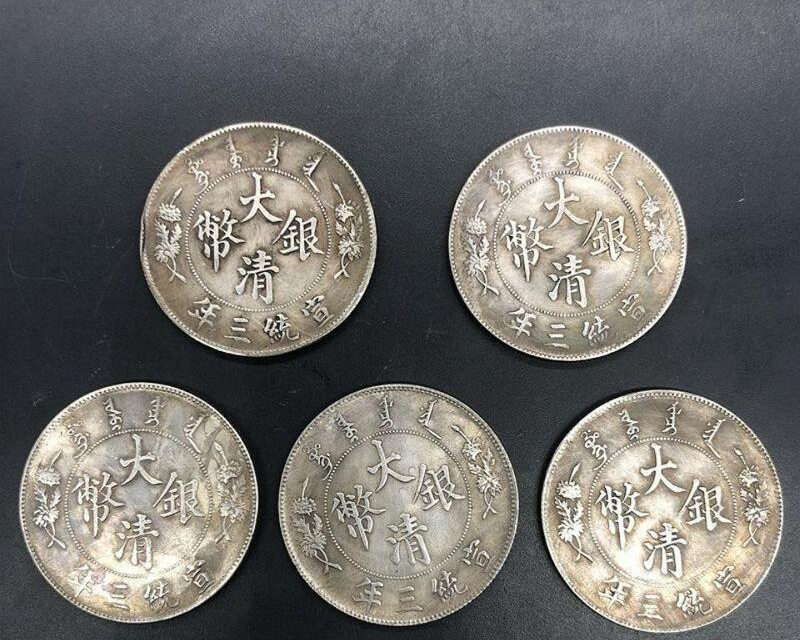
Phase 5: Xuantong Three Years Daqing Silver Coin (1911) - The"Five Dragons Contend"Standardized Version
In 1911, the Tianjin Mint test-struck five dragon motif designs, representing the pinnacle of Qing Dynasty silver dollar design:
| Variety | Dragon Motif Characteristics | Outcome |
|---|---|---|
| Curved Whiskers Dragon | Whiskers curved in an S-shape, balanced posture | Selected as the official version |
| Long Whiskers Dragon | Extremely long, flowing whiskers | Test strike, not issued |
| Short Whiskers Dragon | Short, concise whiskers, simple style | Test strike, not issued |
| Reversed Dragon | Dragon head facing in the opposite direction | Test strike, not issued |
| Large Tail Dragon | Unusually thick dragon tail, occupying a large proportion | Test strike, not issued |
Ultimately, the Curved Whiskers Dragon won, becoming the last"national coin dragon motif"of the Qing Dynasty. From an artistic perspective, the Curved Whiskers Dragon's design is the most balanced – with coordinated dragon body proportions, elegant whiskers, and intricate scales, it is the culmination of 22 years of dragon motif evolution. Unfortunately, the Xinhai Revolution broke out in the same year, and only about 15 million of these silver coins were minted, making it a swan song.
Practical Significance of Dragon Motif Evolution for Collecting
Understanding the evolution of dragon motifs is not just about knowledge; it has a direct impact on actual collecting and monetization:
For Authentication– The most common problem area for counterfeit coins is the details of the dragon motif. Genuine dragon scales have distinct period characteristics, and it's impossible for different phases of dragon motif styles to be mixed. A coin claiming to be"Guangdong Guangxu"but with a dragon motif clearly from the Xuantong period can generally be deemed problematic.
For Valuation– For the same reign title, differences in dragon motif designs from different provinces can lead to price differences of several times. The collecting market places a premium on"rare dragon motifs"– for example, certain years of Fengtian province's dragon motifs are distinctly different from other provinces and have low mintage, naturally leading to high-prices.
Want to know the period and variety of your silver dollar?
WhatsApp us a clear photo of the dragon side, and we'll help you identify the era and variety immediately. Free appraisal, same-day reply.
Data Boundary (2026-06-03)
This article is for understanding the collecting context and valuation logic of silver coins, and should not be considered a fixed buyback price. To determine the value of a single collectible, it is still necessary to refer to the following physical evidence:
- Specifications:Silver coins must first be measured for weight, diameter, and thickness to rule out low-quality counterfeits or privately minted pieces.
- Edge Milling:The depth, spacing, and direction of wear of the edge milling are key points for determining the authenticity of silver coins.
- Condition:Patina, cleaning marks, nicks, and wear will affect the actual received value more than the year itself.
Data Citation Boundary (2026-06-03)
The quoted prices for silver coins are not fixed figures; this article can only provide a framework for judgment and recent market trends. Silver coin collectibles are also affected by variety, patina, edge milling, cleaning marks, and grading scores. Before a formal transaction, please refer to physical appraisal, itemized quotation, and the achievable price on the day.
Frequently Asked Questions
Can I make an initial judgment of a silver coin myself without experience?
You can start by checking the appearance, dimensions, preservation status, and source information according to the checklist in this article, but do not attempt to clean or repair it yourself.
What information is most important to prepare first?
Photos of the front and back, close-ups of specific features, weight and dimensions, provenance description, and any grading or purchase records are the most useful information for valuation.
Preparing Valuation Information:To inquire about a silver coin, please take photos of the front, back, edge, or specific features, and provide dimensions, weight, and provenance. The more complete the information, the easier it is to make an initial judgment close to the actual item.
