
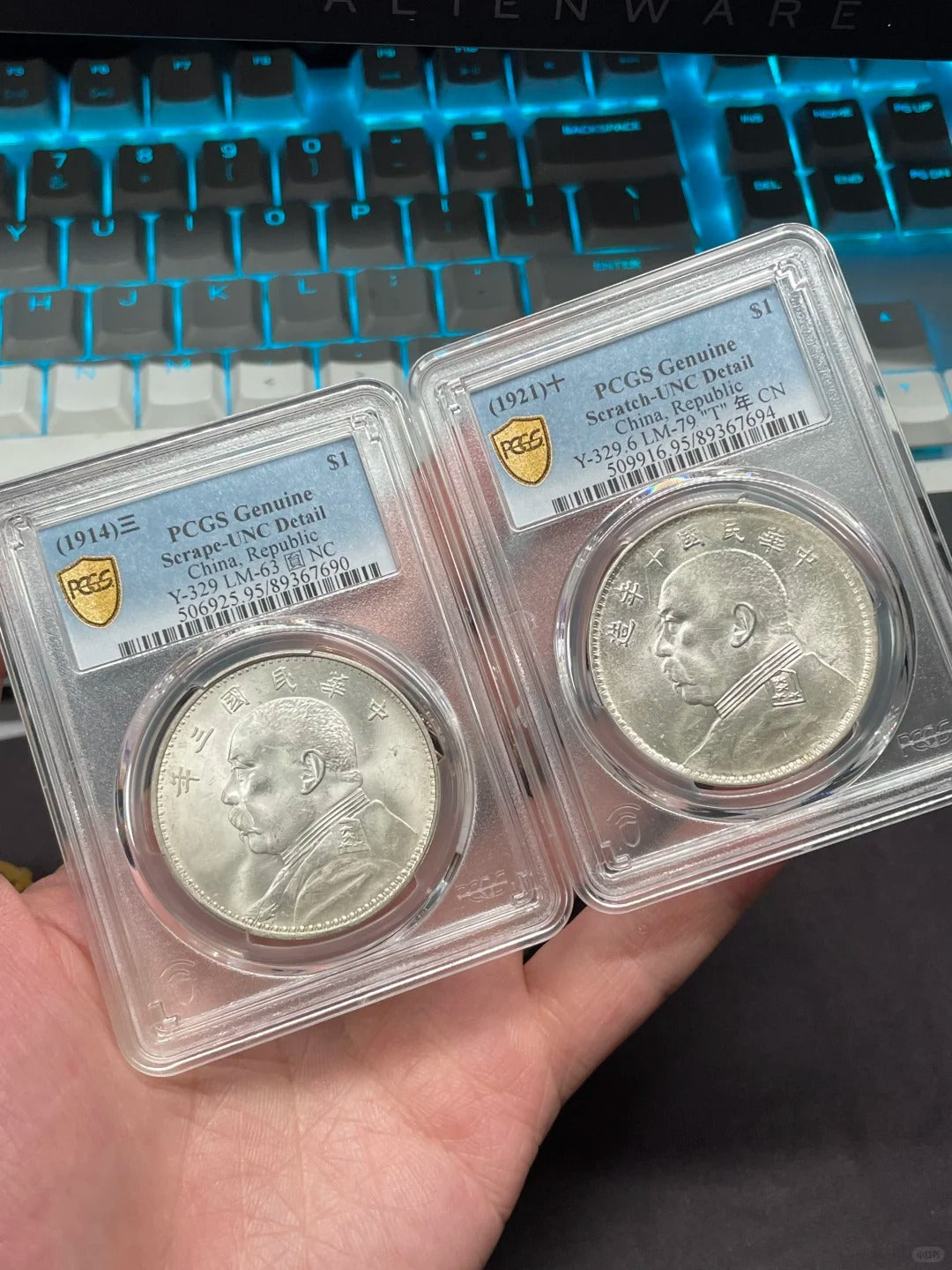
The market price gap between signed and regularYuan Datoucoins has consistently remained over 100 times, and this gap is expected to widen further between 2024 and 2026. Below is a compilation of public auction records from the past three years, analyzing the appreciation trajectory and future trends of the signed edition.
Quick conclusion:When choosing a Yuan Datou buyback service, the most important aspects to verify are transparent inspection, itemized quotations, and clear settlement methods.
I. What is a"Yuan Datou Signed Edition"? A 10-second Introduction
In 1914 (the third year of the Republic of China), when the Tianjin Mint first minted silver coins featuring Yuan Shikai, Italian engraver Luigi Giorgi left his signature"L. GIORGI"on the coin's surface. This is the origin of the signed edition. It belongs to the pattern coin category and was never officially circulated, making its surviving quantity extremely rare. Internationally recognized types of signed editions include:
- Signed Obverse:"L. GIORGI"engraved below Yuan Shikai's neck, the most common type.
- Signed Reverse:Signature appears below the auspicious grain on the reverse, rarer.
- 7-Tenths Face Signed Edition:Yuan Shikai's portrait shows a 7-tenths profile (not a full profile), a trial strike variety.
II. 2024-2026 Hong Kong and International Auction House Records
The data below is compiled from public auction records of Sotheby's, Christie's, Spink Hong Kong, and China Guardian Beijing. All prices have been converted to HKD (including buyer's premium):
2024
- March|China Guardian Spring Auction|PCGS MS62 Signed Obverse|Sold for HK$1,820,000
- June|Spink Hong Kong|PCGS MS64 7-Tenths Face Signed Edition|Sold for HK$2,450,000
- October|Christie's Hong Kong|PCGS AU58 Signed Obverse|Sold for HK$980,000
2025
- April|Beijing Chengxuan|PCGS MS63 Signed Reverse|Sold for HK$3,150,000 (New annual high)
- September|Shanghai Honsen|PCGS MS61 Signed Obverse|Sold for HK$1,560,000
- November|Spink Hong Kong|PCGS AU55 Signed Obverse|Sold for HK$760,000
2026 (As of May)
- March|China Guardian Spring Auction|PCGS MS62 Signed Obverse|Sold for HK$2,080,000
- April|Spink Hong Kong|PCGS XF45 Signed Obverse|Sold for HK$520,000
III. Multiplier Effect of Grading Score on Price
For the same signed obverse edition, each increase in PCGS grading can lead to a several-fold difference in price. Below is a compilation of average transaction data from 2024-2026:
| PCGS Grade | Condition Description | Transaction Price Range (HKD) | Multiplier vs. Regular Edition |
|---|---|---|---|
| VF30 - XF45 | Circulation wear, clear lettering | $450,000 - $750,000 | 180-300 times |
| AU50 - AU58 | Light circulation, 70%+ original luster retained | $800,000 - $1,200,000 | 320-480 times |
| MS60 - MS62 | Uncirculated, light bag marks | $1,500,000 - $2,200,000 | 600-880 times |
| MS63 - MS64 | Uncirculated, very few flaws | $2,300,000 - $3,500,000 | 920-1400 times |
| MS65+ | Nearly perfect | $4,000,000+ | 1600 times+ |
As shown in the table, the transaction price can jump from HK$500,000 to over HK$4,000,000, an 8-fold difference, from XF45 to MS65. Therefore, if you suspect you have a signed edition,never wash it, avoid touching the coin's surface directly with your hands, and have it appraised in its original state. This action could mean a difference of several million dollars.
IV. Appreciation Curve: 10-Year Trend of the Signed Edition
Compared to transaction prices in 2016 and 2026, a PCGS MS62 signed obverse edition appreciated approximately 3.2 times over ten years (average transaction price was about HK$650,000 in 2016, and about HK$2,080,000 in 2026). The annualized appreciation rate is approximately 12.3%, outperforming the Hang Seng Index and international gold prices during the same period.
The appreciation is mainly driven by three factors:
- Sustained scarcity—the quantity in existence has not increased, but the collector base (especially among affluent Chinese) continues to grow.
- Mature grading system—the increasing number of PCGS and NGC representative offices in Hong Kong has widened the price gap between graded coins and raw, uncertified coins.
- Safe-haven demand—inflation and geopolitical factors push up demand for physical asset allocation.
V. Warning: Proliferation of High-Quality Fakes of Signed Editions
Precisely because of the enormous price difference, 95% of self-proclaimed"signed editions"on the market are either fakes or later-cast patterns. Common types of high-quality fakes include:
- Sand-cast reproductions—cast from molds of genuine coins, with blurry lettering and indistinct reeding.
- Modified regular editions—"L. GIORGI"engraved with a tool below Yuan Shikai's neck on a genuine Yuan Datou, destroying the original toning.
- Machine-struck high-quality fakes—struck with the same minting equipment as genuine coins, meeting standards for weight, diameter, and silver content, but lacking natural toning and centuries of oxidation marks.
The only reliable way to avoid buying a fake signed edition is to request that the seller provide aPCGS or NGC slabbed coin. Any ungraded"signed edition"should be considered high-risk, regardless of any authentication certificates provided by the seller.
VI. What to do if you have a suspected signed edition at home?
Three steps:
- Preserve its original state—handle with cotton gloves, place in an acid-free coin holder, avoid cleaning.
- Take clear, high-resolution photos—close-ups of the obverse, reverse, and reeding (macro photography is best).
- WhatsApp photos to 98342057—Gu Jin Jian Bao offers free preliminary appraisal, with an assessment typically provided within 30 minutes during business hours.
If the preliminary assessment suggests it might be genuine, we can arrange a free on-site in-depth appraisal and assist with submitting it to PCGS or NGC for grading. The entire process is transparent, with no pressure to sell.
Conclusion
The Yuan Datou signed edition is a top-tier collectible in Chinese numismatics, renowned for its active market and stable appreciation. However, due to the significant price difference, both knowledgeable and uninformed buyers and sellers risk losing hundreds of thousands to millions. For collectors with a suspected signed edition, the first step is always to clarify its authenticity and grading score, not to rush into selling. The market always welcomes well-graded coins.
Information to Verify Before Choosing a Service
- Inspection Method:Confirm that the other party will explain the inspection tools, criteria, and that evaluations are not based solely on verbal estimates.
- Quotation Sheet:Request an itemized list including type, condition, weight or variant, deduction items, and the final net amount received.
- Settlement Security:Before an on-site or in-store transaction, confirm payment methods, identity verification, receipt, and confidentiality arrangements.
The value of a service-oriented article lies in helping you check if the process is transparent; before an official transaction, you should ask the other party to itemize the inspection methods, quotation basis, and payment methods.
Service Quotation Boundary (2026-06-03)
The commitment to a service process does not imply a fixed purchase price for every collection item. Before an official transaction, a separate calculation for each item should be performed based on its authenticity, condition, purity, weight, variant, grading result, and the prevailing market price on the day.
Frequently Asked Questions
How to determine if a buyback service is transparent?
See if the other party is willing to explain each step of the inspection method, the composition of the quotation, deduction items, and payment methods, rather than just providing a total price.
What should I prepare before an on-site transaction?
First, take clear photos of the collection, organize the quantity and source information, and confirm the transaction location, payment method, receipt, and privacy arrangements.
