
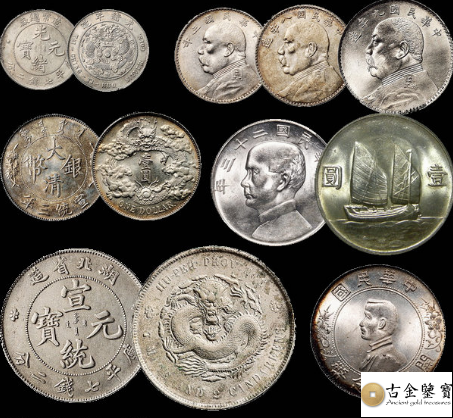
"Should I buy Qing Dynasty dragon dollars or Republic of China Yuan Datou?"This is a classic dilemma for silver dollar collectors. Silver dollars from both periods have their advantages—late Qing dragon dollars are rarer and more artistic, while Republic era silver dollars have better liquidity and market recognition. Which period offers greater long-term appreciation potential? Let's compare using data below.
Quick conclusion:Silver dollars do not have a fixed list price. A reasonable valuation must consider authenticity, condition, immediate demand, and available channels for transaction.
I. Basic Background of the Two Periods
Late Qing Dynasty Silver Dollars (1889-1911)
- Minting Years: Guangxu 15 to Xuantong 3
- Main Types:Guangxu Yuanbao,Xuantong Yuanbao, Da Qing Silver Coin
- Mints: Provincial Mints + Board of Revenue + Beiyang
- Minting Period: 22 years
- Cumulative Mintage: Approximately 200 million+ pieces
Republic of China Silver Dollars (1912-1935)
- Minting Years: Republic Year 1 to 24
- Main Types: Yuan Datou,Sun Xiaotou, Junk Dollars
- Mints: Tianjin, Nanjing, Wuchang, Guangzhou, etc.
- Minting Period: 23 years
- Cumulative Mintage: Approximately 300 million+ pieces
II. In-depth Comparison Across 4 Dimensions
Dimension 1: Minting Background and Political Significance
Late Qing Silver Dollars
Background: The Qing government promoted currency modernization (Guangdong's first minting in 1889) and responded to the financial crisis after the defeat in the First Sino-Japanese War. Significance:
- It marked the beginning of China's modern currency system.
- It reflected the Qing government's transition from centralized power to local decentralization.
- It represented the last currency products of the Qing Dynasty.
Republic of China Silver Dollars
Background: In 1914, the Beiyang government promulgated the"National Currency Regulations,"establishing a unified silver standard. Significance:
- It was the first set of unified national currency of the Republic of China.
- It reflected the turbulent 23-year history of the Republic from its establishment to the civil war.
- It was the most widely circulated silver dollar in China in the 20th century.
Dimension 2: Rarity and Collection Depth
Rarity of Late Qing Silver Dollars
| Type | Commonality | Rare Variant Types |
|---|---|---|
| Guangdong Guangxu Yuanbao | Common | Reversed (Extremely Rare) |
| Hubei Guangxu Yuanbao | Common | Local Province Variant (HK$25,000+) |
| Jiangnan Guangxu Yuanbao | Common | Heavenly Stems and Earthly Branches Year Variant |
| Fengtian Guangxu Yuanbao | Less Common | Guimao Pattern (Tens of millions HKD) |
| Xinjiang Guangxu Yuanbao | Rare | Multiple Local Variants |
| Hunan Guangxu Yuanbao | Extremely Rare | Pattern Grade (Tens of millions HKD) |
| Da Qing Silver Coin Xuantong Three | Common (Curved Whisker Dragon) | Reversed Dragon, Large Tail Dragon (Millions HKD) |
Rarity of Republic of China Silver Dollars
| Type | Commonality | Rare Variant Types |
|---|---|---|
| Yuan Datou Republic Year 3 | Common | L. Giorgi Signed Variant (Millions HKD) |
| Yuan Datou Republic Year 8 | Less Common | Large Characters Variant, Cow-Mouth Manufacture |
| Yuan Datou Republic Year 9 | Common | Fine Hair Variant + Y-dot Flower, 7-dot Year |
| Yuan Datou Republic Year 10 | Common | T-dot Year, Open Mouth Manufacture |
| Sun Xiaotou Six Stars Above | Common | Five Stars Below (Rare), Five Stars Above (Pattern Coin Grade) |
| Junk Dollar Republic Year 23 | Common | Three Birds Coin (HK$120,000+) |
Dimension 3: Market Circulation and Collector Base
Collecting Characteristics of Late Qing Silver Dollars
- Collector Base: Estimated 2-3 million (Chinese-speaking community)
- Market Activity: Medium
- Main Markets: Mainland China, Hong Kong, Taiwan, Southeast Asia
- Auction Frequency: 100-200 pieces transacted per auction
- New Collector Entry Speed: Steady growth
Collecting Characteristics of Republic of China Silver Dollars
- Collector Base: Estimated 4-6.5 million (Chinese-speaking community)
- Market Activity: High
- Main Markets: Global Chinese-speaking community
- Auction Frequency: 300-500 pieces transacted per auction
- New Collector Entry Speed: Rapid growth
Dimension 4: Comparison of Appreciation Potential
Appreciation Rate Over the Past 10 Years (2016-2026)
| Type | Annualized Appreciation Rate |
|---|---|
| Late Qing Guangdong Guangxu Yuanbao MS62 | 9-11% |
| Late Qing Hubei Guangxu Yuanbao MS62 | 10-12% |
| Late Qing Xuantong Da Qing Silver Coin (Curved Whisker Dragon) MS62 | 12-14% |
| Late Qing Rare Variants (e.g., Local Province Variant, Long Whisker Dragon) | 15-18% |
| Republic Yuan Datou Year 3 MS62 | 12-14% |
| Republic Yuan Datou Year 9 Fine Hair Variant MS62 | 14-16% |
| Republic Sun Xiaotou Five Stars Below MS62 | 13-15% |
| RepublicYuan Datou Signed Variant | 16-18% |
Overall trend: High-grade certified items + rare variants simultaneously have the highest appreciation rates. The appreciation rate of Republic era silver dollars is slightly higher than that of late Qing silver dollars (due to higher market activity), but rare late Qing silver dollars (such as local province variants, top-tier dragon dollars) can catch up with or even surpass top-tier Republic items.
III. Comprehensive Comparison of the Two Periods
| Dimension | Late Qing Silver Dollars | Republic of China Silver Dollars |
|---|---|---|
| Historical Status | Beginning of Modernization | First Unified National Currency |
| Rarity (Common Items) | Common | Common |
| Rarity (Top-tier Items) | Extremely Rare | Extremely Rare |
| Variety Richness | ★★★★★ (Provincial Differences) | ★★★★ (Year Variants) |
| Collector Base | 2-3 million | 4-6.5 million |
| Market Liquidity | Medium | High |
| 10-Year Appreciation Rate | 9-18% | 12-18% |
| Entry Threshold (Common Items) | HK$1,500-5,000 | HK$2,500-5,000 |
| Price of Top-tier Collectibles | HK$15,000,000+ | HK$4,000,000+ |
IV. Recommended Choices for Different Collection Goals
Goal 1: Pure Investment, Seeking Stable Returns
Choice:Republic of China silver dollars (mainly Yuan Datou). Reasons:
- Highest market liquidity (easy to cash out)
- Largest collector base (stable prices)
- Clear variants (clear investment logic)
Goal 2: Cultural Collection, Seeking Diversification
Choice:Late Qing silver dollars (various provincial Guangxu Yuanbao). Reasons:
- Rich variety of variants (differences in provincial designs)
- High artistic value (complete record of dragon motif evolution)
- Deep historical significance (starting point of China's currency modernization)
Goal 3: Rare Top-tier Treasures
Choice:Late Qing silver dollars (pattern grade). Reasons:
- Top-tier treasures have higher market value (tens of millions HKD)
- Rarity is more pronounced (only a few pattern grade pieces exist)
- Stronger historical uniqueness
Goal 4: Novice Entry
Choice:Republic Yuan Datou Year 3 common variant. Reasons:
- Affordable price (HK$2,500-5,000)
- Most abundant market data
- Easy authentication (community, books, PCGS Coin Facts)
Goal 5: Comprehensive System Collection
Choice:Collect from both periods. Suggested combination:
- Late Qing: Guangdong Guangxu Yuanbao + Hubei Guangxu Yuanbao + Jiangnan Guangxu Yuanbao + Beiyang Year 34 Guangxu + Xuantong Da Qing Silver Coin
- Republic: Yuan Datou four years (3, 8, 9, 10) + Sun Xiaotou + Junk Dollar
- Total Budget: HK$50,000-150,000
- Presents a complete narrative of currency modernization from late Qing to early Republic.
V. How to Handle Existing Late Qing and Republic Silver Dollars at Home?
- Inventory all silver dollars, categorize them by Late Qing vs. Republic.
- Record key features of each coin (year, variant, condition).
- Compare with the appreciation rates in this article to evaluate your collection.
- WhatsApp 98342057 to schedule a free comprehensive appraisal with Gujin Jianbao.
- Develop a retention/liquidation strategy (retain items with high appreciation potential, liquidate items with low liquidity).
Conclusion
Late Qing silver dollars and Republic of China silver dollars each possess unique collection value. For novices, Republic Yuan Datou is the best entry choice; for culturally-oriented collectors, various provincial Guangxu Yuanbao from the late Qing offer rich variant diversity; for collectors pursuing top-tier treasures, late Qing pattern grade silver dollars offer the greatest market imagination. Regardless of your choice, understanding the basic characteristics of both periods + PCGS / NGC grading is fundamental to silver dollar collecting.
Price Reference Scope (2026-06-03)
| Valuation Factor | Practical Explanation |
|---|---|
| Specifications | Silver dollars must first be measured for weight, diameter, and thickness to rule out low-quality fakes or privately minted coins. |
| Edge Milling | The depth, spacing, and wear direction of the edge milling are key points in determining the authenticity of a silver dollar. |
| Condition | Patina, cleaning marks, dings, and wear will affect the actual price more than the year itself. |
The prices in this article are only suitable for preliminary positioning and cannot be directly equated to transaction prices. Actual buyback still needs to be adjusted based on the physical condition, real-time market demand, grading results, and buyer liquidity.
Market Boundaries (2026-06-03)
Silver dollar quotations are not fixed figures; this article can only provide a framework for judgment and recent market reference points. Silver dollar collectibles are also affected by variants, patina, edge milling, cleaning marks, and grading scores. Before formal transactions, please refer to physical appraisal, itemized quotations, and the achievable price on the day.
Frequently Asked Questions
Can online silver dollar prices be directly referenced?
They can only be used as a directional reference. Online asking prices do not equate to transaction prices; you must also consider the physical condition, local buyer demand, and transaction costs.
When is it appropriate to re-evaluate?
When there are significant changes in gold and silver prices, auction results, grading outcomes, or market demand, the quotation should be re-verified.
Information preparation for valuation:To inquire about silver dollars, please first take photos of the front, back, edge, or specific features, and supplement with dimensions, weight, and origin. The more complete the information, the easier it is to make a preliminary judgment close to the actual item.
