
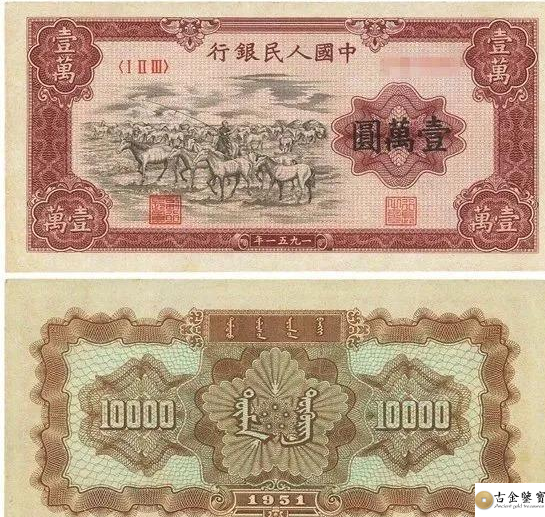
The"Four Treasures"of the First Series Renminbi – Shepherd and Horses (10,000 yuan), Zhande City (500 yuan), Mongolian Yurt (5,000 yuan), and Camel Caravan (10,000 yuan) – are the pinnacle of Chinese banknote collecting. The common characteristics of these four treasures are their extremely limited circulation area (only in border regions such as Xinjiang and Inner Mongolia), extremely short circulation period, and extremely high buyback Xiao Hui Lv (Buyback and destruction rate), resulting in a surviving quantity so small it's counted in"pieces". Below is a detailed breakdown of the identification points for each note.
Quick Glance at the Four Heavenly Kings
| Rank | Banknote | 2026 Perfect Condition Buyback Price (HKD) | Rarity |
|---|---|---|---|
| 1 | 10,000 Yuan Shepherd and Horses | $1,200,000 - 4,500,000+ | King of Banknotes |
| 2 | 10,000 Yuan Camel Caravan | $300,000 - 900,000+ | Top-tier |
| 3 | 500 Yuan Zhande City | $280,000 - 850,000+ | Top-tier |
| 4 | 5,000 Yuan Mongolian Yurt | $250,000 - 750,000+ | Top-tier |
I. 10,000 Yuan Shepherd and Horses (King of Banknotes)
Basic Information
- Issuance Year: May 17, 1951
- Discontinued Year: 1955 (Circulated for only 4 years)
- Specifications: 140mm × 75mm
- Main Color: Yellowish-brown
- Estimated Mintage: Approximately 1 million notes
- Current Surviving Quantity: Estimated only 100-300 notes (fewer than 30 in perfect condition)
Design Details
Front: A scene of herdsmen grazing horses in Xinjiang – a herdsman on horseback, followed by a herd of horses. The background features the Xinjiang grasslands and distant mountains.
Back: Minority languages (Uyghur, Mongolian, Tibetan) for"ONE WAN YUAN"+ numerical denomination.
Identification Features
- Main Design on Note: The number of horses in the herd is 8 (counterfeits often have 7 or 9).
- Watermark: Full-page peony flower hidden watermark (counterfeits often have printed watermarks, which are flat in texture).
- Paper: Original notes have paper with slight fibers (visible with a 10x magnifying glass).
- Color: Yellowish-brown with subtle gradient variations (counterfeits have uniform and dull colors).
- Hidden Markings: There are extremely subtle hidden markings in specific locations of the minority language text on the back (requires professional appraisal).
Why is the Shepherd and Horses the King of Banknotes?
Three reasons:
- At the time, the 10,000 yuan denomination was the largest (equivalent to 1 yuan of theSecond Series Renminbiin 1955), so fewer were printed to begin with.
- After it was withdrawn from circulation in 1955, the state enforced a 1:10,000 exchange, leading to a large number being withdrawn and destroyed.
- It circulated less in the remote Xinjiang region, and its design with minority languages attracts special collecting interest.
II. 10,000 Yuan Camel Caravan
Basic Information
- Issuance Year: October 1, 1951
- Discontinued Year: 1955
- Specifications: 140mm × 75mm
- Main Color: Blue-green
- Estimated Surviving Quantity: 500-1,500 notes
Design Details
Front: A camel caravan on the Silk Road in Xinjiang – multiple camels marching in a line through the Gobi Desert. The background features distant mountains and clouds.
Back: Minority language text for"ONE WAN YUAN".
Identification Features
- Number of Camels: 5 camels (counterfeits often have 4 or 6).
- Camel Posture: Each camel's leg posture is different, creating a sense of dynamic movement.
- Watermark: Full-page peony flower.
- Background: Clear details of the Gobi Desert (counterfeits are often flattened).
III. 500 Yuan Zhande City
Basic Information
- Issuance Year: October 1, 1951
- Discontinued Year: 1955
- Specifications: 130mm × 70mm
- Main Color: Purple + Blue
- Estimated Surviving Quantity: 800-2,000 notes
Design Details
Front: A scene of Zhande City in Xinjiang – a Xinjiang-style castle with camels in the foreground.
Back: Minority language text.
Identification Features
- Castle Details: Zhande City's towers number 3 (counterfeits may have 2 or 4).
- Foreground Camels: 1 camel and its owner, the camel has a complete saddle.
- Color Transition: The gradient from purple to blue is natural (counterfeits often have distinct color block boundaries).
- Watermark: Full-page peony flower.
Historical Background
Zhande City is an ancient castle in Tacheng region, Xinjiang, built during the Qing Dynasty. It is one of the very few designs in New China's banknotes to feature architecture of border minority groups. The intention at the time was to emphasize the multi-ethnic unity of New China.
IV. 5,000 Yuan Mongolian Yurt
Basic Information
- Issuance Year: May 17, 1951
- Discontinued Year: 1955
- Specifications: 135mm × 72mm
- Main Color: Blue
- Estimated Surviving Quantity: 1,000-2,500 notes
Design Details
Front: A scene of Mongolian yurts – multiple yurts scattered across the grasslands. The foreground features herdsmen and sheep.
Back: Minority language text for"FIVE THOUSAND YUAN".
Identification Features
- Number of Yurts: 3 (counterfeits often have 2 or 4).
- Sheep Flock: Sheep scattered across the grasslands, each with a different posture.
- Herdsmen: 2 herdsmen in the foreground and their activities.
- Watermark: Full-page peony flower.
V. Common Identification Points for the Four Heavenly Kings
Point 1: Watermark
All original notes of the Four Heavenly Kings have afull-page peony flower watermark(a small batch has special watermarks). Identification method:
- When held against light, the watermark should be three-dimensional and visible.
- Use a 10x magnifying glass to examine the paper structure; genuine watermarks are formed by differences in fiber distribution within the paper.
- Counterfeits often have printed watermarks, which are flat and lack the fibrous feel of the paper.
Point 2: Paper
Genuine notes use handmade paper from the 1950s:
- Moderate thickness (approximately 0.08-0.10mm).
- Surface has a slight fibrous texture.
- Appears translucent when held against light.
- Has a unique old paper smell (70+ years of natural oxidation).
Point 3: Printing Process
Genuine notes use intaglio printing from the 1950s:
- Lines are deep and have a three-dimensional feel.
- Lightly touching the surface with a fingernail reveals a subtle raised texture.
- Under a magnifying glass, dot-line structures are visible (counterfeits are often flat printed).
Point 4: Hidden Markings
Each note has specific hidden markings (e.g., specific locations in the minority language text on the back, tiny dots on the edge of the design). These markings are only known to professional appraisers and PMG/PCGS grading agencies, serving as the ultimate anti-counterfeiting measure.
VI. Why are the Four Heavenly Kings so Rare?
Reason 1: Short Issuance Period
All four notes were issued in 1951 and withdrawn from circulation in 1955, circulating for only 4 years in total.
Reason 2: Mandatory Exchange and Destruction
When the Second Series Renminbi was issued in 1955, a mandatory recall was enforced at an exchange rate of 1:10,000. Large quantities were destroyed by the central bank.
Reason 3: Regional Issuance Restrictions
The themes of the Four Heavenly Kings are all related to border regions such as Xinjiang and Inner Mongolia. At the time, they primarily circulated in these areas, with less circulation in inland China. The storage conditions for banknotes in these regions were poor (dry climate, simple storage), leading to even fewer surviving notes.
Reason 4: High Denomination
All four were high denominations at the time (500 yuan, 5,000 yuan, 10,000 yuan). For ordinary families, these were astronomical sums and would not be kept as circulating currency. Most were used for large commercial transactions, leading to frequent use and severe wear and tear.
VII. What to Do if You Suspect You Have the Four Heavenly Kings at Home?
- Compare with the identification features in this article to initially determine if it's one of the Four Heavenly Kings.
- Absolutely do NOT clean it, flatten it, or touch the note's surface directly.
- Carefully place it in an acid-free banknote sleeve using cotton gloves.
- Take clear multi-angle photos of the front, back, edges, and watermark (held against light).
- WhatsApp 98342057 to send photos to Gu Jin Jian Bao for a free preliminary appraisal.
- If it's possibly genuine, itMUST be submitted for PMG grading(grading fee HK$500-1,000, but crucial for future liquidity and value appreciation).
- After grading, consider: keeping it as a family heirloom / selling it through an auction house / selling it to Gu Jin Jian Bao for a high buyback price.
Conclusion
The Four Heavenly Kings of the First Series Renminbi are the ultimate treasures in Chinese banknote collecting. They not only carry currency memories from 70 years ago but also represent the political narrative of New China's border unification and multi-ethnic solidarity. If you find banknotes suspected of being the Four Heavenly Kings at home, it is recommended to contact Gu Jin Jian Bao immediately – incorrect handling (such as cleaning or flattening) could lead to a loss of over 70% of the value of a multi-million Hong Kong dollar collectible. Professionalism is the only way to protect these treasures.
Want to know the value of your First Series Renminbi?
Gu Jin Jian Bao offers free appraisal, estimated valuation within 30 minutes, same-day doorstep purchase, and instant cash payment. WhatsApp a photo to us, and we'll provide an immediate valuation – no need to visit our store in person.
