
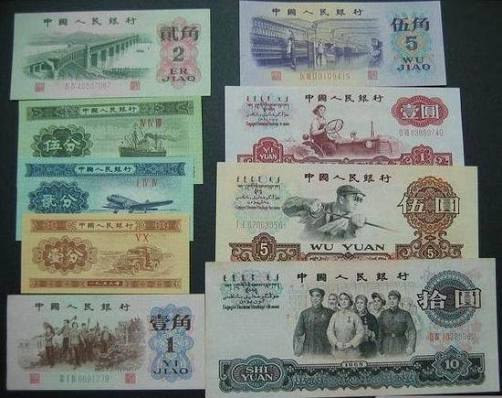
Among the many areas of numismatics, the Third Series Renminbi is one of the most recognisable and widely collected. It traces almost four decades of China's early economic development, from 1962 to 2000. That makes it both a compact historical record and, in today's old-banknote market, one of the more actively traded areas with room for appreciation.
Hello, I am a senior banknote buyer and appraiser at Gu Jin Jian Bao. When Hong Kong collectors clear an old family home or sort through stored belongings, they often uncover bundles of old green and red renminbi notes. What are those notes worth now? How does a full set differ from a small set? And why do collectors pay attention to a closing serial number? Here is a buyer's practical guide to the main rules and lesser-known points in collecting Third Series Renminbi.
1. The Third Series Renminbi in the Market: Why Is It a Collecting Sweet Spot?
The Third Series Renminbi entered circulation in 1962 and was not fully withdrawn until 2000, making it the longest-circulating currency series of the People's Republic of China. The First Series is exceptionally scarce, with an entry threshold above HK$1 million, while individual notes from the Second Series, such as the Big Black Ten, can be worth hundreds of thousands of Hong Kong dollars. The Third Series covers a much broader price range, from a few hundred dollars to tens of thousands, so collectors can enter and progress at different budget levels.
In today's old-banknote buying market, experienced collectors regard the Third Series as essential. Its appeal comes from accomplished designs such as the well-known Two-Yuan Lathe Worker, varied printing methods including planographic and relief printing, different watermark varieties, and the detail hidden in prefix and serial-number combinations.

2. Building a Complete Collection: Full Set vs. Small Set
Completeness is a major value driver in banknote collecting. A single note is valued on its own merits, but a coherent set can be worth more than the sum of its individual parts.
1. Small Set (One Common Variety for Each Denomination)
A small set usually includes every denomination issued within the Third Series: 1-, 2- and 5-fen coins or paper notes, followed by the 1-jiao, 2-jiao, 5-jiao, 1-yuan, 2-yuan, 5-yuan and 10-yuan notes. It normally uses only the most common variety of each denomination.
- Advantage: The entry threshold is low and the price is approachable, making it a practical starting point for newcomers to the old-banknote market.
- How the market assesses it: Condition comes first. A matched set of notes graded PMG 65 or above can be worth considerably more than ordinary loose notes.
2. Full Set (Every Variety and Watermark)
A full set is much more demanding: it must contain every denomination and each of its recognised varieties. The 1-jiao note alone includes the Date-Red 1 Jiao, Green-Back 1 Jiao, Purple-Back 1 Jiao and different watermark varieties, including the Green-Back Butterfly Watermark.
- Advantage: A full set has strong pricing power and is sought after at high-end auctions and in the higher-value banknote market.
- How the market assesses it: The value of a full set rests chiefly on the condition of its key 'king' notes.
Table: Reference Buyback Values for Key Third Series Renminbi Notes
| Note | Collector Name / Feature | What to Check | Market Scarcity | Estimated Buyback Reference (HKD) |
|---|---|---|---|---|
| 1960 1 Jiao | Date-Red 1 Jiao | Red ground pattern; red throughout | Extremely high | HK$5,000 - $12,000+ |
| 1962 1 Jiao | Green-Back 1 Jiao (no watermark) | Green pattern on the reverse | Extremely high | HK$3,000 - $6,000+ |
| 1962 1 Jiao | Green-Back Butterfly Watermark | Watermarked variety; the 'king' of the Third Series | Top tier | HK$30,000 - $50,000+ |
| 1960 2 Yuan | Two-Yuan Lathe Worker | Five-star or ancient-coin watermark | Extremely high | HK$2,500 - $4,500+ |
| 1965 10 Yuan | Great Unity | Three-Roman or two-Roman prefix | Medium | HK$250 - $450 |
(Note: The figures above use an exchange rate of approximately RMB1 = HKD1.1. The actual buyback price depends on the condition of the note in hand.)

3. Advanced Collecting: Serial Numbers and the Premium for Closing Numbers
Once variety is accounted for, serial-number collecting is one of the market's strongest sources of specialist premiums.
1. Full Set with the Same Serial Number
In such a set, the serial-number portion is identical across every denomination. It is exceptionally difficult to assemble because different denominations were printed at different times by different printing works.
- Where the value shows: If an ordinary Third Series set has the same final four digits, or completely matching serial numbers, its buyback price is commonly 2-5 times that of a mixed group.
2. Special Numbers
- Leopard and lion numbers: The final three or four digits of the serial number are identical. The longer the repeated run, the higher the buyback value tends to be.
- Qilin number: All eight digits are identical, as in 88888888. The chance is only one in ten million, placing it among the top varieties in the specialist banknote market in Hong Kong and Macau.
3. Opening and Closing Numbers
- Opening number: The first note under a prefix, such as 00000001.
- Closing number: The last serial number printed before that prefix or variety ceased production.
-
How the market treats them: These numbers have a strong sense of occasion and cannot be replaced by another note. In Gu Jin Jian Bao purchase cases, a Great Unity 10 Yuan or Two-Yuan Lathe Worker with a closing-number feature will often draw bids from advanced collectors.

4. Condition Is Everything: Technical Points in Authentication and Grading
In old-banknote collecting, 'condition is everything' is more than a slogan. Even a small defect can produce a sharp, non-linear change in price.
How PMG Banknote Grades Affect Value
| PMG Grade | Condition | Assessment Points | Effect on Buyback Value |
|---|---|---|---|
| 70 EPQ | Flawless | No marks under 5x magnification; perfectly centred | Top auction grade; highest price |
| 65-66 EPQ | Uncirculated condition | May show an extremely faint handling mark; retains original EPQ quality | Mainstream market grade; steady appreciation |
| 58 | About uncirculated | Usually has one light fold | Worth roughly half the value of a fully uncirculated example |
| 20-45 | Circulated | Obvious folds, soiling and softened paper | Only scarce varieties, such as the Green-Back, retain buyback value |
Important: Never try to 'repair' or 'clean' a banknote yourself. Chemical solutions and physical pressing both damage the paper fibres, can prevent an EPQ designation and may cut the value by more than 50%.

5. A Specialist's Storage Guide: Protecting a Hidden Asset
If condition determines value, storage matters. We use four basic lines of defence:
- Prevent mould (control temperature and humidity): Hong Kong's climate is humid. Keep relative humidity strictly between 50% and 60%, using a purpose-built dry cabinet where necessary.
- Prevent folds (physical protection): Store each note in a high-quality polyester (PET/Mylar) holder. Do not touch the note directly; oil from fingers can encourage mould.
- Prevent fading (keep away from light): Never expose notes to direct sunlight or strong spotlights, which can quickly dull the inks.
-
Prevent insect damage (manage the environment): Do not store notes with old newspapers or miscellaneous clutter. Inspect and air them once a year.

6. Why Sell Through Gu Jin Jian Bao?
Finding a reliable, knowledgeable buyer is the last step in realising the best value from a collection. Gu Jin Jian Bao has worked in the Hong Kong and Macau collecting market for many years, and we understand both the history carried by an old note and the attachment its owner may have to it.
What We Offer:
- One-stop appraisal: Coverage extends from the First through Fourth Series Renminbi to Qing banknotes, old Hong Kong notes and gold and silver coins.
- Open, transparent quotations: We refer to international grading standards and current auction results when setting a competitive purchase price for the Hong Kong market.
- Flexible handover: Free home collection is available across Hong Kong and Macau, with settlement by cash or FPS for a secure, confidential transaction.
- Quick enquiries: Send clear photographs of the collection through WhatsApp for a free preliminary valuation.
Conclusion: A Lasting Story on a Small Piece of Paper
The Third Series Renminbi is more than a bundle of paper. It carries the shared memory of an earnest, hard-working era and is now regarded as a worthwhile physical asset for hedging risk. Whether you hope to complete a set of your own or turn old notes from the back of a drawer into cash, three points will guide you through the market: variety, serial number and condition.
💰 Send a Photo Now and Discover What Your Notes May Be Worth
Do you have a long-stored Two-Yuan Lathe Worker or Great Unity note, but no clear idea of today's market? Contact us and a banknote appraiser will answer your questions online.
🏢 Business: Gu Jin Jian Bao 📲 WhatsApp: (852) 9834 2057 📍 Service area: Hong Kong and Macau (free appointment for home collection / appraisal at our office)
Use the link above or scan the code to add us on WhatsApp. Free valuations are available 24 hours a day to help you realise more of your collection's value.
