
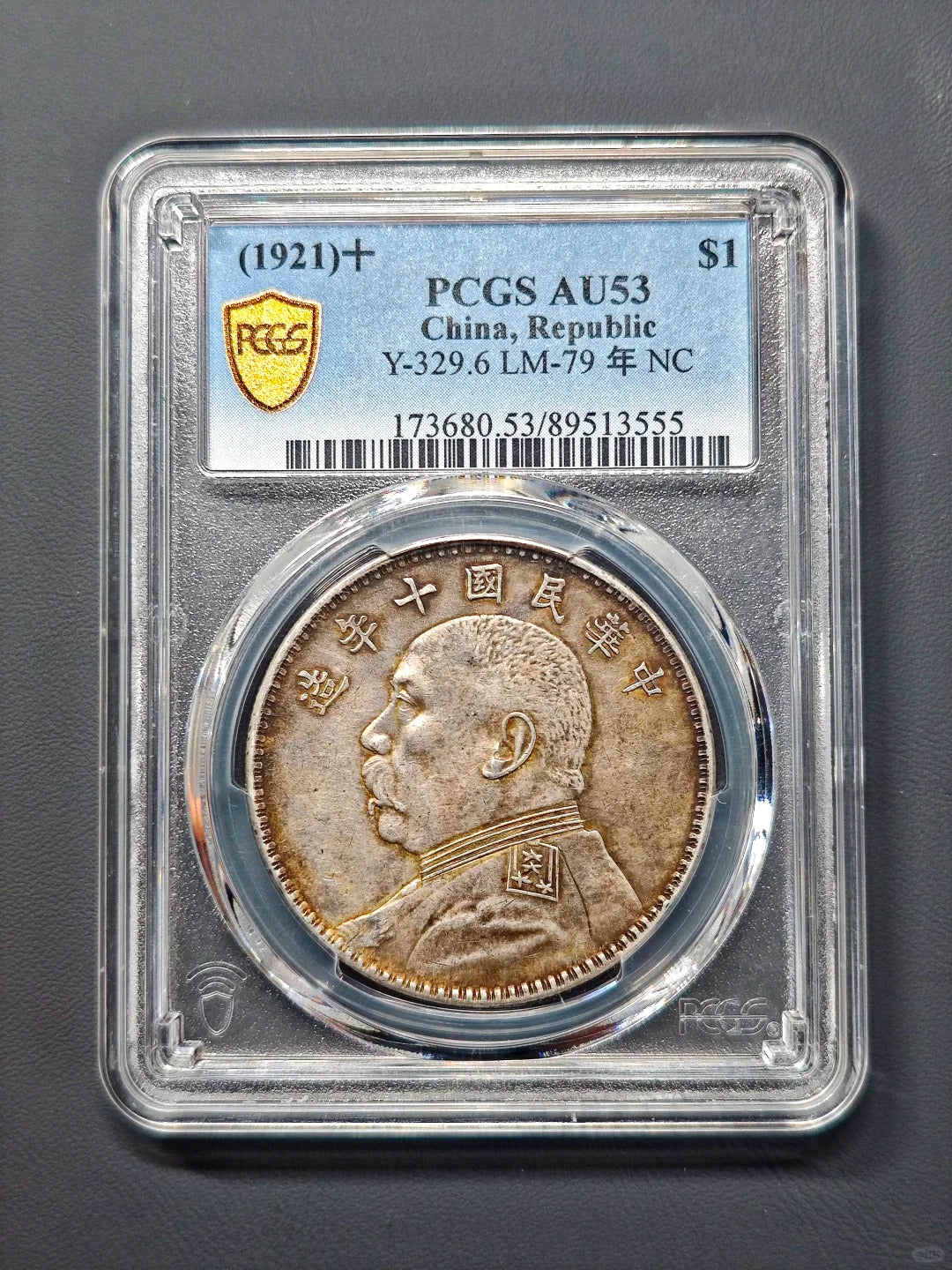
An ordinary"Yuan Datou"costs HK$2,500, while a signed version costs HK$2 million—a difference of 800 times. Many attribute this to"old age,"but age is actually only one factor. Behind the high-price of pattern coins is a complex market mechanism involving minting, history, collector demographics, and grading systems. Let's break it down from an economic perspective.
I. Pattern Coins vs. Circulating Coins: Essential Differences
Pattern coins are silver coins minted in small quantities by the mint before formal mass production, for the purpose of testing dies, alloy formulas, and design styles. They are essentially"unreleased product prototypes"and have never entered circulation. Pattern coins share several common characteristics:
- Extremely low mintage—usually only a few to a few hundred pieces, compared to tens of millions for officially issued versions.
- Design or craftsmanship differences—may have special markings (e.g., engraver's signature), experimental alloys, or different dragon pattern details.
- Never publicly circulated—mostly kept by mint officials, engravers, or high-ranking government officials.
- Lack of historical signs of use—hence the unusually high proportion of high-grade pieces (MS63+).
Thesigned version of the Yuan Datouis a typical pattern coin: designed and personally signed by Italian engraver Luigi Giorgi in 1914 at the Tianjin Mint for die testing purposes. It is estimated that no more than 50 pieces were minted before the design was changed to remove the L. GIORGI signature for mass production.
II. Four Dimensions of Scarcity
Dimension 1: Absolute Mintage (Supply Side)
The surviving quantity of pattern coins determines the market"ceiling."Taking a few classic Yuan Datou pattern coins as examples:
| Pattern Coin Type | Estimated Mintage | Current Surviving Quantity | Typical Transaction Price (HKD) |
|---|---|---|---|
| L. Giorgi Obverse Signed Version | 30-50 pieces | 15-25 pieces | $1,500,000 - 4,000,000 |
| L. Giorgi Reverse Signed Version | 10-20 pieces | 5-10 pieces | $2,500,000 - 6,000,000 |
| Seven-Point Face Signed Version | 20-30 pieces | 10-15 pieces | $2,000,000 - 5,000,000 |
| Republic of China Year 3 Triangular Yuan | 3,000-5,000 pieces | 300-600 pieces | $60,000 - 150,000 |
| Republic of China Year 3 O Version | 5,000-8,000 pieces | 800-1,500 pieces | $35,000 - 80,000 |
| Ordinary Circulating Version | 170 million pieces | Tens of millions of pieces | $1,800 - 4,500 |
From the table, it can be seen that for every order of magnitude (10 times) decrease in surviving quantity, the price can increase by 5-15 times. This is a typical exponential scarcity premium.
Dimension 2: Historical Status (Demand Side - Cultural Value)
Simply being rare does not equate to being valuable. For example, some pattern coins from small African countries might have only a few surviving pieces, but if no one wants them, they have no market value. The signed version of the Yuan Datou can fetch high-prices because it simultaneously carries:
- Political significance—the minting of silver coins before Yuan Shikai's attempt to become emperor, representing the first attempt by the Republic of China to unify the national currency and a critical juncture in the"abolition of tael and adoption of yuan."
- Artistic value—the design quality of Italian engraver Luigi Giorgi is internationally first-class, and Yuan Shikai's portrait is widely considered one of the most exquisite engravings on Republic of China silver coins.
- Historical precedent—it was among the first batch of Chinese silver coins designed through international cooperation, reflecting the early attempts at currency modernization in the Republic of China.
Dimension 3: Collector Demographics and Liquidity
Market price = scarcity × demand population. The collector base for Yuan Datou includes:
- Mainland Chinese collectors—1.4 billion people, with Republic of China silver coins being a mainstream entry-level collection category, an estimated 5 million+ active collectors.
- Hong Kong, Macau, and Taiwan collectors—3 million+ collectors.
- Overseas Chinese—Southeast Asia, North America, European Chinese communities, an estimated 1 million+.
- International numismatists—professional numismatists in Europe and America, although fewer in number (hundreds of thousands), have strong purchasing power.
Compared to some European silver coins that are even rarer (e.g., 17th-century Austrian pattern coins), while their absolute scarcity is higher, their collector base is only tens of thousands, so their market price is lower than the signed version of the Yuan Datou.
Dimension 4: Grading System and Liquidity Premium
The establishment of international grading agencies like PCGS and NGC fundamentally changed the liquidity of rare items. Before the 1990s, buying and selling rare silver coins required buyers to personally authenticate them, leading to extremely high transaction costs and high risks of fraud. After the introduction of the grading system:
- Authenticity guarantees are borne by the grading agency, significantly increasing buyer trust.
- Condition grading is standardized (1-70 points), providing a common language for buyers and sellers.
- Coins in graded holders can be traded directly at international auction houses without on-site verification.
This system makes the liquidity of the signed Yuan Datou approach that of the stock market—there are international buyers ready to bid at any time. The liquidity premium drives up market prices.
III. The Exponential Curve of Scarcity Premium
Actual data shows that the relationship between silver coin prices and surviving quantity is approximately:
Price ∝ 1 / Surviving Quantity^0.7
This is a power law distribution. It means that for every 10-fold decrease in surviving quantity, the price increases by about 5 times; for every 100-fold decrease, the price increases by about 25 times. The 800-fold price difference between the signed Yuan Datou and the ordinary version precisely corresponds to a 1 million-fold difference in surviving quantity.
IV. Practical Implications for Collectors
Implication 1: Low-Entry Versions Still Have Potential
Ordinary Yuan Datou circulating coins are too numerous and lack scarcity, with limited appreciation potential. However, variant versions (O version, Triangular Yuan, T-dot year, etc.) have a surviving quantity of 100-1500 pieces, and their market price already shows a significant scarcity premium, indicating greater potential for future appreciation.
Implication 2: Grading is an Iron Rule for Pattern Coin Investment
For pattern coins, grading is essential. Even if an ungraded pattern coin is genuine, its market price is only 30-50% of a graded coin. If you suspect you have a pattern coin, it is recommended to submit it for grading as soon as possible.
Implication 3: Liquidity > Absolute Scarcity
Choosing versions with high market attention (Yuan Datou,Sun Xiaotou,Xuantong Three YearsQing Dynasty Silver Coin, etc.), even if their surviving quantity is not extremely rare, can maintain stable prices. In contrast, some obscure provincial pattern silver coins, even if only 1-2 pieces survive, have a narrow market reach and are therefore harder to liquidate.
V. How to Handle Suspected Pattern Coins at Home?
Identifying pattern coins requires highly specialized training, and most collectors make mistakes when judging on their own. Recommendations:
- Absolutely do not clean them (the original luster and oxidation on the surface of pattern coins are core factors for grading bonuses).
- Take clear, high-resolution photos and send them via WhatsApp to 98342057 to Gujin Jianbao for preliminary authentication.
- If there is a possibility of a genuine piece, arrange for free on-site appraisal + assistance with sending to PCGS / NGC for grading.
Conclusion
The fundamental reason why the signed Yuan Datou breaks the million-dollar mark is not the single reason of"a hundred-year-old antique,"but the exponential premium generated by the Die Jia of four dimensions: scarcity, historical status, collector demographics, and the grading system. Understanding this logic is crucial to identifying silver coins with true appreciation potential and avoiding being misled by the superficial"old"label, buying ordinary circulating coins without a scarcity premium.
Gujin Jianbao—Professional Buyback of Yuan Datou Signed Version
Free appraisal ‧ Transparent quotation ‧ Instant cash ‧ On-site purchase in Hong Kong, Kowloon, and the New Territories. If you have similar old items, don't rush to sell them cheaply. You can first WhatsApp us for an estimate to understand the true market value.
