
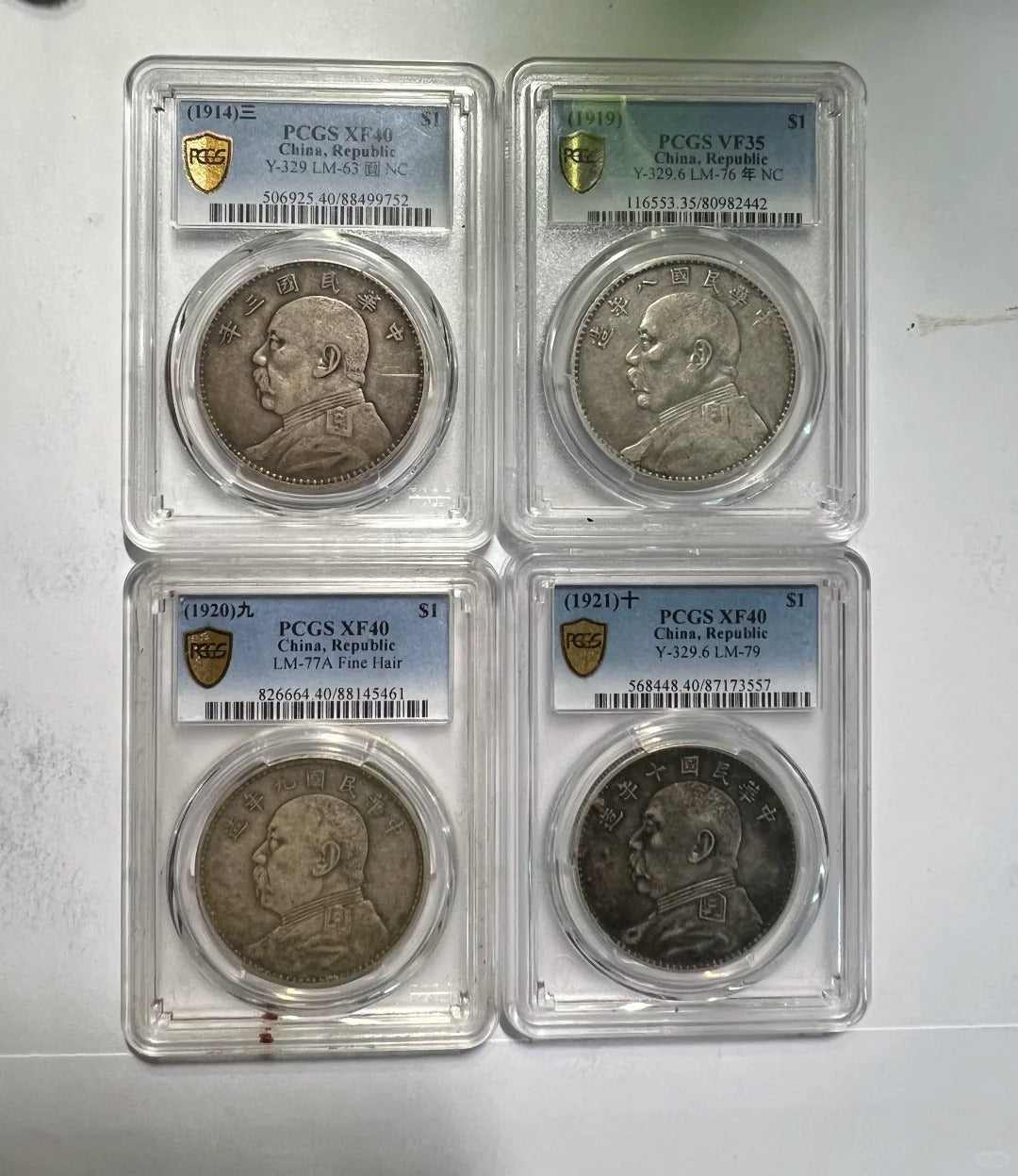
Yuan Datou's"O-version"(with a hidden'O'mark at the ribbon knot of the ears of grain on the reverse) and"Triangular Yuan"(where the"yuan"character's"Yuan"radical head is triangular) are two of the most frequently counterfeited rare variants. This is because their appearance differs very little from regular versions, yet their market price is several times higher. The following 3 key characteristics will help you quickly determine authenticity when examining a physical coin.
I. What are the O-version and Triangular Yuan? A Concise Definition
Both are hidden-mark variants of the Republic of China Year Three Yuan Datou, minted in much smaller quantities than the regular version:
- O-version– On the reverse, below the ears of grain, there is a small'O'mark. Legend has it this was an internal mark for a certain batch from the Tianjin Mint. Approximately 5,000-8,000 pieces were minted.
- Triangular Yuan– On the reverse, the inner"Kou"(mouth radical) of the"Yuan"(yuan) character in"Yi Yuan"(one yuan) is triangular (rather than square). Also known as"Triangular Mouth Yuan,"approximately 3,000-5,000 pieces were minted.
II. 3 Key Authentication Features (Ranked by Importance)
Feature 1: Reeded Edge Direction (Most Crucial)
The reeded edge of genuine Yuan Datou coins is created by mechanical stamping, with each reeding's angle precisely perpendicular to the coin surface (90°), sharp tips, and consistent depth. This detail is the most difficult for high-quality fakes to replicate:
- Sand-cast fakes– Reeded edge angles are tilted (85-88°), tips are blunt, and there are sand residues at the base of the reeds.
- Machine-made high-quality fakes– Angles are standard, but the density of the reeds may show slight variations (genuine coins have 175 reeds, some high-quality fakes have 170-178 reeds), requiring careful counting with a magnifying glass.
Practical tip: Use a 10x magnifying glass to examine the cross-section of the reeded edge. Genuine coins have flat and smooth cross-sections with cold-pressing marks; sand-cast fakes have rough cross-sections with metal flow marks.
Feature 2: Character Structure (Second Most Important)
Key character details for the O-version and Triangular Yuan:
- O-version"O"mark– The inner and outer circles of the genuine'O'are concentric, lines are uniform in thickness, and depth is approximately 0.3mm. Common problems with fakes: The outer circle of the'O'is not perfectly round (oval), lines vary in thickness, depth is too shallow (below 0.1mm) or too deep (above 0.5mm).
- Triangular Yuan"Yuan"character– The three sides of the genuine triangle should be equal in length (equilateral triangle), and all three angles should be 60°. Common problems with fakes: The triangle is deformed (isosceles instead of equilateral), one side is noticeably shorter, or the triangle's position deviates from the center of the"Kou"radical.
Feature 3: Yuan Shikai's Portrait Details (Auxiliary)
This is a comprehensive identification feature, not exclusive to the O-version or Triangular Yuan:
- Hair layers– Genuine Yuan Shikai's hair clearly shows 3-4 layers, with each strand having an individual shadow. Hair on fakes is often flat and lacks layering.
- Ear contours– The inner concave part of genuine earlobes has natural depth; earlobes on fakes are often flat and shallowly engraved.
- Jawline– The transition from the jaw to the neck on genuine coins has a natural curve; fakes often have abrupt transitions.
- The added'O'mark will have knife marks along its edges and lack the smooth transition of natural minting.
- The original patina on the coin's surface will be damaged at the engraved spot, revealing fresh silver.
- A 30x magnifying glass can reveal the start and end points of the engraving marks.
- Overall characters are blurry, lacking sharpness.
- Slightly lighter in weight (genuine coins 26.6-26.8g, sand-cast fakes mostly 25.5-26.2g).
- Abnormal density test results (genuine silver content 89%, fakes often contain lead, copper).
- Patina is chemically aged rather than naturally oxidized – rubbing with a cotton swab dipped in distilled water will cause the fake coin's surface to lose color.
- The coin surface shows modern processing marks – for example, overly neat edges, lacking the natural wear from centuries of use.
- No historical wear marks (abnormally regular distribution of circulation wear points).
- Minute 1– Weighing (requires a digital scale accurate to 0.1g). Genuine coins are 26.6-26.8g; a deviation of more than 0.5g strongly suggests a fake.
- Minute 2– Measure diameter (using calipers or comparing with another coin). Genuine coins are 39.0mm; a deviation of more than 0.3mm indicates a problem.
- Minute 3– Listen to the sound (use a wooden or plastic surface, not metal). Genuine coins produce a long humming sound when gently tapped; fakes produce a short, harsh sound.
- Minute 4– Examine the reeded edge cross-section and O-mark/Triangular Yuan details with a 10x magnifying glass.
- Minute 5– Compare with known genuine coin photos (PCGS Coin Facts website has an official image library).
- Grading slabs provide authenticity guarantees + condition grading, leading to higher resale value in the future.
- Grading fees are low relative to the value of the collectible (HK$300-800 per coin).
- Graded coins are easier to sell, as buyers have greater trust.
III. 3 Common Counterfeiting Methods for O-versions/Triangular Yuans in the Market
Method 1: Reworked Ordinary Yuan Datou
Counterfeiters use genuine ordinary Yuan Datou coins and use a micro-engraving tool to add an'O'mark or modify the inner part of the"yuan"character on the reverse. Identification methods:
Method 2: Sand Casting Post-Minting
This involves creating a mold from a genuine coin, sand-casting it, and then artificially aging it. Identification methods:
Method 3: Machine-made High-quality Fakes
This is the most difficult to identify, as counterfeiters use minting machines and alloy formulas from the same era. Identification methods:
IV. 5-Minute Home Self-Verification Process
If all 5 steps are passed, there is still approximately a 5% chance it could be a machine-made high-quality fake. Final confirmation requires a PCGS or NGC grading slab.
V. Final Verification for Genuine Coins: PCGS / NGC Grading
For variants like the O-version and Triangular Yuan, which have excessively high market prices,international grading is strongly recommended. Reasons:
Gujin Jianbao provides PCGS / NGC Hong Kong submission agent services, including free pick-up, tracking of grading progress, and transparent grading fees. WhatsApp 98342057 for inquiries.
Conclusion
The high market price of O-version and Triangular Yuan coins is precisely because genuine pieces are rare and fakes are rampant. For buyers or sellers unable to distinguish, the greatest loss is not market fluctuations, but selling a genuine HK$800,000 coin for HK$5,000, or buying a fake HK$3,000 coin for HK$800,000. Mastering the 3 key features above + the double assurance of PCGS grading is fundamental to safe transactions.
Want to know how much your Yuan Datou is worth?
Gujin Jianbao offers free appraisal, valuation within 30 minutes, same-day home collection, and instant cash payment. WhatsApp us a photo for an immediate appraisal, no need to visit our shop in person.
