Within the broad field of modern Chinese numismatics, the familiar Yuan Shikai dollar and Guangxu Yuanbao form much of the market. Yet the pieces that best reflect China’s early monetary transition and the height of its minting craft are often far rarer early silver coins with less familiar histories.
I am an appraiser at Gu Jin Jian Bao. Over years of buying old coins in Hong Kong and Macau, we have often met collectors who uncover an unusual, palm-sized silver treasure while sorting through family belongings. This article takes a closer look at three early silver rarities that may be unfamiliar outside advanced collecting circles: Zhongwai Tongbao, Zhangzhou Military Pay and the Taiwan God of Longevity Silver Cake.
(Note: Some of the historical background in this article does not come directly from the accompanying materials. Readers should verify it independently before any high-value transaction. Renminbi figures mentioned in the source have been converted into Hong Kong dollars using the source’s estimated exchange rate of RMB 1 ≈ HKD 1.1.)
1. Zhongwai Tongbao: a pioneering Sino-foreign trade pattern coin
Zhongwai Tongbao is one of the more storied silver coins in Chinese monetary history. It was not an ordinary circulation coin. During the Tongzhi reign of the Qing dynasty, it was reportedly planned as a pattern to be struck by the Hong Kong Mint in response to the needs of foreign trade.
1. Design and distinctiveness: The coin combines traditional Chinese imagery with Western minting techniques. The four characters “Zhongwai Tongbao” appear at the centre of the obverse, while the reverse carries either a distinctive paired-dragon-and-pearl design or a “Guanping One Tael” inscription. Such a design was unusually ambitious for the monetary system of its time and was intended to provide a common settlement standard for domestic and foreign trade.
2. Collecting interest: Following a change in Qing fiscal policy, the planned issue did not enter large-scale circulation. Surviving Zhongwai Tongbao pieces are generally described as patterns. At specialist auctions, a particularly well-preserved example may carry an estimate in the millions of Hong Kong dollars. For collectors seeking advanced varieties in the Hong Kong old-coin market, it sits at the very top end of the field.

2. Zhangzhou Military Pay: evidence from the Opium War era
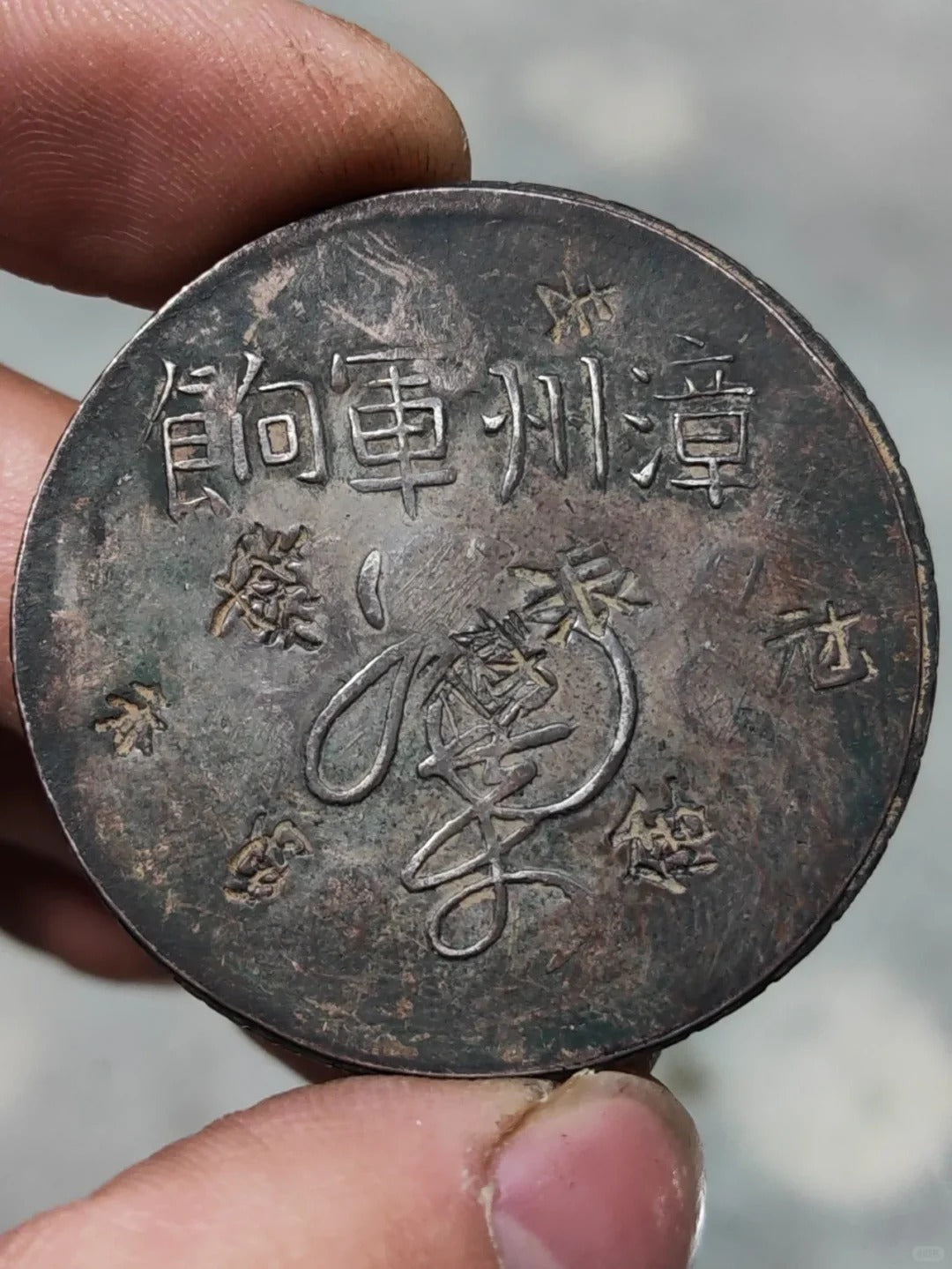
If you have a roughly made silver cake with a hand-finished appearance and a “Zhangzhou Military Pay” stamp, you may be holding an object tied to a weighty period of history.
1. Historical setting: This type is said to date from the Daoguang reign of the Qing dynasty, around the 1830s to 1840s and the period surrounding the Opium War. To meet military expenditure, local authorities or money shops in the Zhangzhou area of Fujian reportedly made these silver cakes after the form of foreign silver dollars and issued them as military pay.
2. Identification features: The most recognisable feature of Zhangzhou Military Pay is its surface countermark. When formal credit systems were less developed, money shops placed their own stamps on silver coins in circulation to attest to fineness. A stamp may detract from the appearance of an ordinary collectible banknote, but on an early silver cake of this kind, an old countermark can form part of the evidence considered when assessing period and authenticity.

3. Taiwan God of Longevity Silver Cake: an early landmark in Taiwan’s monetary history
In Taiwan’s monetary history, the God of Longevity Silver Cake struck during the Daoguang reign is described as the foremost of the “Three Treasures of Taiwan.”
1. Form and symbolism: The obverse depicts an elderly God of Longevity holding a staff, an image associated with good fortune and long life. The direct use of traditional cultural imagery on money is highly unusual among early Chinese silver coins. Crossed swords on the reverse symbolise military authority.
2. Market context: The God of Longevity Silver Cake is presented as one of China’s early attempts at independently produced machine-struck coinage. Limited production and heavy losses during later upheaval mean that surviving examples can command substantial prices. A natural patina—the darker surface colour formed through oxidation over time—may add further appeal, and collectors sometimes call it a silver coin’s “second life.”

Reference table: early Chinese silver rarities and popular buyback categories
The following table brings together the source’s market references for several early rarities and better-known collectible issues:
| Name | Main variety or feature | Historical standing or rarity | Estimated Hong Kong buyback reference (HKD) | Points to examine |
|---|---|---|---|---|
| Zhongwai Tongbao | Guanping One Tael pattern | Extremely high (museum level) | 1,000,000–5,000,000+ | Detail in the dragon scales and the workmanship of the edge |
| Zhangzhou Military Pay | Signed variety / large-character variety | High | 50,000–250,000 | The natural appearance of the countermarks and the silver fineness |
| Taiwan God of Longevity Silver Cake | Daoguang-period issue / Fuzhou manufacture | High | 80,000–400,000 | Clarity of the figure’s head and the surrounding field |
| Yuan Shikai dollar (coin-king tier) | Year 3 of the Republic, signed variety | Extremely high | 220,000–550,000+ | Tool marks around the signature position |
| Dahei Shi, or “Big Black Ten” (banknote king) | 1953 Ten Yuan note | Extremely high | 110,000–440,000+ | EPQ paper quality |
| 1980 Monkey stamp | T.46 complete mint sheet | High | 1,437,500 (historical high) | The sculptural quality of the engraved monkey fur |

4. Gu Jin Jian Bao’s practical guide to examining an early silver coin
For a high-value old coin such as Zhongwai Tongbao, examination has to move beyond a general visual impression and into small physical details. Gu Jin Jian Bao summarises the source’s principal checks below:
1. Silver composition and colour
Silver has a soft, pale lustre, and higher fineness tends to appear whiter. Counterfeits made with iron, copper-lead alloys or compressed metal powder may look dull and dark. The source mentions heating as a traditional test, but owners should not attempt it: heat can permanently alter a coin’s surface. Composition should be checked non-destructively during an in-hand appraisal.
2. Listening to the ring: a limited preliminary clue
The source associates several sounds with different metals or constructions. These are rough clues only; do not strike or drop a coin, and do not treat sound as proof of authenticity.
- Clear and mellow: A genuine silver coin is described as ringing clearly without sounding shrill.
- Sharp and high: Often associated with a counterfeit made on an iron or steel blank.
- Hoarse: Often associated with a counterfeit made from a copper-tin alloy.
- Dull: Commonly associated with a copper-core counterfeit plated or wrapped in silver.
3. Patina: the mark of age
Patina is the natural oxidation layer on a silver coin. On an old coin it may show several tones, including pale black, grey and light orange, and the source treats this layered appearance as an important characteristic. In particular, do not clean a silver coin yourself. Rubbing, polishing or applying chemicals can seriously alter the surface and reduce its value.
4. Weight and specifications
The source gives approximately 26.697 g as a reference weight for certain silver dollars after 1933. Early silver cakes vary by issue, so 26.5–27 g is not a universal authenticity range; weight must be checked against the exact type together with diameter, edge, strike and composition.

5. Condition grading: a decisive factor in value
In the specialist coin-buyback market, condition can be decisive. Two examples of the same early silver coin may differ in price by several times when one is well preserved and the other is damaged.
- Definition of top condition: A state very close to how the item originally left production, without visible defects. The surface is flat, the colour remains vivid and there are no signs of later handling.
- Grading reference: PMG grades banknotes on a 1–70 scale, while ASG grades stamps on a 1–100 scale. On ASG’s stamp scale, 95 is described as XF/Superb. The correct grading system must be matched to the item; a numerical grade alone does not establish rarity or market value.
6. Specialist care: protecting old coins in storage
Because condition matters so much, the article sets out four areas of protection commonly considered in collecting:
- Prevent mould by controlling temperature and humidity: The stated ideal range is 15–25°C with relative humidity of 45%–60%. In Hong Kong’s humid climate, the article recommends an electronic dry cabinet.
- Prevent physical damage: Use a high-quality polyester (PET) coin holder and avoid touching the object directly. Oils and salts from fingers can damage a coin’s surface.
- Prevent pests and maintain ventilation: Inspect stored items periodically so that air does not remain stagnant in a small enclosed space.
- Prevent fading by limiting light: Avoid direct sunlight and intense display lighting.
7. Choosing a coin buyer: Gu Jin Jian Bao’s end-to-end process
If you find old silver dollars, Republican-era banknotes such as Dahei Shi or the “Su Sanbi” notes, or Cultural Revolution stamps such as “The Whole Country Is Red,” but do not know their value, the source recommends obtaining specialist assistance.
Gu Jin Jian Bao’s buyback process:
- Online enquiry: Send clear photographs of both sides of the item through WhatsApp.
- Preliminary quotation: After receiving the images, an appraiser will provide a free preliminary estimate as soon as possible.
- Appraisal appointment: If the preliminary quotation is acceptable, the source states that a free door-to-door buyback service across Hong Kong and Macau can be arranged.
- Settlement: After the object has been examined in person, a final buyback price is provided. If both parties agree, payment is made immediately by cash or FPS; the source describes the process as secure and confidential.
💰 Put an idle collection back to use. Whether you have a rare early pattern or an ordinary circulated silver dollar, Gu Jin Jian Bao states that it will approach the enquiry openly and in good faith.
🏢 Business: Gu Jin Jian Bao 📲 WhatsApp enquiry: +852 9834 2057 📍 Service area: door-to-door service across Hong Kong and Macau, with cash settlement; the source describes the process as safe and dependable.
Rather than leaving a historical object forgotten in a drawer, contact the team to document it and discuss the options available for the collection.
