
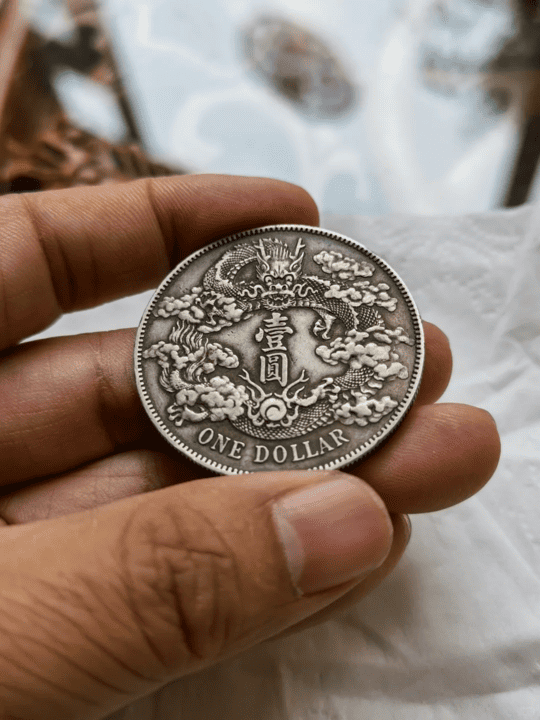
Read the inscriptions before reaching for specifications
Photograph the legend side and dragon side in full. Copy the mint or provincial wording, date and Kuping denomination exactly as visible, leaving worn or covered characters open.
Give the coin one reference number and place it on every face, edge, holder and measurement image. This is especially important when several similar dragon coins share a tray.
A grading label or old envelope can preserve a former attribution. Keep that wording separate until the enclosed legends and design support it.
Do not complete a weak passage from another Great Qing coin. A partial transcription with a located photograph is stronger evidence than a neat but borrowed title.
Follow the dragon out to the border
After the complete face, photograph the dragon head, whiskers, horns, claws, scales, cloud forms and tail with enough context to place each detail.
Include surrounding lettering, beaded border and denticles. Small differences matter only when their location on the subject coin remains clear.
Make the edge and dimensions repeatable
Cover the circumference with overlapping photographs from one marked starting point and direction. Note reeding, seams, knocks, filing, holes, solder or mounting evidence as found.
Place each dimensional reading beside the named instrument, original unit and contact position. When a second attempt conflicts, preserve both results and reproduce the first setup.
Keep condition distinct from attribution
Describe toning, high-point wear, strike softness, wiping hairlines and cleaning-related sheen separately. A dark dragon field should not be polished to reveal more contrast.
Locate every scratch, rim bruise, chop or repaired area on a full view before taking a close-up. The record should show where the observation belongs, not merely magnify it.
Use packaging and research without importing facts
Match old boxes, labels and collector numbers to the coin, but do not let them supply hidden mint wording. Photograph the relationship before separating any loose materials.
Issue history or production claims require an identified reference and consultation date. Comparison specimens may show where to inspect; their dimensions and surface features stay in their own files.
Reconcile the evidence before proposing a finer variety
Read the legend, denomination and dragon once more against the complete photographs. Mark any holder-obscured rim or faint character for a targeted direct examination.
Confirm that the edge run has no gaps and that all measurements belong to the same number. Retain first readings when later equipment produces a different result.
Separate confirmed observations, proposed identification and unresolved points. The next specialist should be able to repeat the comparison without inheriting an unexplained conclusion.
Keep the original patina, holder and paper materials intact at handover. Neither dipping nor scraping is needed to make the Great Qing silver coin easier to assess.
Retain the earliest photographs and measurement card when the attribution changes, adding a dated note that identifies the new evidence.
