
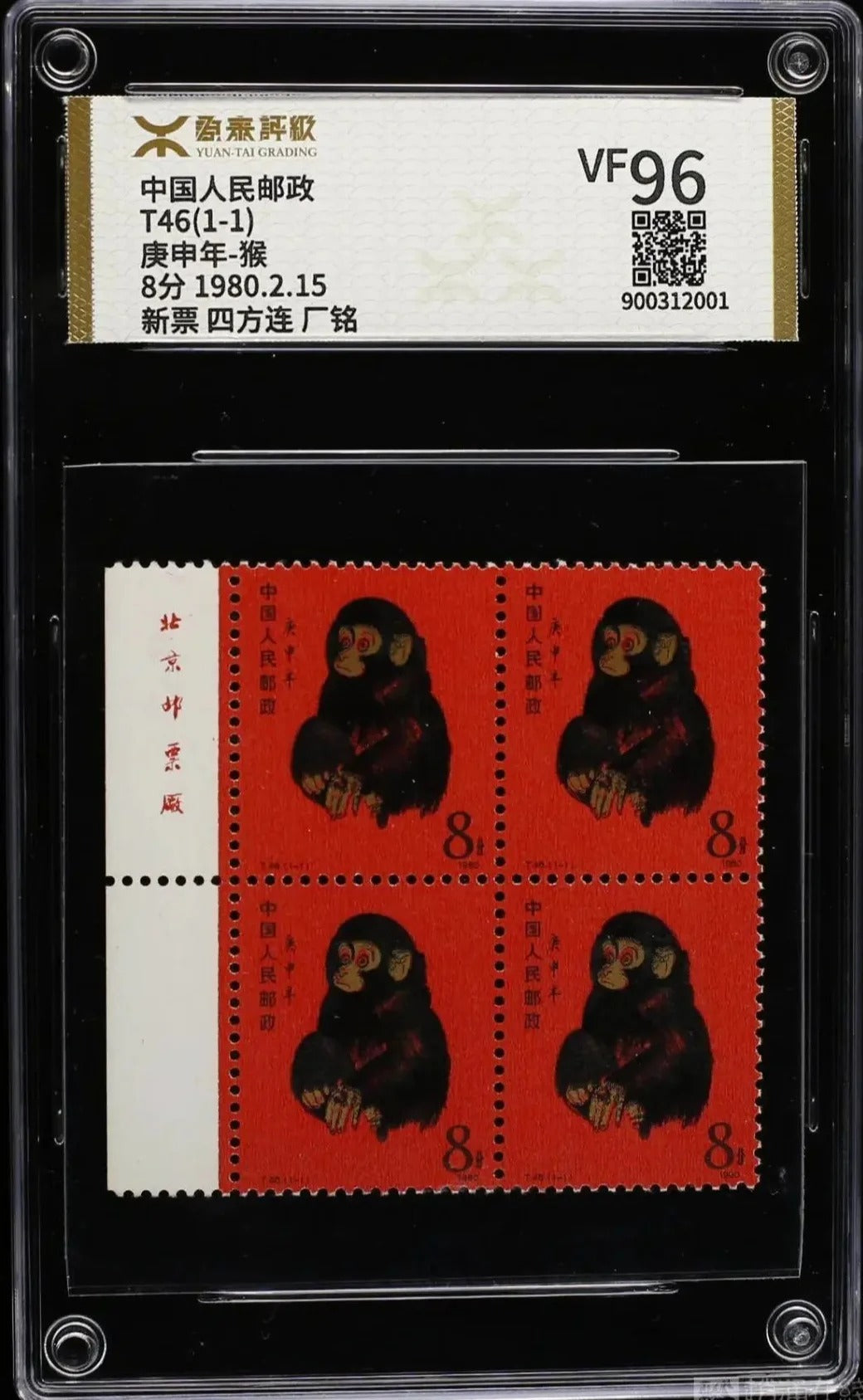
Fix the official T46 issue data first
The T46 Monkey stamp was issued on 15 February 1980. The complete set contains one stamp with a face value of 8 fen, and the stamp measures 26 by 31 millimetres.
Its perforation is gauge 11.5. A full sheet contains 80 stamps arranged in eight columns by ten rows; keep the published format distinct from the format actually being examined.
The stamp uses a combined photogravure-and-engraved process. Huang Yongyu created the original artwork, Shao Bolin designed the stamp, Jiang Weijie engraved it, and Beijing Stamp Factory printed it.
Photograph the whole stamp before a single tooth
Take a level front image with all margins and perforations visible, then photograph the back under even light. Retain a colour reference and the original file before cropping.
Give the stamp, mount, album position and certificate one reference number. A close-up of the monkey or inscription must remain traceable to the complete item.
Measure perforations without forcing the paper
Place a gauge beside the stamp without bending or stretching it. Record short, missing, bent or repaired teeth by side and position rather than reducing them to a general grade.
Check whether irregular holes or fibres suggest reperforation, but keep the conclusion provisional when photographs cannot resolve the paper edge. Do not trim or separate joined stamps.
Compare all four sides at the same scale, retaining corner perforations in full so an irregular tooth is not judged from a cropped enlargement.
Map gum, paper and ink as separate evidence
Under safe light, describe gum coverage, disturbance, hinge traces, adhesion, thinning and possible regumming by location. Avoid heat, water or solvent tests.
Record foxing, stains, fading, creases, tears, repairs and surface abrasion independently. Front colour and back condition require their own photographs.
Name the physical format accurately
A single stamp, pair, block of four, larger multiple, full sheet, souvenir sheet and cover are not interchangeable. State what is physically present and preserve connected pieces.
For a block of four or full sheet, photograph the complete arrangement before details. Include margins, inscriptions, plate features and any separation or fold lines.
A cover needs front, back, address area, postmarks and attachment points. Do not lift the stamp merely to inspect hidden gum.
Keep provenance and comparison in supporting roles
An album caption, certificate or family account may help trace ownership. Transcribe it separately and compare its claims with the stamp's visible design, gauge and condition.
Retain the official reference and consultation date for issue facts. Online images may guide a position check but cannot provide gum or tooth condition for the subject item.
If a stamp is stuck down, photograph the accessible front and surrounding page. Forced removal risks thinning, tearing and loss of the original album context.
Close with confirmed format, observed condition and unresolved points. Store the item flat in suitable material without pressing, washing or attempting a cosmetic gum repair.
For a used example, transcribe the visible postmark date and place without completing weak characters, and preserve the cancellation within the full stamp image.
