
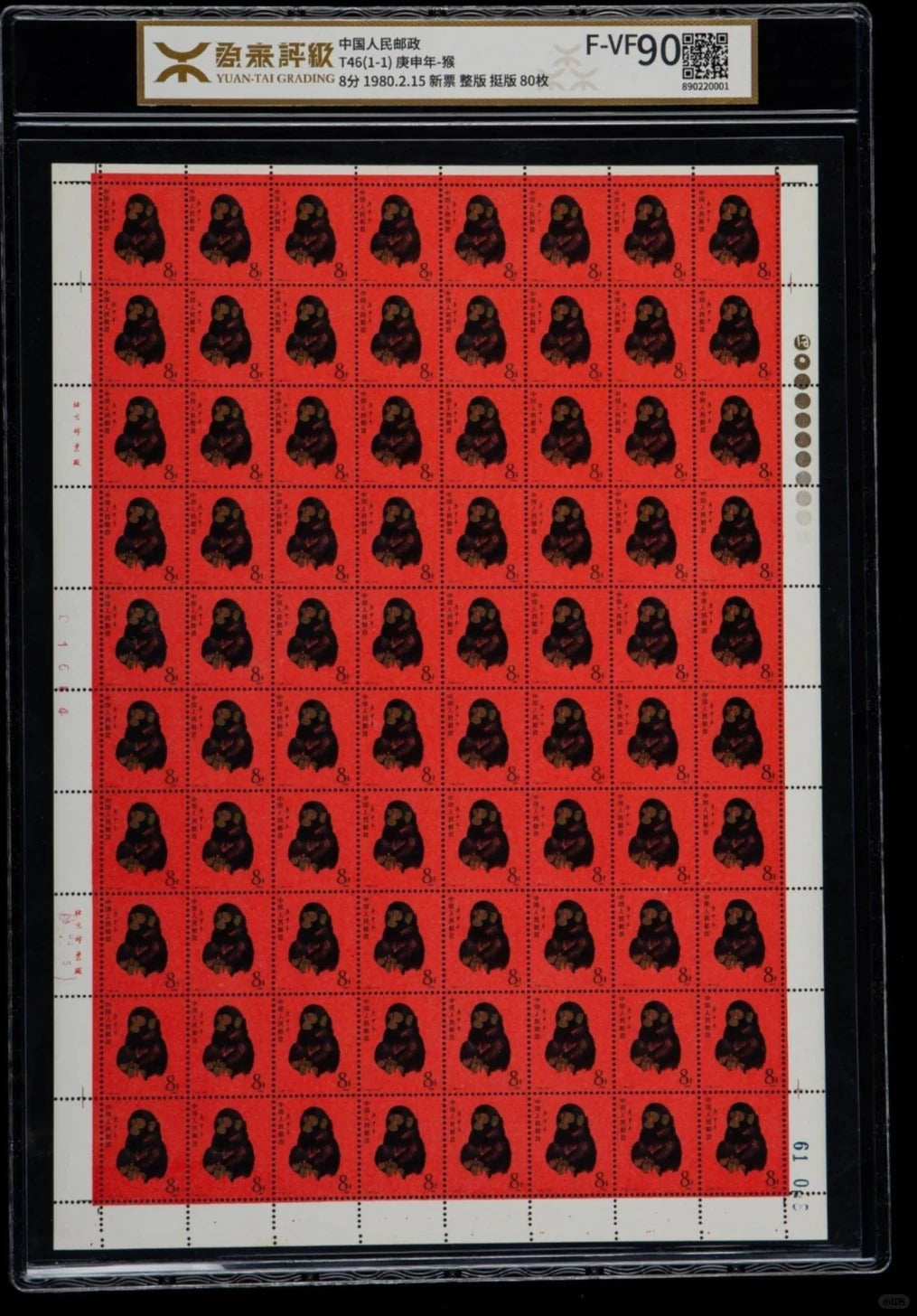
Start with the complete 1980 T46 Monkey stamp
Photograph the entire front and back with every perforation visible before enlarging the monkey design, denomination, inscription, paper or gum. Retain the album position in the first image set.
Official data: issued 15 February 1980 as a one-stamp set with a face value of 8 fen.
Format data: 26 × 31 mm, perforation gauge 11.5, and sheets of 80 arranged 8 × 10.
Official Production and Creative Credits
The issue was printed by a combined photogravure and intaglio process at the Beijing Stamp Factory, from artwork by Huang Yongyu, design by Shao Bolin and engraving by Jiang Weijie.
Use an uncropped front image to establish orientation, then inspect each side for short, bent, pulled or repaired perforations. Do not detach joined material merely to obtain a cleaner outline.
Record the perforation gauge as a reference and document the method if it is measured. A visual guess should remain clearly provisional.
Keep Selvage and Album Position
Photograph any selvage or mount in relation to the stamp, then inspect the reverse gum, hinge remnants, thinning and disturbed areas without intervention.
Preserve the album or stock-book order. If dampness, sticking or mould is suspected, stop turning pages and isolate the affected album without forcing the stamp free.
Do not moisten, steam, scrape or apply adhesive. A glossy or uneven surface can have several causes and should not be assigned a treatment history from one photograph.
Separate Issue Facts from Physical Condition
Locate yellow spots, foxing, mould, creases, tears and paper loss, keeping these observations apart from the official T46 issue data.
The issue date, face value, size, gauge, sheet layout and production credits describe the stamp issue. They do not establish the state of an individual example.
Control Images and Enclosure Limits
Record the stamp pocket, handwritten notes and any yellowing or waviness from ageing plastic as enclosure evidence, stating where the film changes colour or blocks the view.
Use consistent lighting and white balance for the complete front before recording ink density, colour shifts, plate marks or surface disturbance. Exposure differences are not print varieties.
Where T46 Perforation, Gum and Print Evidence Meet
The T46 evidence set joins the complete Monkey design, four perforated sides, back, gum and paper surface under one stamp identifier.
Its visible 8-fen face value belongs with the front image, whereas gum disturbance and thinning remain observations from the reverse.
Documented 26 × 31 mm and 11.5 references are compared with separately retained actual size and gauge readings, including the method used.
Album order, selvage and sheet-position context can survive without removal, and any attachment limits remain visible in the record.
Dry support and freedom from new pressure or adhesive protect the stamp when magnification cannot settle concealed repair or gum composition.
