
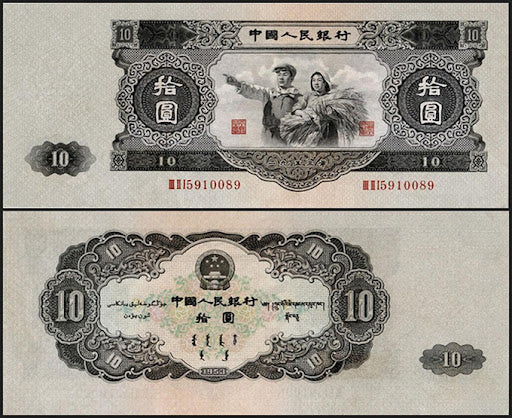
Place the 10 yuan note on a verified timeline
The Second Series 10 yuan note was issued on 1 December 1957 and withdrawn on 15 May 1964. Keep those two events distinct rather than describing the note with an approximate decade.
The People's Bank of China's withdrawn-currency material provides the issue images and published data used here. Retain the reference and consultation date beside any later historical note.
Read the full front and back before judging a detail
The note measures 210 by 85 millimetres. Its front shows worker-and-peasant portraits and is chiefly black; the reverse combines the national emblem with multicoloured peonies.
Photograph both faces uncropped, followed by the four corners, all edges and the full prefix and serial number. Use the same item number on the sleeve and measurement card.
Keep neighbouring Second Series denominations separate
The Second Series 3 yuan note was issued on 1 March 1955. That date belongs to the 3 yuan denomination and should not be transferred to the 10 yuan record.
The 5 yuan denomination exists in two versions with different issue times. Record the exact version visible before attaching a date or design description.
Document condition without assuming hidden features
Use transmitted light only on the note actually being examined. Do not assert a watermark, security thread or printing feature merely because a reference specimen carries one.
Map folds, edge splits, missing corners, stains, foxing, thinning, glue, repairs, recolouring and flattening by position. A broad grade cannot replace these repeatable observations.
Preserve the paper and its evidence
Handle the note on a clean support and keep it in its existing safe sleeve while preparing images. Do not wash, iron, laminate or press it flat to improve presentation.
An old album caption or family account can explain provenance, but it cannot supply a serial digit or prove a variety. Photograph such material separately under the same reference number.
When several notes arrived together, record denomination, version and serial individually before describing a run or set. A group image is useful for count only.
Keep the first colour-calibrated photographs when later imaging reveals more detail. Date any amended reading rather than silently replacing the original transcription.
Close with three layers: verified issue data, features visible on this note and unresolved observations. This keeps official history, physical evidence and interpretation from being mixed.
