 WhatsApp item photos
Su San Bi is a market grouping, not a single note
Collectors commonly use Su San Bi for three separate Second Series Renminbi notes: the 3-yuan note, the 1953 5-yuan note and the 1953 10-yuan note. The term is neither a denomination nor an official set name.
Give each note its own identifier, complete front and back photographs, exact denomination, visible date wording, dimensions and condition. Never transfer a serial detail or paper feature from one member of the group to another.
The Second Series 3-yuan note
The front design depicts Jinggangshan. It was issued on 1955-03-01, withdrawn on 1964-05-15 and measures 160 × 72.5 mm; keep those facts with the 3-yuan note rather than treating them as group specifications.
Capture all four corners and edges, the complete designs and any legible identifying numbers. Transmitted light may document visible paper features or repairs, but it should not manufacture an expected watermark.
The 1953 5-yuan note
Its front depicts ethnic unity. The note was issued on 1955-03-01, withdrawn on 1964-05-15 and measures 165 × 75 mm, so its dates and dimensions should be stated independently.
Describe folds, edge splits, stains, thinning, retouching and pressing by location. An album caption or group nickname cannot replace the wording and condition visible on the paper.
The 1953 10-yuan note
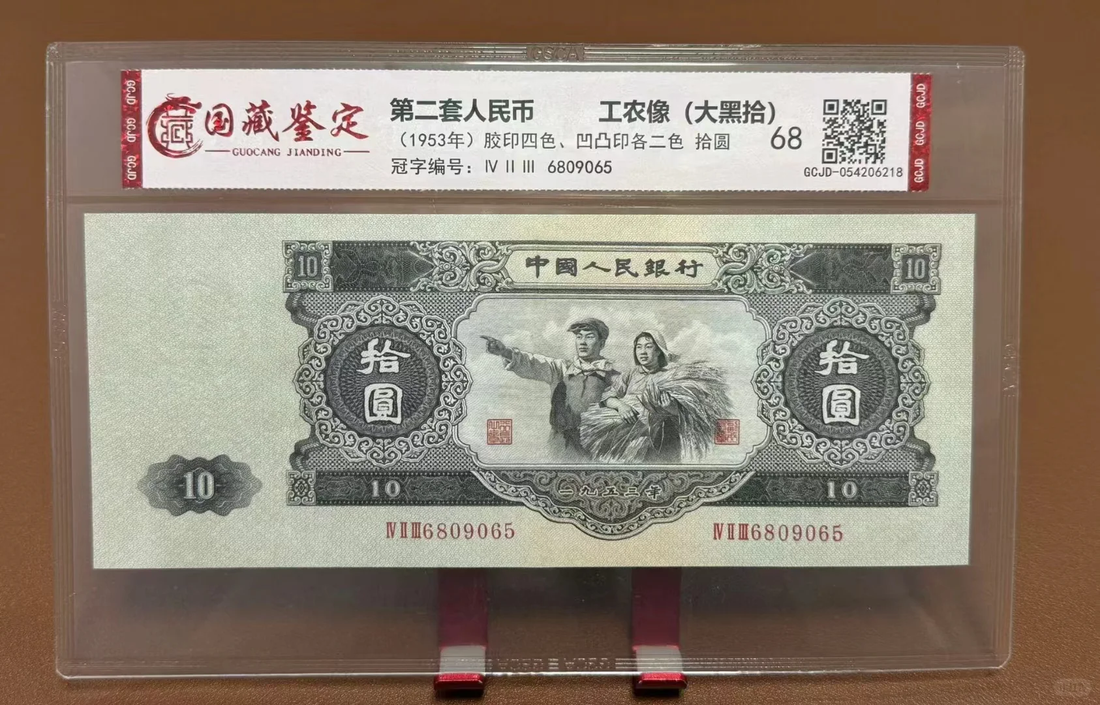
The front shows a worker and peasant. This note was issued on 1957-12-01, withdrawn on 1964-05-15 and measures 210 × 85 mm; it must not inherit the 3-yuan or 5-yuan issue date.
Use an uncropped neutral view beside every corner, edge or repair detail. Keep its exact prefix and serial transcription with this note alone, marking any hidden character as uncertain.
Compare only after all three descriptions are complete
Place denomination, design, issue date, withdrawal date and dimensions in parallel only after each note has been independently identified. This makes the differences clearer without turning Su San Bi into a false single type.
Preserve old envelopes, grading labels and family accounts as contextual material. They may help establish custody, but the visible note and a cited reference remain the basis for identification.
Do not wash, press, tape or erase any of the three notes before assessment. Stable support, brief transmitted light and careful corner handling protect both paper and evidence.
For an appraisal, present the 3-yuan, 1953 5-yuan and 1953 10-yuan notes as three numbered items. Include complete faces, dimensions, paper-condition details and any enclosure limitation for each one.
A precise comparison preserves the convenience of the collector term while respecting the different designs, dates, sizes and condition of the individual notes.