
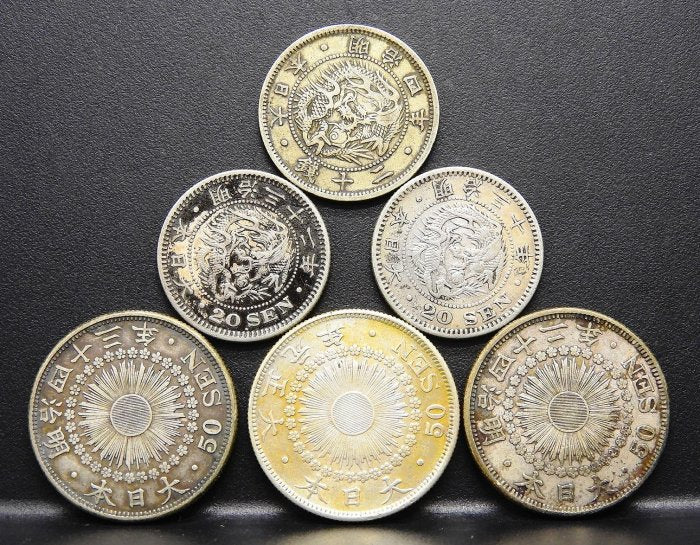
Read the era and denomination from the coin
Photograph both faces level and uncropped before converting an era year or choosing a variety. Copy the Japanese characters and denomination in their visible order, including any worn or blocked passage.
Inscription side
Retain the full legend, value, wreath or crest, inner border and rim in one image.
Dragon side
Show the complete dragon, beaded border and surrounding wording before enlarging the head, claws, scales or tail. Keep any Gregorian conversion in a separate cited note.
Give each Japanese silver coin its own record
Use one item number for the two faces, every edge frame, weight, diameter, holder and label. A group photograph documents quantity but not an individual coin's date or condition.
Leave unclear characters unresolved. A nearby Meiji example or a product comparison cannot complete worn wording on this piece.
Follow the dragon from centre to circumference
Use located close-ups for horns, whiskers, claws, scales and the relationship between dragon and border. Keep enough adjacent design to identify the exact position.
Photograph the edge in overlapping sections from a fixed landmark. Record reeding, seams, filing, knocks, holes, solder and mounting traces without scraping the rim.
Retain the level full-face images with every macro view. A dragon detail or edge defect is useful only when another reviewer can return it to an exact position on this coin.
Keep measurements and attribution in the right order
Record weight, diameter and thickness with the instrument, unit and contact points. Compare them only after the visible era, denomination and design support a coin type.
If a second reading differs, repeat the same setup and retain both dated values. Do not select a measurement because it matches a catalogue entry.
Treat published specifications as cross-checks, not missing evidence. A close weight cannot restore a worn era character or prove that an unrecorded edge belongs to this example.
Describe the surface without cleaning it
Separate stable toning, worn relief, strike softness, wipe marks, scratches and chemical-cleaning sheen. Dark colour around the dragon or wreath is not a reason to polish.
Locate chops, countermarks, repairs and edge work on the full coin. Record what is visible without assuming when or why the alteration occurred.
Use sources and old labels as background
Transcribe a sleeve, holder or family account under the coin number. Test its era, denomination and variety wording against the actual inscriptions and devices.
Cite references used for era conversion, issue history or variety diagnostics and note the consultation date. Online images guide inspection but cannot provide missing characters.
Photographs can establish major design and legible wording. Metal, very fine tooling, concealed rim repair and subtle cleaning may remain uncertain under a holder.
State the hidden area before opening any enclosure. Preserve the original surface and provenance link until the benefit and handling risk are clear.
Reconcile the era inscription, denomination, dragon, wreath or crest, borders, full edge and measurements under one number. Preserve first images and keep conversion, attribution and condition separate; pass hidden areas forward without dipping, filing or opening a sealed holder.
