
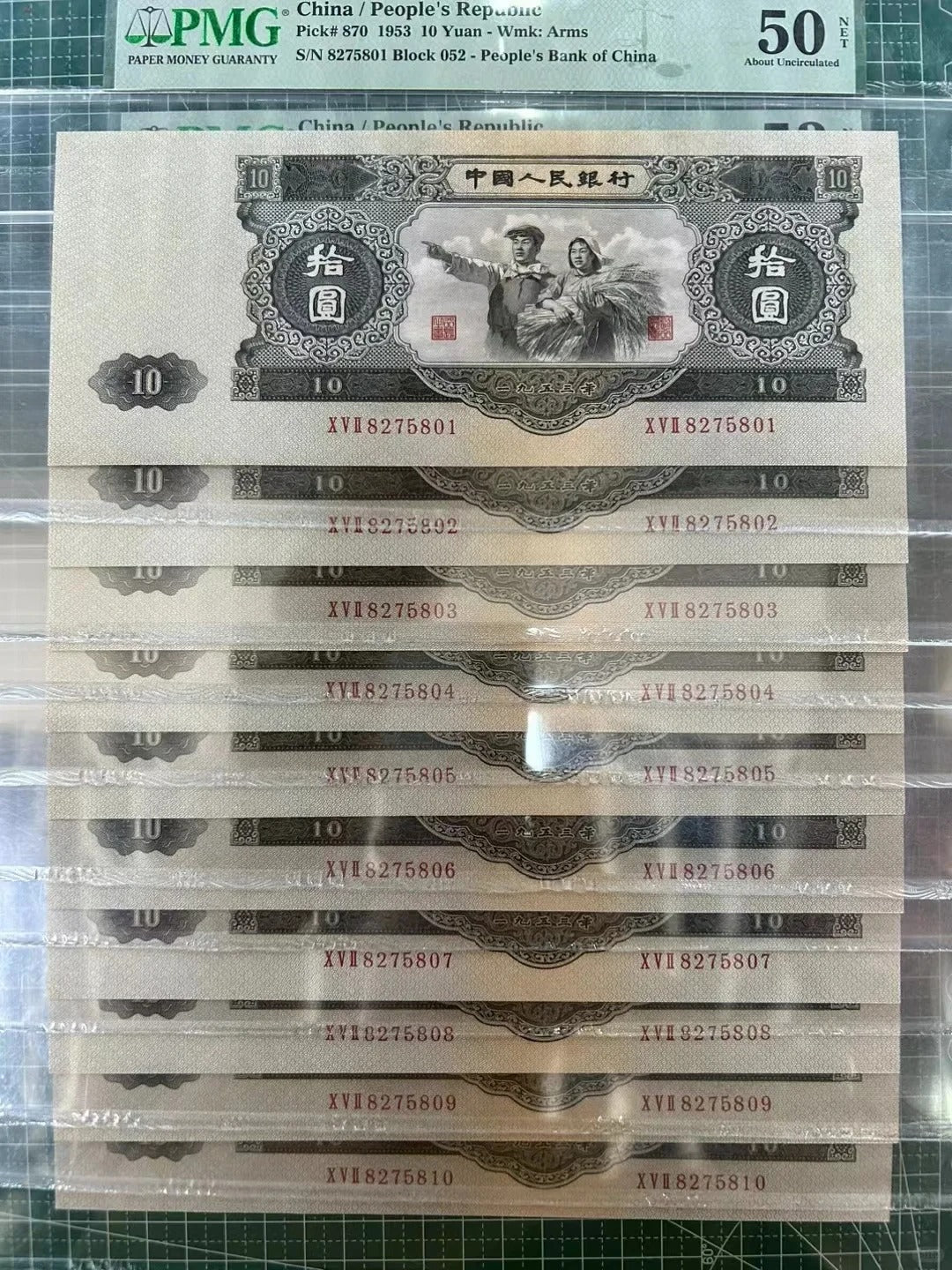
In the realm of high-end banknote collecting and Buyback, if one were to name the banknote that best embodies"prestige"and"a symbol of wealth,"the"1953 Ten Yuan note"from the Second Series of Renminbi(colloquially known as"Big Black Ten"or"Da Hei Shi") would undoubtedly be the undisputed king. This legendary banknote, printed by the Soviet Union, not only witnessed the ebb and flow of Sino-Soviet relations but also became an asset-level treasure coveted by collectors worldwide due to its oversized dimensions, exquisite printing craftsmanship, and extremely scarce surviving quantity.
Quick Conclusion:When assessing the value of a Da Hei Shi, a physical inspection should precede any discussion of market prices, avoiding quotes based solely on year or online images.
For collectors in Hong Kong and Macau, discovering a"Da Hei Shi"while sorting through old items left by elders often equates to the value of a luxury car or even a down payment for an apartment. However, high returns are invariably accompanied by high risks, and the market for"Da Hei Shi"is rife with increasingly sophisticated counterfeits. As a professional buyback dealer with many years of experience in the Hong Kong and Macau markets,Ancient Coin Appraisalwill today provide an in-depth analysis of the authentication essentials for this Soviet-made masterpiece, examining it from four dimensions: historical background, identification techniques, market value, and preservation systems.
I. The Legend of the King of Banknotes: Why is the"Da Hei Shi"Worth a Hundredfold?
The"Da Hei Shi"was issued in 1955 and belongs to the second series of Chinese Renminbi. Its uniqueness lies in its triple endorsement of"historicity,""speciality,"and"rarity":
- "Soviet Three Notes"Printed by the Soviet Union: Due to the limitations of domestic banknote printing technology at the time (especially for high-denomination banknotes with strong anti-counterfeiting features), the"Da Hei Shi"and the contemporary three and five yuan notes were all engraved and printed by the Soviet Union. This special foreign printing background gives it a distinct paper texture and ink layering.
- Emergency Recall Amidst Political Games: In the 1960s, as Sino-Soviet relations deteriorated, the People's Bank of China announced a deadline for the recall of these Soviet-printed banknotes to prevent hostile forces from using the printing plates to counterfeit currency and disrupt the economy. The thorough recall resulted in very few remaining in circulation among the public, cementing its status as the"King of Banknotes."
- Massive Dimensions: Its impressive size of 210mm × 165mm makes it the largest banknote in the history of the Renminbi. It has a significant presence when held, which also made it prone to damage during circulation, making brand-new condition notes extremely rare to find.

II. In-depth Authentication: Five Core Essentials to Distinguish Authenticity
Authenticating a"Da Hei Shi"goes beyond simple visual inspection, requiring multi-dimensional verification of the paper, ink, background pattern, and micro-craftsmanship.
1. Paper Fiber and Ink Absorption
The"Da Hei Shi"uses special Soviet-made banknote paper, which is stiff and elastic. Under a magnifying glass, the paper fibers of a genuine note are naturally distributed and exhibit excellent ink absorption. Counterfeits often use ordinary coated paper or modern white paper, which appears white and highly reflective, and under UV light, fake notes often reflect strong fluorescence.
2. Tactile Impression of Intaglio Printing
Genuine notes employ high-end intaglio printing technology, especially for the worker and farmer images on the front, the surrounding patterns, and the"People's Bank of China"inscription, where the ink is noticeably raised. When gently touched with a finger, a strong three-dimensional tactile sensation can be felt. Counterfeits often use flat offset printing or scanned inkjet printing, resulting in flat, unlayered images with dull colors and a lack of three-dimensional feel.
3. Anti-Counterfeiting Background Dot Matrix
The background lines of a genuine note are clear and smooth, with rounded dots. Under high magnification, the shaded areas are composed of extremely fine ink dots, with distinct layering. Counterfeit background patterns are often blurry, with broken lines, and the dots may even show blurred double images.
4. Watermark Authentication
The"Da Hei Shi"features a fixed national emblem watermark. Genuine watermarks are formed during the papermaking process, showing distinct layering and a clear national emblem outline when viewed against light. Many low-quality counterfeit watermarks are printed on the surface of the paper later or sandwiched between two thin layers of paper, appearing stiff and lacking transparency.
5. Number and Prefix Features
The prefix numbers of a genuine note are arranged very neatly, and the font has specific aesthetic characteristics, with the ink tightly bonded to the paper. If there are signs of scratching, patching, or reprinting on the numbers, it may be a"re-numbered"counterfeit.

III. Market Value: Condition Determines Value (with HKD Reference Price)
In the old banknote buyback market,"condition is life."The price of a"Da Hei Shi"can vary significantly depending on its PMG grading or physical preservation status.
Da Hei Shi Buyback Reference Price Table (June 2026 Reference)
| Condition Grade | Description | Reference Price (Renminbi) | Reference Price (HKD) |
|---|---|---|---|
| Gem Uncirculated (PMG 65-70) | Original crisp, no folds, no foxing, no handling marks | ¥400,000+ | HK$440,000+ |
| Uncirculated (PMG 58-64) | Near perfect, may have extremely slight handling marks or 1 soft fold | ¥250,000 - ¥350,000 | HK$275,000 - $385,000 |
| Fine (PMG 35-50) | Circulated, with noticeable folds, but paper is still firm, colors are vibrant | ¥100,000 - ¥200,000 | HK$110,000 - $220,000 |
| Good (PMG 15-25) | Heavily worn, with tears, missing corners, or severe aging marks | ¥30,000 - ¥60,000 | HK$33,000 - $66,000 |
| Damaged Note/Specimen | Number is 00000000 or has"SPECIMEN"printed on it | Price determined by specific rarity | Online valuation required |
(Note: HKD exchange rate is calculated at 1 Renminbi ≈ 1.1 HKD; actual prices are subject to daily market fluctuations)

IV. Professional Preservation: Protecting Your"Square Inch of Gold"
High-value banknotes are extremely delicate; if not properly preserved, a single rainy season can halve their value.
- Constant Temperature and Humidity: It is recommended to store banknotes in an electronic dehumidifying cabinet, maintaining a relative humidity between 45%-55% to prevent paper fibers from molding due to dampness or becoming brittle due to excessive dryness.
- Physical Isolation: Strictly avoid touching banknotes directly with bare hands. Hand oils and sweat salts can oxidize the paper. Use stainless steel round-tipped tweezers to handle them and place them in acid-free protective sleeves.
- No"Beautification": For banknotes with existing folds or stains,never attempt to wash them with water, bleach them with chemicals, or iron them flat yourself. Any physical repair marks will not pass authoritative grading (such as PMG) and may even be considered substandard, leading to a value drop of over 50%.

V. Choosing a professional buyback dealer: Ancient Coin Appraisal Guides You
When dealing with high-end collectibles like the"Da Hei Shi,"choosing a buyback dealer with a physical storefront and professional appraisal capabilities is crucial.Ancient Coin Appraisal, with years of deep experience in Hong Kong and Macau, offers you:
- Free Online Appraisal: Simply send photos of your collection via WhatsApp to receive an initial professional assessment.
- Door-to-Door Service Throughout Hong Kong and Macau: To ensure client privacy and security, professional appraisers can be scheduled to visit your home for buyback, with cash or instant FPS settlement, ensuring safety and confidentiality.
- Transparent Market Quotations: We keep abreast of the latest auction data to ensure fair and reasonable buyback prices, maximizing the value of your treasured collection.
If you have old Renminbi banknotes, silver dollars, gold coins, or stamps, feel free to contact us anytime!

Contact Us
- Company Name:Ancient Coin Appraisal
- WhatsApp:(852) 9834 2057
- Service Area: Free door-to-door appraisal and high-price Buyback throughout Hong Kong and Macau
【Ancient Coin Appraisal】— Your professional old coin valuation and Buyback manager, ensuring that every piece of historical memory can be transformed into its rightful financial value!
Initial Self-Verification Checklist
- Condition:Folds, stains, holes, and flattening marks will directly cause a significant price difference for the same series.
- Numbers:Prefix, consecutive numbers, fancy numbers, and replacement numbers should all be recorded separately.
- Authenticity:Watermark, hidden marks, paper quality, and ink layering are more important than just the year.
The above checklist is only suitable for preliminary screening and cannot replace physical appraisal; for high-value or potentially rare collectibles, it is recommended to keep them in their original state and arrange for a professional inspection.
Appraisal Standards and Price Ranges (2026-06-03)
The quoted price for Da Hei Shi is not a fixed figure. This article can only provide a framework for judgment and recent market trends. Banknote collectibles are also affected by condition grade, prefix, consecutive numbers, and market demand. Before a formal transaction, please refer to physical appraisal, itemized quotation, and the achievable price on the day.
Frequently Asked Questions
Can I make an initial self-assessment of a Da Hei Shi without experience?
You can start by checking the appearance, size, preservation status, and source information according to the checklist in this article, but do not clean or repair it yourself.
What information is most valuable to prepare first?
Photos of the front and back, close-ups of specific features, weight, dimensions, a description of the source, and any grading or purchase records are the most useful information for valuation.
Preparation for Valuation:If you wish to inquire about a Da Hei Shi, first take photos of the front, back, edges, or specific details, and provide information on size, weight, and origin. The more complete the information, the easier it is to make a preliminary assessment close to the actual item.
