
 WhatsApp item photos
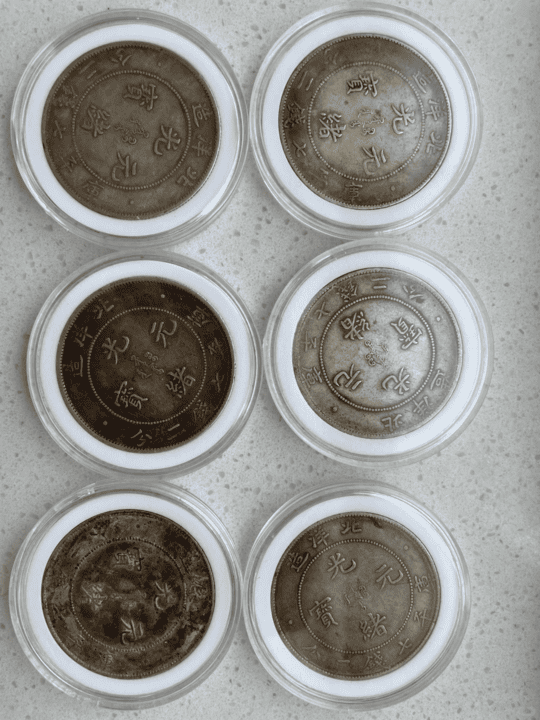
Sort Guangxu Yuanbao coins by visible inscriptions
Do not reduce several coins to one total weight or a distant photograph. Number every Guangxu Yuanbao, keep inherited date claims as background and begin with details visible on that coin.
- Identification: provincial mint or mint name, date, Kuping denomination and legends
- Measurements: complete edge sequence, weight, diameter, instrument and original unit
- Condition: mint letters, counterstamps, perforations and modified rim positions
Hold obverse, reverse and edge in a fixed direction, then locate each damage close-up on the whole coin. Unsupported details remain open, with any seal or handling restriction stated clearly.
Keep the description centred on the Guangxu Yuanbao itself, while labels and inherited claims remain separate dated context.
Begin with both complete faces
Transcribe the provincial mint or mint name, date, Kuping denomination and legends on both sides. Compare weight and diameter only within the same established type, retaining the initial units.
Preserve uncropped faces showing the full circumference, then add located views of the dragon, beaded border, denticles, English lettering and denomination. Note any area still concealed by packaging.
Photograph the edge independently
Capture overlapping edge sections around the whole circumference. Leave joins, modified rim sections, perforations, solder and signs of a previous mount unchanged beside the first readings and units.
Read surface evidence in order: tone, wear from circulation, incomplete strike, fine wiping marks and any hue associated with cleaning. Darkness needs no cleaning; describe any obstruction from the holder.
Connect measurements with surface condition
Group several dragon dollars by visible provincial mint, date and Kuping denomination. Give each coin its own number so the inscription side, dragon side, edge, weight and diameter cannot be exchanged.
A grading holder supplies its label and score, not confirmation of the mint, date, denomination, dragon or surface. Compare those points with the enclosed coin wherever visible.
Preserve the boundary of the evidence
Chop marks, an old paper sleeve and provenance statements may remain with the background material. They do not replace the legends, dragon, beaded border, metal surface or edge.
Coins bearing the same market name may differ by provincial mint, date, denomination or dragon design. Sort them from visible inscriptions before comparing finer details.
When Provincial Legends and Measurements Point in Different Directions
First match the provincial mint or mint name, date, Kuping wording and legends to complete faces and dragon close-ups. State every missing view so information from another coin cannot slip in.
Next locate mintmarks, chop marks, holes and altered-edge positions before bringing in a sleeve, holder or old label. This sequence avoids changing the coin simply to fill a gap.
An original box or attachment can add provenance context but never replace the coin. Keep its identifier, seal condition and visible limits apart from the physical observations.
Retain unedited photographs. Take a new image when a clearer view is required instead of sharpening or filtering the first one; finish with the mint, date and Kuping wording.
Before an enquiry, photograph the provincial mint, date and Kuping denomination clearly, then list measurements, packaging and unresolved points. Leave any missing item open rather than guessing.