
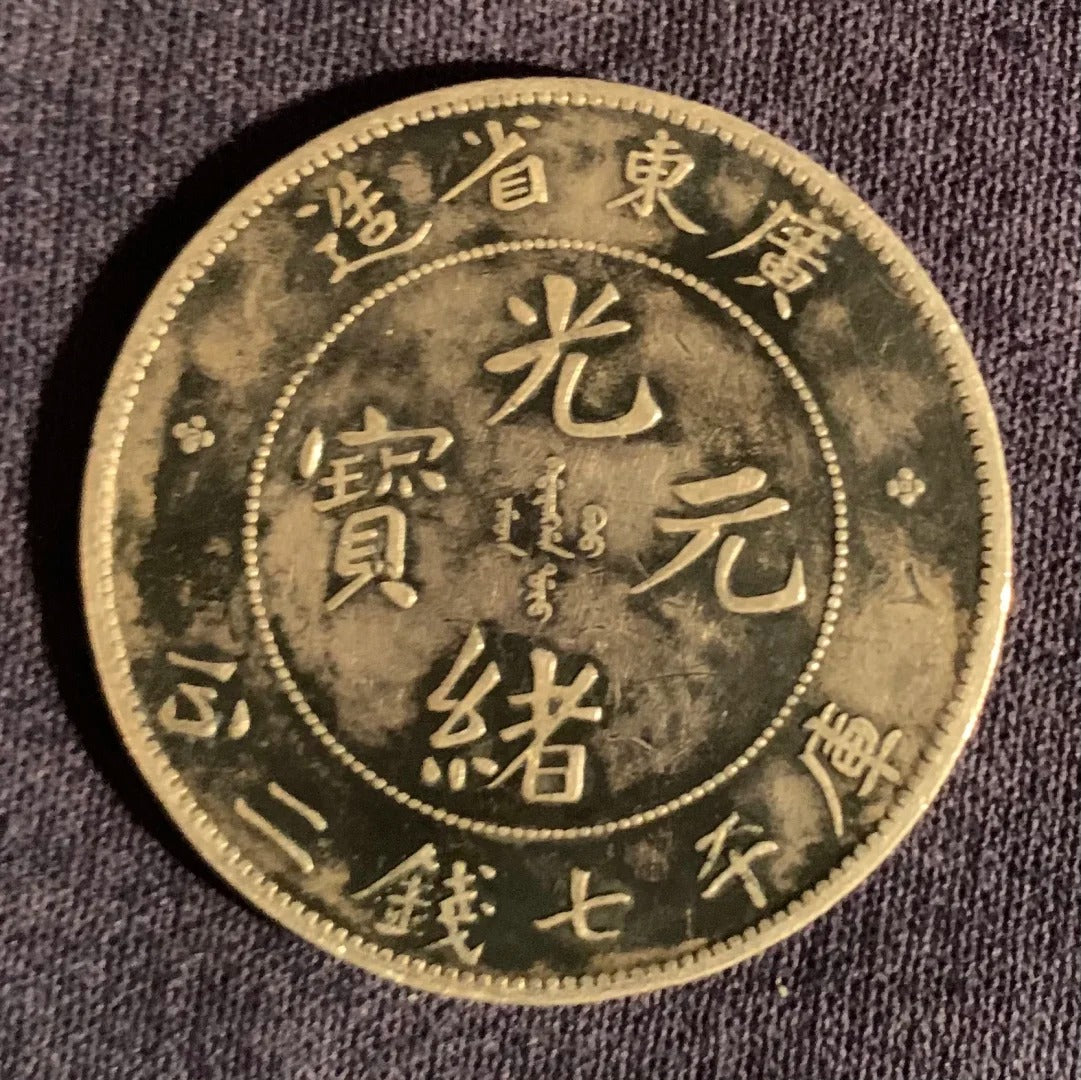
Transcribe the Guangxu Yuanbao before assigning a finer variety
Province and mint-name wording can be more useful than a broad dragon-dollar label. Number the specimen and copy only the characters visible on its own faces.
- Identification: note the province, mint or bureau name, reign or cyclical date, Kuping denomination and surrounding text in reading order.
- Physical data: attach weight, diameter, instrument, native unit and a continuous edge sequence to the same identifier.
- Surface notes: locate chops, piercings, repaired rims and suspected later treatment without disturbing the patina.
Keep an uncertain character as a partial transcription. A complete date from a catalogue is a comparison, not evidence for the coin in hand.
Whole images make a transcription traceable
Capture the inscription face and dragon face with the full rim. Follow with close-ups of the mint wording, date characters, Kuping value, dragon and English legend.
Photograph the circumference in sequence so every join can be reconstructed. Note where plastic, staples or a mount prevents a clear view.
Record First, Classify Second
Maintain one identifier across the coin card, image files, readings, sleeve and certificate so similar dragon designs cannot be cross-matched by accident.
For a group of Guangxu Yuanbao coins, arrange them by readable province or mint, then by date and Kuping denomination. Leave pieces with missing text in a separate provisional group.
Compare dragon features, beaded borders, denticles and English wording only after both complete faces have been matched to each item.
Documents have their own evidential role
Transcribe a holder label exactly and date the observation. Check it independently against the coin rather than folding the printed claim into the physical description.
When citing an issue history or mint attribution, identify the publication or archive and record when it was consulted. An unsupported family note remains background.
Weight and diameter can test a comparison, but they cannot choose between varieties on their own. Retain discrepancies and repeat the reading at the documented position.
Protect diagnostic surfaces
Separate stable patina, honest wear, weakly struck areas, parallel wiping lines and unnatural colour. Never brighten the field to make characters easier to read.
Direct examination is useful where reflections conceal lettering, repairs sit at the rim, or a holder prevents a complete edge sequence.
A mint-name review for Guangxu Yuanbao
Read the provincial and bureau characters aloud against the orientation image, then check the reign or cyclical date and Kuping phrase. Mark every uncertain stroke.
Reconnect that transcription to the dragon face, edge photographs and measurements. Another examiner should be able to find the exact character without guessing the camera direction.
Use scale and callipers consistently, but preserve their native displays. Any conversion belongs in a separate calculated field with its basis stated.
Position condition observations by a nearby character, pearl or clock-face reference. Broad grading adjectives should not replace a locatable description.
Keep original packaging and attachments if they support provenance, while noting which parts of the coin they obscure. Opening requires a separate decision and consent.
