
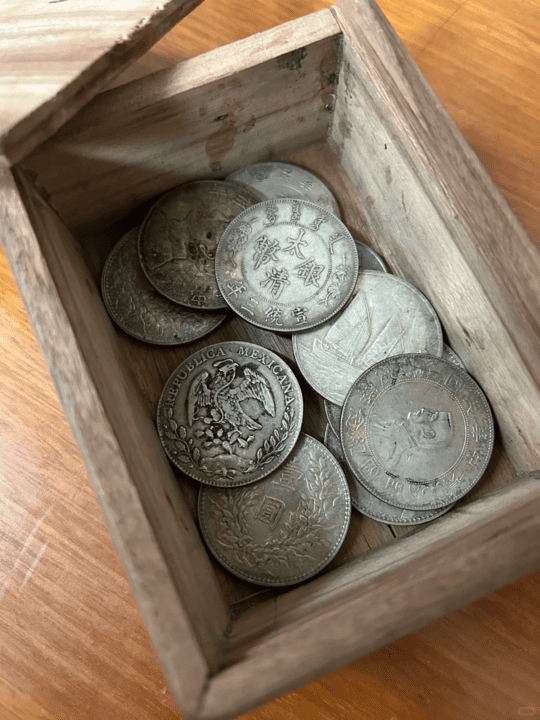
Map the Late Qing and Republican Silver Batch First
A dated tray view establishes the original quantity and arrangement, after which every coin receives a separate identifier before any Mexican Eagle Dollar candidate is named.
Each candidate record transcribes the visible date, denomination, national wording, mintmark where present and principal designs without borrowing a character from another coin.
Located raking-light and damage details follow the numbered face views, with enough surrounding design to prevent a batch close-up from drifting to the wrong specimen.
Paper sleeves, holder wording and family accounts remain dated context, particularly where a label names a coin that the available photographs do not establish.
Record Available Edge Evidence Without Assuming Full Coverage
Accessible edge sections are photographed in sequence from a stated start, while every holder obstruction and unrecorded interval is marked as a gap rather than called complete.
Seams, reshaped areas, piercings, solder and former jewellery-mount traces stay untouched, with the relevant coin number visible beside each recorded section.
Separate Similar Silver Before Comparison
Separate Mexican Eagle Dollars from junk dollars, French Indochina piastres, British Trade Dollars, Morgan dollars and other foreign silver before comparing specifications.
Faces, available edge frames, weight and diameter remain attached to one identifier, including the instrument, native unit and measuring position for every reading.
Describe Surface Evidence Separately
Distinguish stable patina, circulation wear, weak strike, wiping hairlines and chemically altered colour. A dark surface is not an instruction to clean the coin.
Compare dimensions only after the visible date, denomination and designs establish a plausible coin type; a single measurement cannot decide the attribution.
Decide Whether a Specific Coin Needs Direct Access
Direct examination is relevant only when a named legend, hidden edge interval, conflicting measurement or suspected rim change cannot be resolved through the present holder.
The images can support inscriptions and conspicuous damage, whereas composition, subtle repair and unphotographed areas remain explicitly unresolved.
Separating Mexican Eagle Dollars Within the Batch
The batch may contain Mexican Eagle Dollars beside late Qing provincial silver, Yuan Shikai issues and other foreign trade coins, so the first useful result is a numbered grouping rather than a single attribution.
Visible eagle design, denomination, date and national wording provide the Mexican candidate's working identity; measurements become comparative evidence only after those features agree.
Edge evidence varies from coin to coin in the source photographs, and a partial sequence remains valid when its exact coverage and missing intervals are stated.
An old envelope can preserve provenance even when its description conflicts with the enclosed coin, because both readings stay dated and independently searchable.
The handover record ends with the batch count, each coin's current group, the images actually available and a short list of evidence still needed for disputed pieces.
