
 WhatsApp item photos
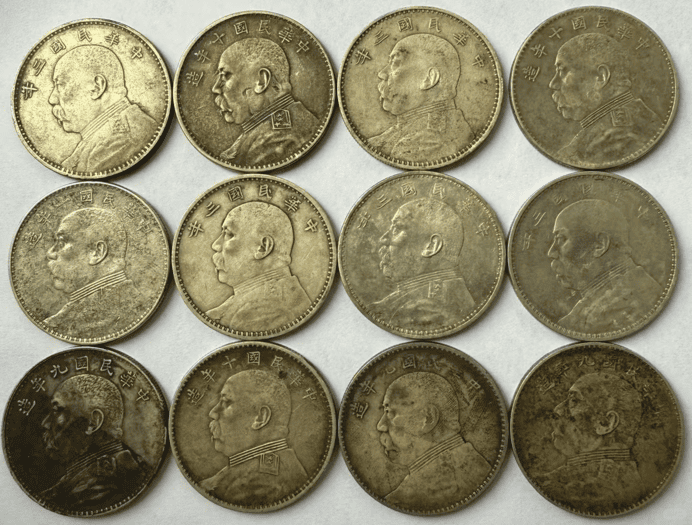
Start with the Yuan Shikai dollar before its damage
Take complete views of the portrait side and grain-wreath reverse. Copy the date, denomination and surrounding words before a punch, hole or worn area draws attention away from the basic coin.
Portrait side
Keep the head, hair, epaulettes, date inscription and denticles in one level image. A close-up of a mark needs enough surrounding design to show its precise position.
Grain-wreath reverse
Photograph the denomination, leaves, ribbon and inner border without cropping the rim. Note which elements are weak from wear, strike or later disturbance rather than assuming one cause.
Assign a single item number to the two faces, holder, edge run and measurement card. When several Yuan Shikai dollars arrive together, a group photograph records quantity but not individual evidence.
Map every intervention by location
Describe a chop by face, clock position, shape, depth and whether it crosses lettering or relief. Record multiple punches separately instead of compressing them into the phrase ‘chop-marked’.
For a hole, show both openings and the connecting edge or wall where safely visible. Note surrounding deformation, solder, filing or mount traces without probing the perforation.
Read the circumference as an ordered sequence
Begin the edge survey at a fixed landmark and overlap every frame. Record reeding changes, flattened areas, seams, tool marks, clipping and repairs without rubbing the edge to expose fresh metal.
Keep the original weight, diameter, instrument and unit together. A hole or removed rim metal may affect a reading, so dimensions should describe the present coin rather than force it into a catalogue range.
Distinguish wear, strike and later surface work
Separate grey or brown toning from high-point loss, weakly struck detail, parallel wiping lines and unnatural brightness. A dark field should remain untouched during examination.
Use raking light for scratches, tooling and repaired areas, but retain the first neutral-light image. Image enhancement must not become a substitute for observable metal.
Treat labels and stories as supporting material
A grading insert, paper sleeve or family note may preserve a former year or variety name. Transcribe it in a background note and verify the date, portrait and wreath directly.
Names such as O variety or other specialised subtypes belong only where the corresponding feature is visible and located. Similar online photographs do not provide the missing diagnostic detail.
Make every chop mark and altered rim position retraceable
Check that every chop, perforation and altered rim area can be found first on a full face or edge frame and then in its detail photograph before drawing a condition conclusion.
Repeat conflicting measurements under the same setup and retain both dated results. Do not discard a figure simply because another value better suits the proposed attribution.
State what remains hidden by a slab, mount or envelope. Direct inspection should answer that defined gap while preserving useful packaging whenever possible.
Keep confirmed date and denomination, proposed variety and condition observations separate. This prevents damage from being used as proof of identity, or identity from being used to explain damage.
At handover, preserve the coin's toning and enclosure. No chemical cleaning, edge filing, scratch test or attempt to open an old hole is required.