
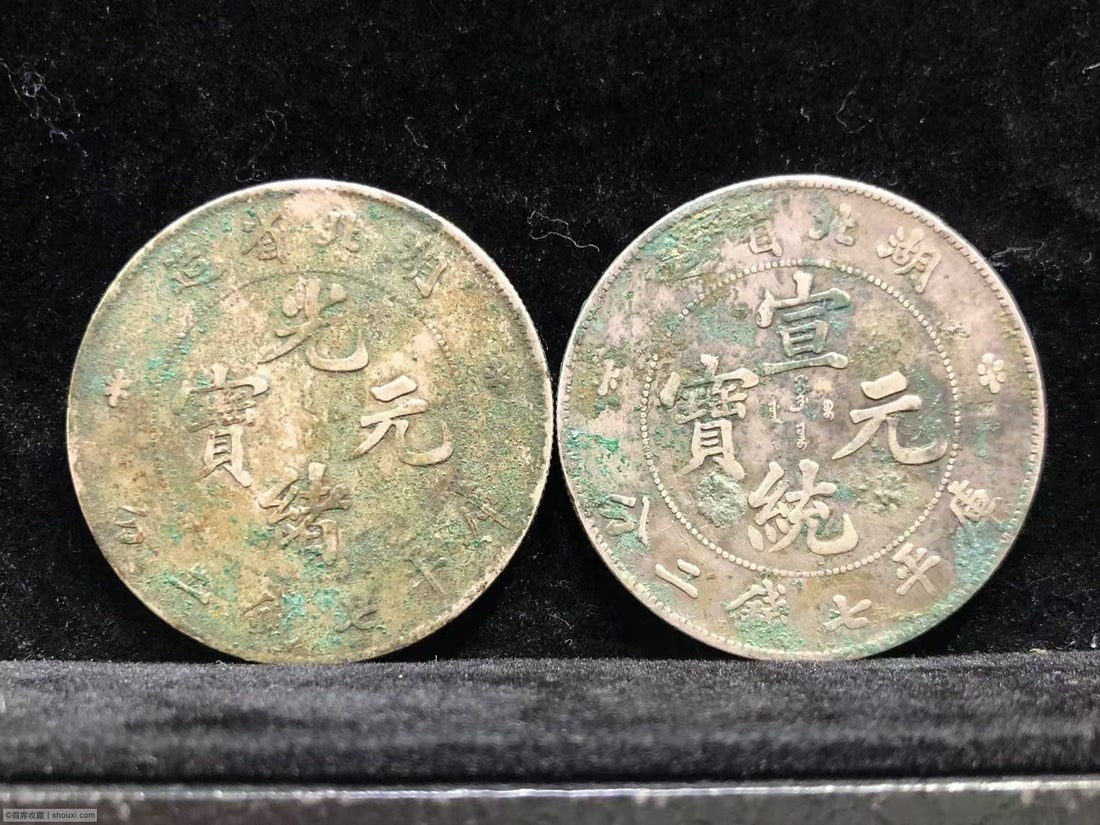
Hello everyone, I am the person in charge of"Gu Jin Jian Bao". In recent years, the collecting craze for antique silver dollars (commonly known as"dayang"or old silver dollars) has remained high in Chinese communities worldwide and in the Hong Kong market. Many friends often stumble upon a few old, dark-glowing silver coins while tidying up their elders'belongings or browsing street stalls. However, as market values rise, counterfeit silver dollars have consistently been a"disaster area"in antique forgery. From early sand-casting to today's"high-fidelity silver fakes"made with computer numerical control (CNC) technology, counterfeiting methods are constantly evolving. A single wrong character or a subtle imperfection in craftsmanship can lead to a value difference of hundreds, or even thousands, of times.
To help new collectors and owners avoid pitfalls and enhance their knowledge of authenticating old silver dollars and protecting their assets,"Gu Jin Jian Bao,"drawing on years of professional Buyback and appraisal experience, brings you this in-depth"Guide to Identifying and Valuating Old Silver Dollars."By mastering the three core techniques –"listening for authenticity,""observing the patina,"and"examining the reeding"– you will be able to quickly spot over 90% of fake silver dollars on the market, as if you had X-ray vision.

Tip 1: Listening for Authenticity – Listen Carefully, Real Silver Dollars"Sing"
Listening is one of the most traditional, direct, and scientifically accurate methods for authenticating silver dollars, as it reflects the physical density of the metal. This is because pure silver (machine-minted silver coins typically have a silver content of 88% to 90%) and copper alloys form a dense metallic structure under high-pressure striking, and their sound wave propagation patterns are distinctly different from other inferior metals.
1. Correct Listening Technique
Never drop a silver dollar heavily onto a table. The most professional testing method is to gently hold the center of the silver dollar between your thumb and forefinger, allowing its edge to hang freely and vibrate. Then, take another coin or a metal rod and lightly tap the edge of the suspended silver dollar.
2. Distinguishing Different Sound Responses
- The"Melody"of a Real Silver Dollar: When struck, a genuine silver coin will emit a clear, solid, soft, and prolonged"om..."sound. The sound is crisp without any harsh noise, as if a long resonance slowly echoes in the air. This is what experts call"silver that sings."
- Lead and Tin Alloy Fakes (Sand-Cast Replicas): These metals have low hardness and high sound absorption. When tapped, the sound is very dull and heavy, producing a"thud, thud"sound that stops abruptly, with no resonance whatsoever.
- Steel Core Silver-Plated Fakes: Due to the extremely high elastic modulus of steel, the vibration frequency is too fast, producing a sharp, short, and piercing"ding, ding"sound. It sounds very shallow and lacks the solidity of pure silver.
- Silver-Clad Copper (Sandwich Coins): These have a silver outer layer with copper or lead sandwiched inside. Because of the discontinuous internal interface, sound energy is lost when tapped, resulting in a dull, hollow, and muffled sound that lacks penetration.
Professional Tip: The common practice in movies and TV shows of"blowing on a silver dollar to hear it ring"can test for metallic resonance, but many hard alloys might produce a louder sound than real silver dollars. Therefore,"if it rings, it's real"is a serious misconception. The"resonance"and"tail of the sound"are key.

Tip 2: Examining the Patina for Authenticity – Deciphering the Chemical Imprints of Time
Patina (Toning) is an extremely thin and dense layer of oxidation that forms on the surface of circulated silver dollars over decades or even centuries, resulting from slow chemical reactions with atmospheric sulfides, oxygen, and human oils.
1. The Layers and Beauty of Natural Patina
The patina on genuine silver dollars often appears light black, light gray, light orange, or chestnut-colored, and in specific sealed environments, it can form an incredibly captivating"rainbow toning."Natural patina has distinct"layers"and slowly"grows"from within the metal's crystal lattice, bonding tightly with the coin's surface, giving it an"ingrained"aged look. Against a dark patina, the raised details like dragon scales and strands of hair appear more three-dimensional and vibrant.
2. Flaws in Artificially Aged Fake Patina
To hide the glaring sheen of modern counterfeit coins, forgers often use shoe polish, smoke, wax fire, or strong chemical acids to create"fake patina."
- Visually Stiff: Artificial patina often appears a heavy black, is uniform in color distribution, or shows obvious chemical residues in recessed areas of the design, lacking transitional layers.
- Poor Adhesion: Fake patina feels superficial and sticky when rubbed. It can even be scratched off with a fingernail or wiped away with a damp cloth, leaving black smudges on the fingertips.
- Distinct Odor: Silver dollars artificially blackened with chemicals or shoe polish often have a pungent sulfurous, acidic, or paint-like smell. Natural old patina, however, has no odor, only a faint, aged metallic scent.
Special Warning: Never clean heirloom silver dollars that have turned black! Patina is the"second life"of a silver dollar and is key to high resale value. Using chemical silver cleaners or brushes will create countless fine physical scratches (hairlines) and destroy the original"cartwheel luster."This will be classified as"cleaned"by professional graders, causing the resale value to plummet by 50% or even 70%!
 Yuan Datou"style="margin-bottom: 16px; float: none;">
Tip 3: Examining the Edge Reeding for Authenticity – The Unreplicable Industrial Anti-Counterfeit Fingerprint
In the eyes of professional appraisers, examining the edge reeding is the most important and decisive step in authenticating silver dollars. This is because mints in the late Qing Dynasty and early Republic of China used imported heavy-duty presses (over a thousand tons) to strike silver blanks in a single high-pressure operation. This extreme mechanical pressure is extremely difficult for modern small workshops or sand-casting molds to perfectly replicate.
1. Machine-Pressed Reeding (Genuine Coins)
- Deep and Uniform: The reeding on genuine coins is regular in shape (trapezoidal or olive-shaped), with each tooth having consistent depth and width, and flat grooves between the teeth.
- Microscopic Drag Marks: Under high magnification, the grooves of genuine coins often show fine horizontal or linear engraving marks, which are industrial imprints left by the die during the moment of release.
- Natural Wear: After long circulation, the edges of genuine coins (the raised parts) become smooth and rounded, not sharp to the touch, and show natural nicks at the junctions, with absolutely no burrs.
2. Sand-Cast and Inferior Fake Reeding (Counterfeit Coins)
- Blurred and Irregular: The reeding on sand-cast counterfeit coins is shallow and blurred, with varying lengths, irregular arrangements, and sometimes even two teeth merging into one.
- Pits and Seams: Small casting pits or air bubbles can often be seen in the grooves. Since most fake coins are cast from two halves, a faint"seam line"or excess metal (flash) often remains on the edge.
- Filed Bevels: To remove burrs, counterfeiters often file the edges manually, resulting in harsh"straight bevels"or parallel file marks at the junction of the reeding and the coin's surface. These feel rough and sharp to the touch.
 Guangxu Yuanbao"style="margin-bottom: 16px; float: none;">
Summary of Multi-Dimensional Authentication Features: Genuine vs. Counterfeit Silver Dollars
| Authentication Dimension | Genuine Old Silver Dollar Characteristics | Common Flaws in Counterfeit/Replica Coins |
|---|---|---|
| Sound (Listening) | Clear, soft, with a prolonged"hum..."resonance | Dull and short (lead/tin), sharp and piercing (steel core), muffled (sandwich) |
| Patina (Visual/Olfactory) | Tight, natural transitions, iridescent or dark black, no peculiar smell | Floating on surface, dull color, easily scratched off, with acidic or pungent chemical smell |
| Edge Reeding (Microscopic) | Deep and regular, trapezoidal, flat grooves, smoothly worn, not sharp to the touch | Shallow and blurred, irregular length, pits, seam lines or filed bevel marks |
| Weight (Physical) | Standard between 26.6g - 26.9g (minimum wear not below 25.5g) | Significant weight deviation, either too heavy or too light; disproportionate thickness to diameter |
| Design & Strike Pressure | Deep strike, strong lines, three-dimensional dragon scales/hair, flat fields | Insufficient pressure, soft"melted"lines, weak lettering, wavy and shallow fields |
2026 Hong Kong Latest Market Buyback Prices for Old Silver Dollars (in HKD)
The value of silver dollars is determined by two major factors:"rarity of variety"and"condition (cleanliness and patina)". The price difference between a common"Yuan Datou"and a rare"Signed Edition"can be like night and day.
Below is a reference price table for common and rare silver dollars, compiled based on the latest international auction data and the Hong Kong secondhand market.(Note: The prices below have been converted to HKD based on recent market exchange rates, with 1 Renminbi ≈ 1.1 HKD. Actual prices depend on the coin's specific condition and whether it has been professionally graded by PCGS/NGC.)
| Coin Type and Year | Specific Variety / Condition Reference | Latest Market Reference Buyback Price (HKD) | Value Analysis and Remarks |
|---|---|---|---|
| Republic of China Year 3 Yuan Datou | Common variety / Common fine condition | Approx. HKD $1,210 | Large mintage, market hard currency. Extremely fine condition or rainbow-toned can reach thousands to tens of thousands of HKD. |
| Republic of China Year 3 Yuan Datou | Signed Edition (L.GIORGI) | Approx. HKD $66,000+ | Signed by Italian engraver, extremely rare, highly valuable for investment. |
| Sun Yat-sen Founding of the Republic Commemorative Coin | Sun Xiaotou/ Common six-pointed star variety | Approx. HKD $715+ | Large restrikes in ROC Year 16 and 17, suitable for beginner collectors. |
| Sun Yat-sen Founding of the Republic Commemorative Coin | Upper Five-Star variety / Extremely fine condition | HKD $200,000 - $240,000+ | Pattern coin, extremely rare, stars are straight on left and slanted on right, very high value. |
| Sun Yat-sen Founding of the Republic Commemorative Coin | Lower Five-Star variety / Top condition | HKD $130,000 - $900,000+ | First batch minted in ROC Year 1. Reached a record-breaking price of nearly one million HKD if graded MS66. |
| Qing Dynasty Silver Coin, Xuantong Year 3 | One Yuan Common variety (Curly Dragon) | Approx. HKD $5,500+ | Representative coin of the Qing Dynasty. Those with intact fields and clear inscriptions command a high premium. |
| Qing Dynasty Silver Coin, Xuantong Year 3 | Long-Bearded Dragon Pattern Coin | HKD $1,900,000+ | Rare pattern coin that was never officially issued, a multi-million dollar favorite at auctions. |
| Guangxu Yuanbao, Mint General Factory | Kuping Qi Qian Er Fen / Fine condition | Approx. HKD $11,000+ | Leading variety in the Dragon Dollar series, highly sought after by Chinese collectors. Extremely fine pieces are individually priced. |
Gentle Reminder:"High-fidelity silver fakes"on the market (i.e., fake coins made from pure silver using modern high-precision CNC engraved dies) can perfectly pass sound and weight tests. For high-value silver dollars (such as Upper Five-Star, Long-Bearded Dragon, etc.), relying solely on the naked eye is extremely difficult for 100% confirmation. It is necessary to combine observation under a high-magnification microscope to check metal melting point density and planchet marks.

Professional Appraisal, Safeguarding Your Family Treasures
Old silver dollars are not just precious metals; they embody the turbulent history and cultural heritage of China's transition from a feudal dynasty to a modern nation. That thick layer of patina is the soul endowed by time. If you find old silver dollars, old banknotes, or gold artifacts passed down by elders in a deep drawer, do not clean them with chemical solutions or scrub them vigorously!
In an age where counterfeiting technology is constantly advancing, instead of guessing based on fragmented information online, entrust this professional appraisal work to a reputable physical buyer.
"Gu Jin Jian Bao"is rooted in Hong Kong, offering professional, transparent, and high-value one-stop buyback services for antique coins, old silver dollars, old renminbi banknotes, and fine wines. We combine traditional appraisal expertise with modern scientific equipment, ensuring fair pricing and the highest possible returns for your valuable collectibles, in line with current market trends!
👇Want to know the value of your silver dollars and ancient coins? Contact us now for a free, accurate online valuation!
Company Name:Gu Jin Jian BaoWhatsApp Contact:(852) 98342057(Feel free to send clear photos of the front, back, and edge reeding for consultation. Our specialists are online 24/7 to provide free appraisal and quotation, offering rapid door-to-door cash collection services throughout Hong Kong!)
Gu Jin Jian Bao – Professional Silver Dollar Buyback
Free appraisal ‧ Transparent quotation ‧ Instant cash ‧ Door-to-door collection across Hong Kong. If you have similar old items, don't rush to sell them cheaply. You can WhatsApp us for a valuation first to understand the true market value.
