
 WhatsApp item photos
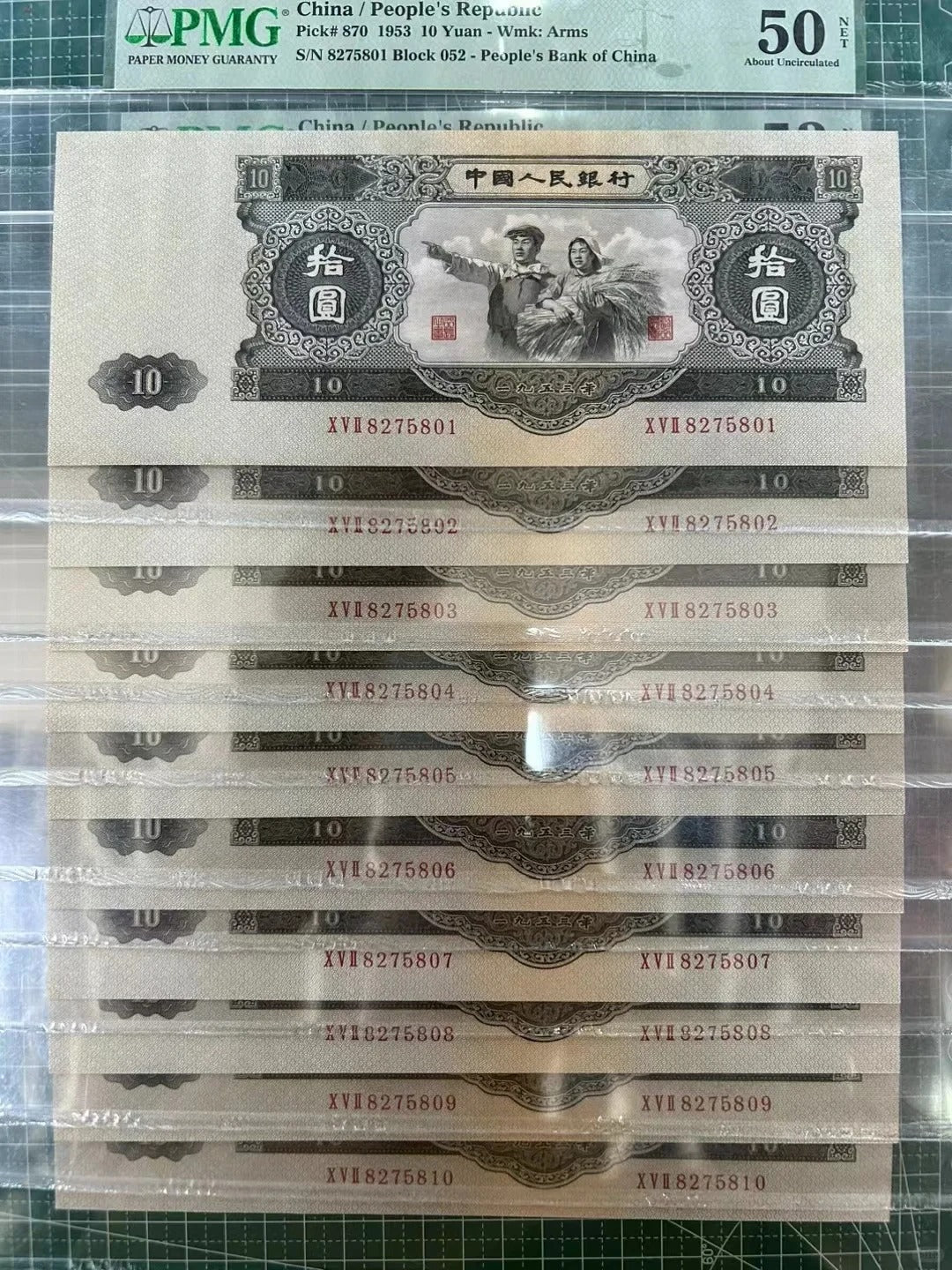
Correct the name and chronology first
Da Hei Shi is the Second Series Renminbi 10 Yuan note, not a note issued in 1953. People's Bank of China information gives 1 December 1957 as the issue date, 15 May 1964 as the withdrawal date and 210 × 85 mm as its size.
The obverse shows workers and peasants; the reverse includes the national emblem and multicoloured peonies, with black as the principal tone. Compare those layout points directly, while paper, print and condition remain matters for complete images and physical examination.
A safe order for measurement and photography
Lay the note flat without pulling its edges and exclude the sleeve from the measurement. Record long and short sides, then photograph both faces, four corners and every edge; use even backlighting without local overexposure.
Add positioned details of the workers and peasants, bank name, value text, background junctions, national emblem, peonies and complete serial. Each enlargement should remain locatable on the whole note.
Describe the condition feature by feature
Distinguish a hard fold from a gentle curve, and locate tears, paper loss, rebuilt edges, trimming, stains, mould, washing, recolouring, adhesive and pressing. Visible observations are more useful than a broad grade.
Paper colour varies with lighting and camera settings. Preserve differences among front, back, transmitted-light and raking-light views for examination rather than selecting the most flattering image.
Keep the banknote as found
Do not wash, iron, laminate, recolour or remove an old repair. Support damaged paper across its full area in a firm acid-free sleeve and store it dry, dark and at stable temperature.
A reviewable set includes the cited official information, measuring method, complete faces, local details, transmitted-light images and a damage list. It should not present an unseen area as confirmed.
How the Da Hei Shi Layout and Paper Condition Relate
Concentrate first on the four corners, edges and paper surface. Connect dimensions, tool and unit with transmitted-light observations and any unconfirmed watermark, leaving an unsupported name open.
There is no need to fill every field at once. Secure the series, value, printed date and main designs, then move to prefix, serial and print positions wherever the enclosure permits.
Keep only visible evidence in the physical section; labels, certificates and recollections stay with provenance. If the two accounts disagree, preserve both without completing one from the other.
Before an enquiry, check the note count, attachments, packaging and unresolved points. Any inspection, deduction or handover condition should be stated item by item after the actual material is seen.
Use complete views, local details, measurements and packaging as a final four-part check; add a new photograph where value, design or serial remains incomplete without changing the note.