
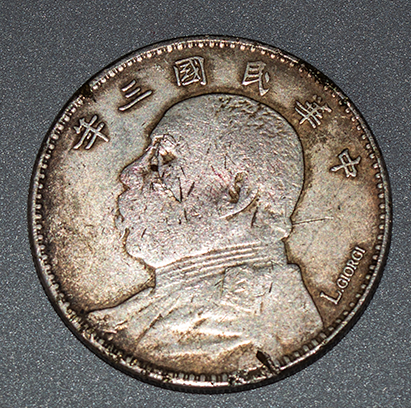
Begin with the entire proposed L. Giorgi pattern
Take level, uncropped views of the Yuan Shikai portrait side and reverse. Copy the date, denomination and surrounding lettering before enlarging any area thought to carry a signature.
Assign one reference number to the coin, holder, full edge, measurement card and old documentation. An isolated signature photograph cannot establish which coin supplied it.
Use ‘proposed L. Giorgi signed pattern’ until the complete design and signature position have been reviewed together. A familiar market name should not outrun the evidence.
Locate every portrait-side diagnostic
Photograph the hair, ear, moustache, epaulettes, date characters and denticles with enough context to place them on the full portrait side.
Show the supposed signature area first at medium scale, then in detail under neutral and raking light. Record weak, interrupted or ambiguous strokes without tracing over them digitally.
Read the reverse and edge with equal care
Retain the denomination, grain wreath, ribbon, inner border and all visible lettering in one complete reverse image before taking comparison details.
Survey the circumference from a fixed point in overlapping order. Note reeding, seams, flattening, filing, holes, solder or repaired sections without rubbing the metal.
Record weight, diameter and thickness with the original tools, units and contact points. A matching specification supports only evidence already visible on the coin.
Keep provenance outside the physical attribution
Transcribe an old sleeve, grading insert, auction note or family account exactly. Preserve its number and date without allowing it to supply missing signature strokes or date characters.
Terms such as O variety, triangle-yuan or local issue should appear only when their own diagnostic feature is visible and located. Do not stack several prestigious names onto one uncertain coin.
Cite historical or production claims with the consulted reference and date. A comparison image indicates where to look; it does not contribute surface or lettering to the subject.
Describe condition before drawing a conclusion
Separate toning, high-point wear, strike softness, wiping hairlines, tooling and cleaning-related brightness. Surface alteration can imitate or obscure fine lettering.
Map every chop, scratch, rim bruise or repair to a complete view. Preserve the initial neutral-light images before making any high-contrast enlargement.
Locate the proposed Giorgi signature before testing the pattern attribution
Place the proposed signature on the complete portrait-side view, then confirm that the portrait, date, reverse, edge and dimensions all return to one reference number. List any holder-blocked or unreadable position.
Keep confirmed features, proposed L. Giorgi attribution and condition findings in separate sections. Another reviewer should be able to disagree without losing the observations.
If photographs do not resolve metal, microscopic tooling or a concealed rim, define the specialist question and preserve the current enclosure.
Retain the first measurements when a repeat differs, noting the changed setup. Never choose a value merely because it fits a pattern specification.
At handover, leave patina and packaging intact. No polishing, acid, scratch test or edge filing can strengthen a signature attribution.
