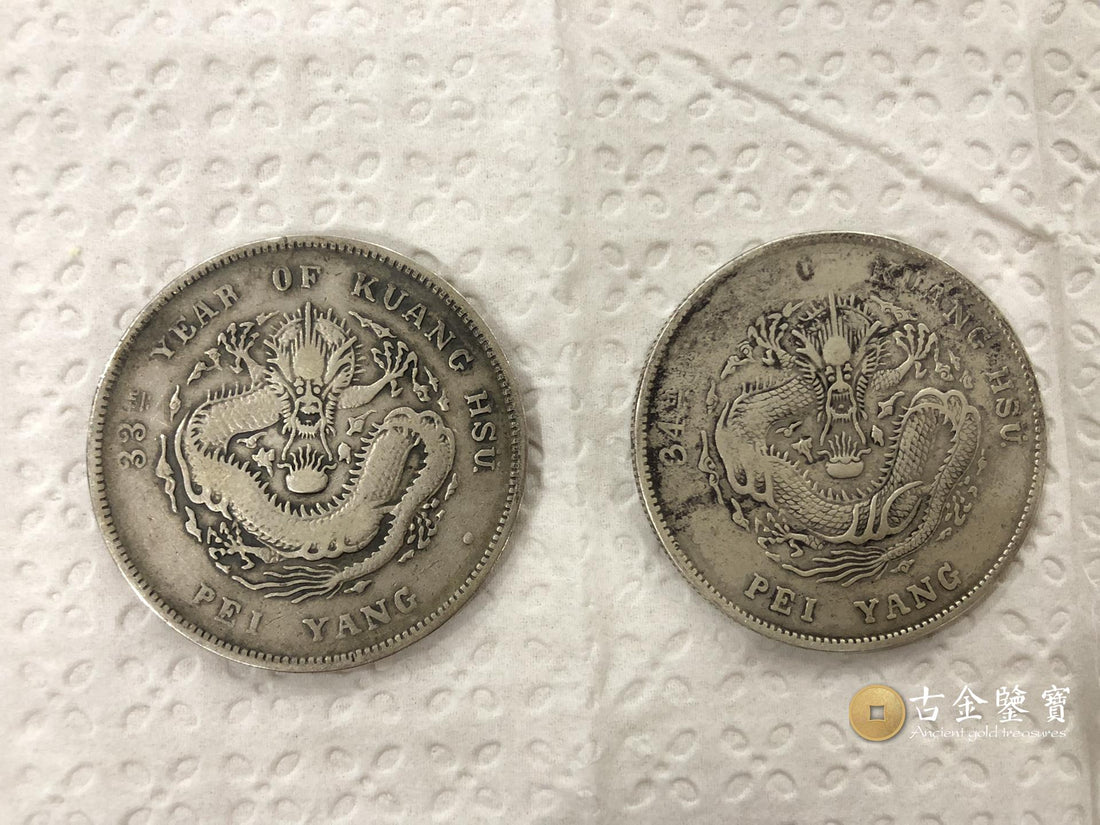
When you come across a"Guangxu Yuanbao"silver coin, the first question is always:"Is it real?"The following six steps, from simple visual inspection to advanced tool checks, will gradually narrow down the scope of your judgment. You don't need professional equipment; you can perform a preliminary screening at home.
1. The Place of Silver Dollars in Modern Chinese History
As the main form of currency circulating in modern China, silver dollars were mass-produced mechanically starting from the Guangxu reign in the late Qing Dynasty, and continued through the Republican era with coins like the"Sun Xiaotou"and"Yuan Datou,"spanning several decades. Among these, Qing Dynasty"Dragon Dollars"(Guangxu Yuanbao, Xuantong Three-Year Daqing Silver Coin) and RepublicanRepublican Era silver dollarsare the most commonly found types in Hong Kong households.
Their large circulation and wide distribution also explain why there are so many counterfeit coins on the market—especially"high-quality silver fakes,"advanced counterfeits made by re-casting with an equal amount of pure silver, whose sound and weight are very close to genuine articles. In the past decade, a considerable number of these have come from counterfeit workshops in Guangdong, Fujian, and other regions. Therefore, identifying authenticity cannot rely on just one indicator.
2. Step One: Check the Luster
Genuine silver dollars typically have a silver content between 88%–90% (the"Regulations on Currency Reorganization"stipulated that one seven-mace-two-candareen silver dollar should contain 90% silver). Their surface has a soft, warm white luster. If the silver content is insufficient, the surface may appear slightly reddish (mixed with copper), yellowish (mixed with zinc), bluish, or grayish-black (mixed with lead and tin).
It's important to note that genuine circulated coins, due to long-term natural oxidation, will develop a patina of varying shades on their surface—it could be light gray, light orange, millet husk color, or even iridescent. This is a layer of silver sulfide formed by the long-term reaction of silver with sulfur in the air, not dirt.Do not wash it.Once the patina is washed away, the coin's luster is damaged, and its market value immediately drops by more than half. For detailed reasons, you can readWhy Patina is the Second Life of a Silver Dollar.

3. Step Two: Listen to the Sound
Hold the silver dollar by its center with your fingernail and gently tap its edge with another silver dollar or a hard object. Genuine silver dollars, due to the density and ductility of silver, will emit a melodious and gentle"ommm"sound, with a long, rather solid resonance.
Counterfeit coins commonly exhibit three sound characteristics:
- Sharp and short:Usually a steel core with silver plating. Steel has high density and elasticity, resulting in a higher-pitched sound.
- Dull with no resonance:Mostly lead-tin alloy, ending with a"plop."
- Clear but without echo:Zinc-copper alloy, producing a louder sound but very short resonance.
Sound identification is a supplementary method; do not solely rely on this to determine authenticity—because the sound of"high-quality silver fakes"is almost identical to genuine articles. However, if the sound doesn't match, you can largely rule out the possibility of it being genuine. The articleListen for Authenticity: Three Tips to Identify Your Heirloom Silver Dollarsprovides a more detailed acoustic analysis.
4. Step Three: Measure Weight and Dimensions
This is the quickest way to eliminate most low-quality counterfeit coins. For one-yuan silver coins minted in the late Qing and early Republican periods, the standard weight and dimensions are as follows:
| Coin Type | Standard Weight | Diameter | Thickness |
| Guangxu Yuanbao (seven mace, two candareens) | 26.7g | 39.0–39.5mm | Approx. 2.5mm |
| Xuantong Three-Year Daqing Silver Coin | 26.8g | 39.0mm | Approx. 2.5mm |
| Yuan Datou (from Republican Year 3) | 26.6–26.8g | 39.0mm | Approx. 2.4mm |
| Japanese One-Yen Dragon Coin (Meiji) | 26.69g | 38.1mm | 2.6–2.8mm |
The specific gravity of genuine silver is approximately 10.5 g/cm³. Weight deviation usually does not exceed 2% of the standard value. A weight below 25.5g or above 27.5g should raise a question mark.

📷 Still unsure after measuring yourself?
Send clear photos of the obverse, reverse, and reeding, along with the weight reading, to us viaWhatsApp 98342057. We'll get back to you within half an hour with a preliminary authenticity judgment and estimated range. Free appraisal.
5. Step Four: Examine the Reeding
Reeding is known as the"fingerprint"of machine-minted coins in the industry. The reeding of genuine silver dollars is formed by machine pressing with several tons of pressure, resulting in deep, regular, and uniform grooves, with even spacing between the teeth. Guangxu Yuanbao and Daqing Silver Coins mostly use straight reeding, while Xuantong Three-Year coins use olive-shaped reeding with a rounded edge. TheO-version reeding of Yuan Datouis even a crucial factor in identifying varieties.
Common flaws in counterfeit coins:
- The reeding profile is straight (hand-filed), lacking the trapezoidal cross-section produced by genuine pressing.
- Uneven tooth size and"irregular teeth"(sand casting or die displacement).
- Abrupt transition angle between the reeding and the coin face, showing signs of later addition.
Using a 10x magnifying glass to examine the reeding is the most cost-effective way to distinguish fakes.
6. Step Five: Observe the Spirit of the Text and Design
Genuine silver dollars are stamped by powerful presses, resulting in a strong three-dimensional design where dragon scales are distinct and not interconnected. The strokes of the text are smooth and of consistent depth. Counterfeit coins, due to insufficient pressure or crude sand-casting techniques, often exhibit problems such as:
- Dragon scales appearing mesh-like:Genuine dragon scales are distinct, individual pieces, while fakes show interconnected patterns due to mold copying.
- Weak and soft text:Genuine"Guangxu Yuanbao"characters are sharply engraved with crisp edges, while fakes have blurry strokes and burrs.
- Lack of spirit in figures or dragon patterns:Genuine coins have a layered, three-dimensional quality, while fakes appear flat and rigid.
Guangxu Yuanbao coins from different provinces in the Qing Dynasty vary greatly in design. The articleAnalysis of Price Differences for Hubei, Guangdong, and Jiangnan Dragon Dollarsprovides a comparison of characteristics for each province, which can be referred to during authentication.

7. Step Six: Beware of"High-Quality Silver Fakes"and Other Advanced Counterfeits
In the past five years, high-quality counterfeit coins on the market are no longer just inferior lead-tin fakes. Counterfeiters use an equal amount of pure silver for re-casting, resulting in weight, sound, and specific gravity that are identical to genuine articles. The first five steps simply won't rule them out. The flaws in these"high-quality silver fakes"primarily lie in:
- Insufficient design pressure:High-quality counterfeit molds are reproduced from genuine coins, and each reproduction loses a layer of detail. Dragon scales, facial features, and text edges will appear"softer"than genuine coins.
- Reeding grinding marks:After sand-casting, the teeth are manually filed, and file marks will be visible in the grooves under a 10x magnifying glass.
- Overly uniform patina:Genuine patina is the result of decades of natural oxidation, with lighter areas on raised parts and deeper areas in recesses, showing distinct layers. Fake patina (shoe polish, chemical solutions) has a single color, floats on the surface, and may have a pungent odor.
- Combined with fake grading slabs:Illicit dealers may place high-quality silver fakes in fake PCGS/NGC slabs. Collectors can check the barcode on the official website for comparison and identify fakes if the photos don't match the scratches on the actual coin.
If any of the above six steps don't match up, don't take chances.Seeking centralized appraisal from professional coin dealersis a much safer approach.
8. A Few Principles Before Valuation
After confirming authenticity and preparing to seek a dealer for valuation, keep the following in mind:
- Bring it as is:Do not wash, wipe, or apply shoe polish to color it. Any cleaning action will reduce its market value.
- Pay attention to variety details:Guangxu Yuanbao coins from the same year but different provinces like Hubei, Guangdong, Jiangnan, and Anhui can have market values differing by several times. Varieties are a source of premium.
- Take three photos:One of the obverse, one of the reverse, and one of the reeding, in natural light without flash.
- Record the weight reading:Weigh it at home and provide the reading to the appraiser for reference.
For specifics on how to get a quote and which channels to choose, you can refer to the previous article onChoosing Silver Dollar Buyback Channels in Hong Kong.
9. Contact Information
If you're unsure about the authenticity or value of your silver dollar, instead of letting it sit in a drawer indefinitely, get a free initial assessment.Gujin Jianbaooffers free on-site appraisal in Hong Kong, Kowloon, and the New Territories:
Want to know how much your silver coin is worth?
Welcome to use theGuangxu Yuanbao Buyback Seriesto get a precise valuation service.
Found silver dollars while cleaning house? Want to know their value?
WhatsApp us a photo, and an experienced appraiser will personally evaluate it. Transparent process, free appraisal, immediate cash payment. Years of honest business, with over 60% of new customers referred by existing clients.
