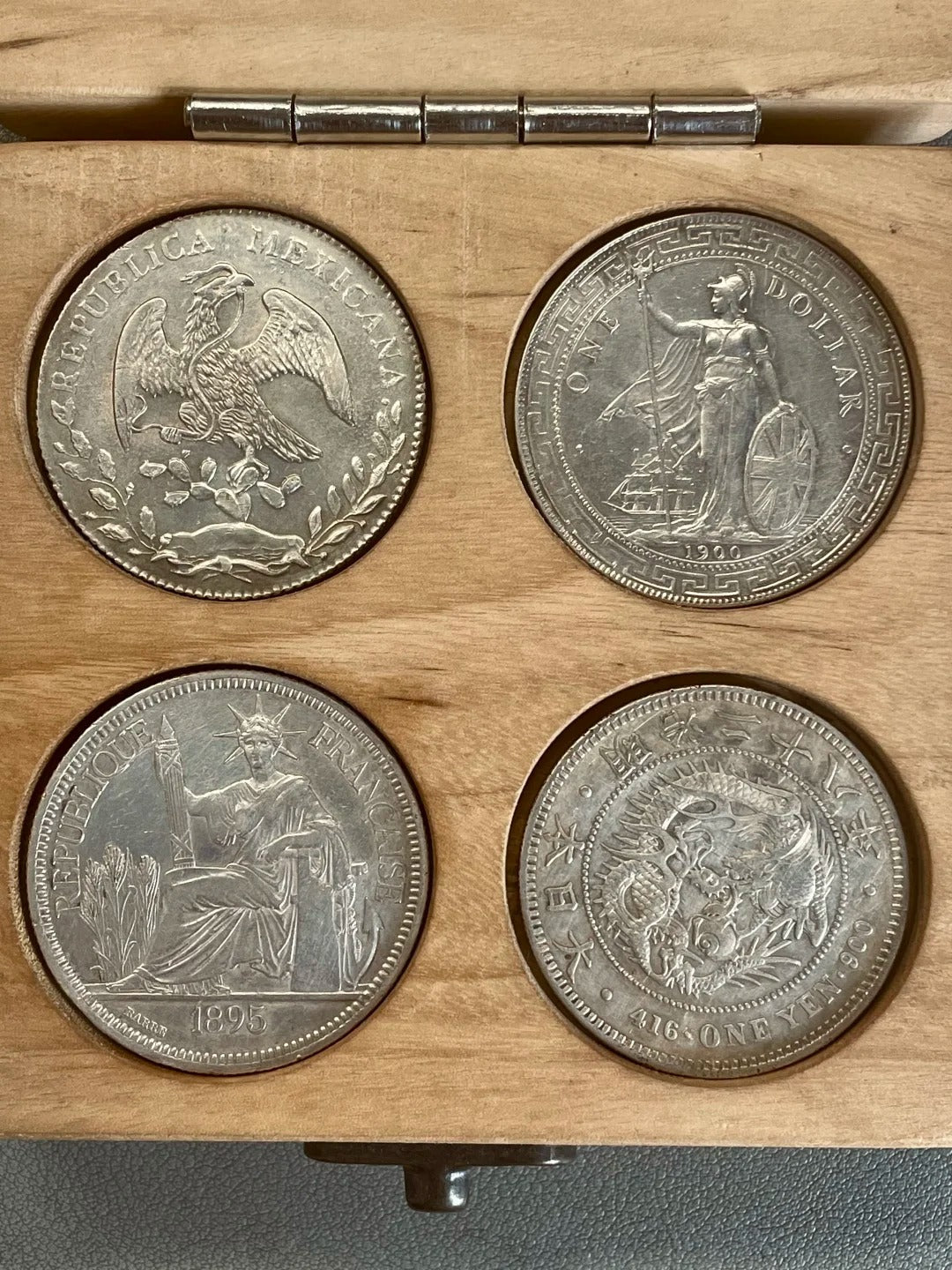
When people think of silver dollar Buyback, the first thing that often comes to mind is theYuan Datou, believing that anything else is"less valuable."In fact, in a market like Hong Kong and Macau, where Chinese and Western cultures converge, the Republican era's"Junk Dollars"and French Indochina's"Seated Dollars"are extremely active segments. They have stable circulation and a broad collector base, with some rare varieties even outperforming the Yuan Datou in terms of appreciation.
These silver coins carry the trade history of that period of Sino-foreign commerce. Today, they are gradually being rediscovered in the context of art and real asset allocation. Below, we will discuss the varieties, authentication key points, and buyback price ranges of the Junk Dollar and Seated Dollar, along with a comparison table and tips to avoid pitfalls, for readers who may have similar silver dollars at home.
I. Junk Dollar: A Craftsmanship Masterpiece Among Republican Era Silver Coins
"Junk Dollar"refers to the silver coins minted by the Central Mint in Shanghai during the Republican era, featuring Sun Yat-sen's portrait on the obverse and a double-masted sailboat on the reverse. It was one of the main circulating currencies in the later Republican period and is now a popular item in the silver dollar buyback market.
1. Market Differences Among Three Main Varieties
Junk Dollars were primarily issued in the 21st, 22nd, and 23rd years of the Republic, among which:
- 23rd Year of the Republic Junk Dollar: The most common version on the market, featuring excellent minting quality and standard silver color. It has the highest liquidity and is the top choice for entry-level collection and physical investment.
- 22nd Year of the Republic Junk Dollar: Less circulated, its market price is usually higher than the 23rd-year version, sought after by mid-tier collectors.
- 21st Year of the Republic Junk Dollar (Three Birds Coin): The rarest variety of Junk Dollar. Because of the three flying bird patterns above the sailboat on the reverse, it was then believed to allude to Japan's invasion of China (associated with the rising sun and military aircraft). Under political pressure, minting was urgently stopped and existing coins were recalled and destroyed, making it extremely rare in existence and a true top-tier rare variety.

2. Junk Dollar Authentication Key Points
Authenticating Junk Dollars mainly involves checking the following:
- Jiahe (grain) and Sailboat Lines: On genuine coins, the sailboat lines are smooth, with clear details of ropes and sails. The Jiahe (rice ears) on the obverse are full and the awns are distinct.
- Edge Reeding Craftsmanship: Genuine coins have uniform and regular reeding, with distinct trapezoidal corners at the reeding teeth. This is one of the most difficult technical details for modern counterfeiters to replicate.
- Weight and Diameter: Standard weight is around 26.7 grams, diameter around 39 mm, with 88% silver content. A significant deviation should raise suspicion.
For an in-depth analysis of Junk Dollar and similar sailboat silver coin varieties, you can also refer to the articleComparison of Junk Dollars, Seated Dollars, and Standing Dollars.
II. Seated Dollar: A Representative of International Trade Silver
"Seated Dollar"is the full name for the French Indochina Trade Dollar, named for the seated Liberty goddess on its obverse. From the late 19th to early 20th century, it was an important medium of exchange in Southern China and Southeast Asia. It has a large circulation in Hong Kong and Macau, with a mature Buyback system and high-price transparency.
1. Why is the Seated Dollar so active in Hong Kong?
- Stable Specifications: Each coin weighs 27.215 grams and contains 90% silver, providing a clear material base price and minimizing valuation disputes.
- Significant Rarity Differences by Year: Seated Dollars were minted from 1885 to 1928, and buyback prices vary greatly depending on the year. For example, early years like 1885 and 1890, or certain special year combinations, command much higher premiums than common years.
- Unique"White Light"Luster: High-quality Seated Dollars possess a cool, lustrous white sheen. Versions that retain their original luster well are common targets for experienced collectors.

2. Common Counterfeit Traps for Seated Dollars
Most counterfeit Seated Dollars circulating in the Hong Kong and Macau market are later reproductions from Vietnam and Guangdong. Key things to check are the neatness of the French inscription's strokes, the layering of the drapery on the Goddess of Liberty, and the completeness of the edge reeding's trapezoidal shape. If the material feels light and produces a dull sound when tapped, it might be a copper-cored coin, and should not be valued as genuine.
📷 Unsure if your coin is a Junk Dollar, Seated Dollar, or Eagle Dollar?
The quickest way is to take three clear photos – obverse, reverse, and edge reeding – and send them to us viaWhatsApp at 98342057. We will respond within 30 minutes with our assessment of the type, variety, and reasonable price range.
III. 2026 Hot Silver Dollar buyback price Range in Hong Kong and Macau Market
The table below is compiled from actual transaction records over the past three months, providing a rough idea for owners of old silver coins. The actual transaction price of a specific item depends on its condition, variety, and grading score.
| Coin Category | Main Year / Variety | Key Authentication Indicators | Reference buyback price (HKD) |
|---|---|---|---|
| Junk Dollar (One Yuan) | 23rd Year of Republic | Original luster, clear sailboat lines, no dings | $1,200 – $2,500+ |
| Junk Dollar (Three Birds) | 21st Year of Republic | Flying birds above sailboat, sun rays | $25,000 – $80,000+ |
| Seated Dollar (One Yuan) | 1885 – 1928 | Seated Liberty, clear French inscription | $800 – $3,500+ |
| Sun Xiaotou | Founding Commemorative Coin | Upper five-star / Lower five-star varieties, natural patina | $1,500 – $15,000+ |
| Yuan Datou | 3rd Year of Republic | O-version, triangular yuan, original untouched condition | $1,800 – $6,000+ |
| Japanese Dragon Silver (One Yen) | Meiji Era | Rising sun on obverse, two dragons on reverse | $1,320 – $8,800+ |
Note: The prices above are for reference only. Actual transaction prices depend on condition, presence of original patina, and whether it has been graded by PMG/NGC. For detailed identification of Yuan Datou's O-version and triangular yuan, please refer toYuan Datou"O-version"and"Triangular Yuan"Practical Authentication; for key varieties of Japanese Dragon Silver, please refer toJapanese One Yen Dragon Silver Buyback Guide.

IV. Pitfall Avoidance Guide: Self-Checks Before Transaction
The techniques for creating counterfeit silver dollars on the market are becoming increasingly sophisticated. Before selling, you can perform a few simple self-checks:
- Sound Authentication: Gently tap it with another silver dollar. A genuine coin produces a clear, melodious sound with a lingering resonance; a counterfeit (steel or alloy) produces a sharp or dull, muffled sound.
- Weight Check:Republican Era silver dollarstypically weigh around 26.5 – 26.7 grams, and Seated Dollars about 27 grams. Be wary of significant deviations.
- Patina Authentication: The oxidized layer on the surface of a silver dollar is a mark of time and an important basis for authentication.Never attempt to clean or wipe a silver dollar yourself. Any improper cleaning or polishing will severely damage its condition, leading to a drop in buyback value of over 50%. For detailed principles, refer toPatina and Preservation of Value.

- Beyond sound and appearance checks, for additional assurance, you can refer toAuthenticating by Sound: Three Tips to Identify Your Family's Silver Dollars, which also covers edge reeding and edge feel.
V. Condition Grading: The Last Mile in Determining Value
In the high-end Buyback and auction markets,"condition is everything."Coins with professional grading certification have higher liquidity and premium.
- Original Patina / Original Luster Full Condition: Represents coins in their original state, untouched by human physical or chemical treatment, making them the highest-scoring tier in the grading system.
- Score Premium: Silver coins graded PMG 65 or higher often fetch several times the price of ordinary condition coins.
- Storage Methods: Constant temperature and humidity (relative humidity 45%-50%), handling with stainless steel tweezers, and avoiding direct finger oil contact with the coin surface.

About the Buyback Process
If you have old silver coins, old banknotes (first to fourth series Renminbi), old Hong Kong silver coins, or Cultural Revolution rare stamps, and want to find a professional and no-nonsense place to determine their true value,Gu Jin Jian Bao's approach is:
- Free Online Initial Appraisal: Send clear photos via WhatsApp, and receive initial feedback within half an hour.
- On-site Service Across Hong Kong and Macau: After making an appointment, we will visit your location to inspect and appraise, making an offer on the spot.
- Payment Methods: Cash or Faster Payment System (FPS) on site, with funds transferred immediately.
- No Obligation to Sell: If the valuation is not satisfactory, you are free to keep your items, with no pressure.
For a more comprehensive understanding of the entire silver dollar market, you can also refer toCentralized Valuation for Old Silver Dollars: Qing Dynasty Silver Coins, Yuan Datou, Guangxu Yuanbao All in One Article.
Contact Information
- WhatsApp / Phone:(852) 9834 2057
- WeChat: john19998
- Service Area: Free on-site service throughout Hong Kong and Macau, 24-hour online consultation
Friendly Reminder: Do not clean or bump silver dollars. Keeping them in their original condition yields the highest value.
Professional Buyback of Junk Dollars, Seated Dollars, and Yuan Datou
Free appraisal ‧ Transparent quotation ‧ Instant cash payment ‧ On-site purchase service across Hong Kong and Kowloon. If you have similar old silver dollars, don't rush to sell them cheaply. First WhatsApp for an estimate to understand the real market value before deciding your next step.
