

Collectible appraisal
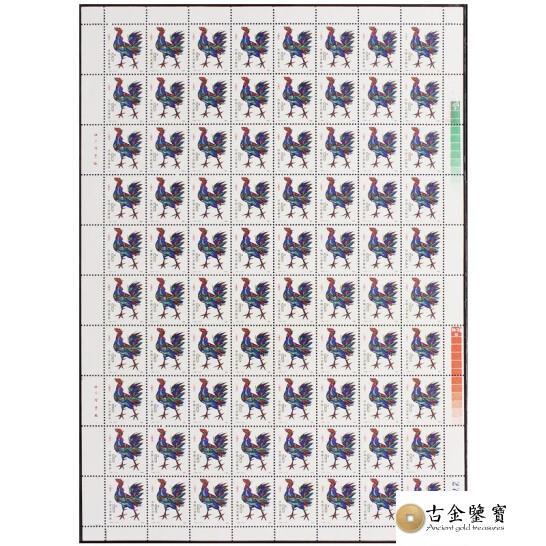
1981 T58 Year of the Rooster Full Stamp Sheet
Start with photos so we can assess type, condition and market direction. Higher-value or uncertain items can then be checked in person.
1981 T58 Year of the Rooster Full Stamp Sheet
Photograph the front, back, side or edge, plus any close-up details. Include dimensions, the measured weight, certificates or original packaging where relevant.
An intact T58 Rooster sheet carries 80 stamps in an 8 × 10 grid. The sheet margins, factory or plate inscriptions and perforation crossings belong to the assessment just as much as the 8-fen rooster design and 5 January 1981 issue date.
Item details and appraisal notesItem details and appraisal notes
Scroll horizontally to view the full table
An intact T58 Rooster sheet carries 80 stamps in an 8 × 10 grid. The sheet margins, factory or plate inscriptions and perforation crossings belong to the assessment just as much as the 8-fen rooster design and 5 January 1981 issue date.
T58 issue facts and physical format
| T58 detail | What to match on the Rooster sheet |
|---|---|
| Official issue name | T58 Xinyou Year |
| Issue date | 5 January 1981 |
| Issue code | T58 |
| Number in set | One stamp—the complete T58 design set |
| Face value | 8 fen per Rooster stamp |
| Dimensions | 26 × 31 mm at each T58 position |
| Perforation | P11.5 through the sheet grid |
| Printing process | Combined photogravure and engraving on T58 |
| Artists and printer | Original artwork by Zhang Ding; design by Cheng Chuanli; engraving by Sun Hongnian; printed by Beijing Stamp Factory |
| T58 full-sheet arrangement | 80 Rooster stamps in eight rows by ten columns |
| Format presented here | One intact T58 full sheet; count eight rows by ten columns and retain every margin in the photographs. |
Reading the Xinyou Rooster sheet from margin to margin
Issue identity: Use the whole T58 front to count ten stamps across each of eight rows. Retain the rooster image, 8-fen value and surrounding marginal features in the same colour-accurate view.
Paper, gum and size: Check 26 × 31 mm on an unobstructed stamp and trace P11.5 through several grid intersections. Photograph the reverse as a complete gum field before enlarging a fold, hinge or thin.
Condition map: Number local faults by row and column: foxing, separated teeth, creases and disturbed gum should be easy to place on the Rooster sheet. Marginal inscriptions need enough surrounding paper to show whether they remain complete.
Counting T58 positions and reading its four margins
- Perforations and margins: Inspect the outer teeth, then follow the P11.5 lines through the sheet. A tear at a four-stamp junction can spread under tension, so photograph it in place rather than opening the split.
- Completeness: Verify eight rows by ten columns and mark any absent or replacement Rooster stamp. A complete one-design issue is not the same thing as an intact 80-position sheet.
- Album and packaging: Keep interleaving, wrapper and album labels with the T58 object. Record damp staining or adhesion where it touches the sheet, but do not assume a storage label proves originality.
Protecting T58 margin inscriptions and internal joins
Slide a clean support beneath the entire Xinyou-year sheet before it is turned. Avoid pulling a weak perforation crossing, and leave old folds or album contact untouched while the front and gum are documented.
Storage guidance for an 80-position T58 sheet
For the T58 grid and its joined perforations, open Collectible Stamps then compare the precautions in Stamp Mould: Isolation, Documentation and Storage Limits. The Rooster sheet should remain supported as one object.
Zodiac sheet comparisons with independent condition evidence
For the T58 full grid and numbered condition details, contact About Gu Jin Jian Bao | Collection Enquiries. Send the images by WhatsApp 9834 2057, or call +852 9834 2057. Quote “Rooster 8 × 10 sheet” and start with a row-and-column location.
Questions before an appraisal
What should you check before selling?
What matters depends on the item. Photograph both sides, the edge, hallmarks or base marks, and any damage. Include the original box, certificate or weight information where relevant so we can decide whether an in-person inspection is needed.
